Euclidean geometry: Difference between revisions
en>Wcherowi Reverted to revision 509527079 by 24.155.104.129: Vandalism. (TW) |
→As a description of the structure of space: added some links |
||
| Line 1: | Line 1: | ||
{{redirect|Plane geometry}} | |||
[[File:Sanzio 01 Euclid.jpg|thumb|A Greek mathematician (possibly [[Euclid]] or [[Archimedes]]) performing a geometric construction with a compass, from ''[[The School of Athens]]'' by [[Raphael]]]] | |||
{{General geometry}} | |||
'''Euclidean geometry''' is a mathematical system attributed to the [[Alexandria]]n [[Greek mathematics|Greek mathematician]] [[Euclid]], which he described in his textbook on [[geometry]]: the ''[[Euclid's Elements|Elements]]''. Euclid's method consists in assuming a small set of intuitively appealing [[axiom]]s, and deducing many other [[proposition]]s ([[theorem]]s) from these. Although many of Euclid's results had been stated by earlier mathematicians,<ref>Eves, vol. 1., p. 19</ref> Euclid was the first to show how these propositions could fit into a comprehensive deductive and [[logical system]].<ref>Eves (1963), vol. 1, p. 10</ref> The ''Elements'' begins with plane geometry, still taught in [[secondary school]] as the first [[axiomatic system]] and the first examples of [[Mathematical proof|formal proof]]. It goes on to the [[solid geometry]] of [[three dimensions]]. Much of the ''Elements'' states results of what are now called [[algebra]] and [[number theory]], explained in geometrical language.<ref>Eves, p. 19</ref> | |||
For more than two thousand years, the adjective "Euclidean" was unnecessary because no other sort of geometry had been conceived. Euclid's axioms seemed so intuitively obvious (with the possible exception of the [[parallel postulate]]) that any theorem proved from them was deemed true in an absolute, often metaphysical, sense. Today, however, many other [[self-consistent]] [[non-Euclidean geometry|non-Euclidean geometries]] are known, the first ones having been discovered in the early 19th century. An implication of [[Einstein]]'s theory of [[general relativity]] is that physical space itself is not Euclidean, and [[Euclidean space]] is a good approximation for it only where the [[gravity|gravitational field]] is weak.<ref>Misner, Thorne, and Wheeler (1973), p. 47</ref> | |||
==''The Elements''== | |||
{{main|Euclid's Elements}} | |||
The ''Elements'' are mainly a systematization of earlier knowledge of geometry. Its superiority over earlier treatments was rapidly recognized, with the result that there was little interest in preserving the earlier ones, and they are now nearly all lost. | |||
There are 13 total books in the ''Elements'': | |||
Books I–IV and VI discuss plane geometry. Many results about plane figures are proved, e.g., ''If a triangle has two equal angles, then the sides subtended by the angles are equal.'' The [[Pythagorean theorem]] is proved.<ref>Euclid, book I, proposition 47</ref> | |||
Books V and VII–X deal with number theory, with numbers treated geometrically via their representation as line segments with various lengths. Notions such as [[prime numbers]] and [[rational number|rational]] and [[irrational number]]s are introduced. The infinitude of prime numbers is proved. | |||
Books XI–XIII concern solid geometry. A typical result is the 1:3 ratio between the volume of a cone and a cylinder with the same height and base. | |||
[[File:Parallel postulate en.svg|thumb|The parallel postulate: If two lines intersect a third in such a way that the sum of the inner angles on one side is less than two right angles, then the two lines inevitably must intersect each other on that side if extended far enough.]] | |||
===Axioms=== | |||
Euclidean geometry is an [[axiomatic system]], in which all [[theorems]] ("true statements") are derived from a small number of axioms.<ref name=Wolfe> | |||
The assumptions of Euclid are discussed from a modern perspective in {{cite book |title=Introduction to Non-Euclidean Geometry |author=Harold E. Wolfe |url=http://books.google.com/books?id=VPHn3MutWhQC&pg=PA9 |page=9 |isbn=1-4067-1852-1 |year=2007 |publisher=Mill Press}} | |||
</ref> Near the beginning of the first book of the ''Elements'', Euclid gives five [[postulate]]s (axioms) for plane geometry, stated in terms of constructions (as translated by Thomas Heath):<ref>tr. Heath, pp. 195–202.</ref> | |||
"Let the following be postulated": | |||
# "To draw a [[straight line]] from any [[Point (geometry)|point]] to any point." | |||
# "To produce [extend] a [[Line segment|finite straight line]] continuously in a straight line." | |||
# "To describe a [[circle]] with any centre and distance [radius]." | |||
# "That all right angles are equal to one another." | |||
# ''The [[parallel postulate]]'': "That, if a straight line falling on two straight lines make the interior angles on the same side less than two right angles, the two straight lines, if produced indefinitely, meet on that side on which are the angles less than the two right angles." | |||
Although Euclid's statement of the postulates only explicitly asserts the existence of the constructions, they are also taken to be unique. | |||
The ''Elements'' also include the following five "common notions": | |||
# Things that are equal to the same thing are also equal to one another (Transitive property of equality). | |||
# If equals are added to equals, then the wholes are equal (Addition property of equality). | |||
# If equals are subtracted from equals, then the remainders are equal (Subtraction property of equality). | |||
# Things that coincide with one another are equal to one another (Reflexive Property). | |||
# The whole is greater than the part. | |||
===Parallel postulate=== | |||
{{main|Parallel postulate}} | |||
To the ancients, the parallel postulate seemed less obvious than the others. They were concerned with creating a system which was absolutely rigorous and to them it seemed as if the parallel line postulate should have been able to be proven rather than simply accepted as a fact. It is now known that such a proof is impossible.<ref>{{Citation|title=History of the Parallel Postulate|journal=The American Mathematical Monthly|volume=27|issue=1|pages=16–23|date=Jan 1920|author=Florence P. Lewis|doi=10.2307/2973238|publisher=The American Mathematical Monthly, Vol. 27, No. 1|postscript=.|jstor=2973238}}</ref> Euclid himself seems to have considered it as being qualitatively different from the others, as evidenced by the organization of the ''Elements'': the first 28 propositions he presents are those that can be proved without it. | |||
Many alternative axioms can be formulated that have the same [[logical consequence]]s as the parallel postulate. For example [[Playfair's axiom]] states: | |||
:In a [[Plane (geometry)|plane]], through a point not on a given straight line, at most one line can be drawn that never meets the given line. | |||
[[File:euclid-proof.svg|thumb|A proof from Euclid's elements that, given a line segment, an equilateral triangle exists that includes the segment as one of its sides. The proof is by construction: an equilateral triangle ΑΒΓ is made by drawing circles Δ and Ε centered on the points Α and Β, and taking one intersection of the circles as the third vertex of the triangle.]] | |||
==Methods of proof== | |||
Euclidean Geometry is ''[[Constructive proof|constructive]]''. Postulates 1, 2, 3, and 5 assert the existence and uniqueness of certain geometric figures, and these assertions are of a constructive nature: that is, we are not only told that certain things exist, but are also given methods for creating them with no more than a [[compass and straightedge|compass and an unmarked straightedge]].<ref>Ball, p. 56</ref> In this sense, Euclidean geometry is more concrete than many modern axiomatic systems such as [[set theory]], which often assert the existence of objects without saying how to construct them, or even assert the existence of objects that cannot be constructed within the theory.<ref name=set_theory> | |||
Within Euclid's assumptions, it is quite easy to give a formula for area of triangles and squares. However, in a more general context like set theory, it is not as easy to prove that the area of a square is the sum of areas of its pieces, for example. See [[Lebesgue measure]] and [[Banach–Tarski paradox]]. | |||
</ref> Strictly speaking, the lines on paper are ''[[Scientific modelling|models]]'' of the objects defined within the formal system, rather than instances of those objects. For example a Euclidean straight line has no width, but any real drawn line will. Though nearly all modern mathematicians consider [[Existence theorem|nonconstructive methods]] just as sound as constructive ones, Euclid's constructive proofs often supplanted fallacious nonconstructive ones—e.g., some of the Pythagoreans' proofs that involved irrational numbers, which usually required a statement such as "Find the greatest common measure of ..."<ref>{{cite book|author=Daniel Shanks|title=Solved and Unsolved Problems in Number Theory|year=2002|publisher=American Mathematical Society}}</ref> | |||
Euclid often used [[proof by contradiction]]. Euclidean geometry also allows the method of superposition, in which a figure is transferred to another point in space. For example, proposition I.4, side-angle-side congruence of triangles, is proved by moving one of the two triangles so that one of its sides coincides with the other triangle's equal side, and then proving that the other sides coincide as well. Some modern treatments add a sixth postulate, the rigidity of the triangle, which can be used as an alternative to superposition.<ref>Coxeter, p. 5</ref> | |||
==System of measurement and arithmetic== | |||
Euclidean geometry has two fundamental types of measurements: angle and distance. The angle scale is absolute, and Euclid uses the right angle as his basic unit, so that, e.g., a 45-[[degree (angle)|degree]] angle would be referred to as half of a right angle. The distance scale is relative; one arbitrarily picks a line segment with a certain nonzero length as the unit, and other distances are expressed in relation to it. | |||
A line in Euclidean geometry is a model of the [[real number line]]. A line segment is a part of a line that is bounded by two end points, and contains every point on the line between its end points. Addition is represented by a construction in which one line segment is copied onto the end of another line segment to extend its length, and similarly for subtraction. | |||
Measurements of area and volume are derived from distances. For example, a rectangle with a width of 3 and a length of 4 has an area that represents the product, 12. Because this geometrical interpretation of multiplication was limited to three dimensions, there was no direct way of interpreting the product of four or more numbers, and Euclid avoided such products, although they are implied, e.g., in the proof of book IX, proposition 20. | |||
[[File:Congruentie.svg|thumb|An example of congruence. The two figures on the left are congruent, while the third is [[Similarity (geometry)|similar]] to them. The last figure is neither. Note that congruences alter some properties, such as location and orientation, but leave others unchanged, like [[distance]] and [[angle]]s. The latter sort of properties are called [[invariant (mathematics)|invariant]]s and studying them is the essence of geometry.]] | |||
Euclid refers to a pair of lines, or a pair of planar or solid figures, as "equal" (ἴσος) if their lengths, areas, or volumes are equal, and similarly for angles. The stronger term "[[congruence (geometry)|congruent]]" refers to the idea that an entire figure is the same size and shape as another figure. Alternatively, two figures are congruent if one can be moved on top of the other so that it matches up with it exactly. (Flipping it over is allowed.) Thus, for example, a 2x6 rectangle and a 3x4 rectangle are equal but not congruent, and the letter R is congruent to its mirror image. Figures that would be congruent except for their differing sizes are referred to as similar. Corresponding angles in a pair of similar shapes are congruent and corresponding sides are in proportion to each other. | |||
==Notation and terminology== | |||
===Naming of points and figures=== | |||
Points are customarily named using capital letters of the alphabet. Other figures, such as lines, triangles, or circles, are named by listing a sufficient number of points to pick them out unambiguously from the relevant figure, e.g., triangle ABC would typically be a triangle with vertices at points A, B, and C. | |||
=== Complementary and supplementary angles === | |||
Angles whose sum is a right angle are called [[Complementary angles|complementary]]. Complementary angles are formed when one or more rays share the same vertex and are pointed in a direction that is in between the two original rays that form the right angle. The number of rays in between the two original rays are infinite. Those whose sum is a straight angle are [[Supplementary angles|supplementary]]. Supplementary angles are formed when one or more rays share the same vertex and are pointed in a direction that in between the two original rays that form the straight angle (180 degrees). The number of rays in between the two original rays are infinite like those possible in the complementary angle. | |||
=== Modern versions of Euclid's notation === | |||
In modern terminology, angles would normally be measured in [[degree (angle)|degree]]s or [[radian]]s. | |||
Modern school textbooks often define separate figures called [[line (geometry)|line]]s (infinite), [[Line (mathematics)#Ray|rays]] (semi-infinite), and [[line segment]]s (of finite length). Euclid, rather than discussing a ray as an object that extends to infinity in one direction, would normally use locutions such as "if the line is extended to a sufficient length," although he occasionally referred to "infinite lines." A "line" in Euclid could be either straight or curved, and he used the more specific term "straight line" when necessary. | |||
== Some important or well known results == | |||
<gallery perRow="4"> | |||
Image:pons_asinorum.png|The '''bridge of asses theorem''' states that if A=B then C=D. | |||
Image:sum_of_angles_of_triangle.png|The sum of angles A, B, and C is equal to 180 degrees. | |||
Image:Pythagorean.svg|'''[[Pythagorean theorem]]''': The sum of the areas of the two squares on the legs (''a'' and ''b'') of a right triangle equals the area of the square on the hypotenuse (''c''). | |||
Image:Thales' Theorem Simple.svg|'''Thales' theorem''': if AC is a diameter, then the angle at B is a right angle. | |||
</gallery> | |||
===Bridge of Asses=== | |||
The [[Pons Asinorum|Bridge of Asses]] (''Pons Asinorum'') states that ''in isosceles triangles the angles at the base equal one another, and, if the equal straight lines are produced further, then the angles under the base equal one another.''<ref>Euclid, book I, proposition 5, tr. Heath, p. 251</ref> Its name may be attributed to its frequent role as the first real test in the ''Elements'' of the intelligence of the reader and as a bridge to the harder propositions that followed. It might also be so named because of the geometrical figure's resemblance to a steep bridge that only a sure-footed donkey could cross.<ref>Ignoring the alleged difficulty of Book I, Proposition 5, [[T. L. Heath|Sir Thomas L. Heath]] mentions another interpretation. This rests on the resemblance of the figure's lower straight lines to a steeply-inclined bridge that could be crossed by an ass but not by a horse: "But there is another view (as I have learnt lately) which is more complimentary to the ass. It is that, the figure of the proposition being like that of a trestle bridge, with a ramp at each end which is more practicable the flatter the figure is drawn, the bridge is such that, while a horse could not surmount the ramp, an ass could; in other words, the term is meant to refer to the surefootedness of the ass rather than to any want of intelligence on his part." (in "Excursis II," volume 1 of Heath's translation of ''The Thirteen Books of the Elements''.)</ref> | |||
===Congruence of triangles=== | |||
[[File:Congruent triangles.svg|thumb|right|Congruence of triangles is determined by specifying two sides and the angle between them (SAS), two angles and the side between them (ASA) or two angles and a corresponding adjacent side (AAS). Specifying two sides and an adjacent angle (SSA), however, can yield two distinct possible triangles.]] | |||
Triangles are congruent if they have all three sides equal (SSS), two sides and the angle between them equal (SAS), or two angles and a side equal (ASA) (Book I, propositions 4, 8, and 26). (Triangles with three equal angles (AAA) are similar, but not necessarily congruent. Also, triangles with two equal sides and an adjacent angle are not necessarily equal or congruent.) | |||
===Sum of the angles of a triangle acute, obtuse, and right angle limits=== | |||
The sum of the angles of a triangle is equal to a straight angle (180 degrees).<ref>Euclid, book I, proposition 32</ref> This causes an equilateral triangle to have 3 interior angles of 60 degrees. Also, it causes every triangle to have at least 2 acute angles and up to 1 [[obtuse angle|obtuse]] or [[right angle]]. | |||
===Pythagorean theorem=== | |||
The celebrated [[Pythagorean theorem]] (book I, proposition 47) states that in any right triangle, the area of the square whose side is the hypotenuse (the side opposite the right angle) is equal to the sum of the areas of the squares whose sides are the two legs (the two sides that meet at a right angle). | |||
===Thales' theorem=== | |||
[[Thales' theorem]], named after [[Thales of Miletus]] states that if A, B, and C are points on a circle where the line AC is a diameter of the circle, then the angle ABC is a right angle. Cantor supposed that Thales proved his theorem by means of Euclid Book I, Prop. 32 after the manner of Euclid Book III, Prop. 31.<ref>Heath, p. 135, [http://books.google.com/books?id=drnY3Vjix3kC&pg=PA135 Extract of page 135]</ref> Tradition has it that Thales sacrificed an ox to celebrate this theorem.<ref>Heath, p. 318</ref> | |||
===Scaling of area and volume=== | |||
In modern terminology, the area of a plane figure is proportional to the square of any of its linear dimensions, <math>A \propto L^2</math>, and the volume of a solid to the cube, <math>V \propto L^3</math>. Euclid proved these results in various special cases such as the area of a circle<ref>Euclid, book XII, proposition 2</ref> and the volume of a parallelepipedal solid.<ref>Euclid, book XI, proposition 33</ref> Euclid determined some, but not all, of the relevant constants of proportionality. E.g., it was his successor [[Archimedes]] who proved that a sphere has 2/3 the volume of the circumscribing cylinder.<ref>Ball, p. 66</ref> | |||
==Applications== | |||
{{Expand section|date=March 2009}} | |||
Because of Euclidean geometry's fundamental status in mathematics, it would be impossible to give more than a representative sampling of applications here. | |||
<gallery perRow="3"> | |||
Image:us land survey officer.jpg|A surveyor uses a [[Dumpy level|Level]] | |||
Image:Ambersweet oranges.jpg|[[Sphere packing]] applies to a stack of [[orange (fruit)|orange]]s. | |||
Image:Parabola with focus and arbitrary line.svg|A parabolic mirror brings parallel rays of light to a focus. | |||
</gallery> | |||
As suggested by the etymology of the word, one of the earliest reasons for interest in geometry was [[surveying]],<ref>Ball, p. 5</ref> and certain practical results from Euclidean geometry, such as the right-angle property of the 3-4-5 triangle, were used long before they were proved formally.<ref>Eves, vol. 1, p. 5; Mlodinow, p. 7</ref> The fundamental types of measurements in Euclidean geometry are distances and angles, and both of these quantities can be measured directly by a surveyor. Historically, distances were often measured by chains such as [[Gunter's chain]], and angles using graduated circles and, later, the [[theodolite]]. | |||
An application of Euclidean solid geometry is the [[packing problem|determination of packing arrangements]], such as the problem of finding the most efficient [[sphere packing|packing of spheres]] in n dimensions. This problem has applications in [[error detection and correction]]. | |||
[[Geometric optics]] uses Euclidean geometry to analyze the focusing of light by lenses and mirrors. | |||
<gallery perRow="3"> | |||
Image:Damascus Khan asad Pacha cropped.jpg|Geometry is used in art and architecture. | |||
Image:Water tower cropped.jpg|The water tower consists of a cone, a cylinder, and a hemisphere. Its volume can be calculated using solid geometry. | |||
Image:Origami crane cropped.jpg|Geometry can be used to design origami. | |||
</gallery> | |||
Geometry is used extensively in [[architecture]]. | |||
Geometry can be used to design [[origami]]. Some [[Compass and straightedge constructions#Impossible constructions|classical construction problems of geometry]] are impossible using [[compass and straightedge]], but can be [[mathematics of paper folding|solved using origami]].<ref>{{cite web |url=http://mars.wne.edu/~thull/omfiles/geoconst.html |title=Origami and Geometric Constructions |author=Tom Hull}}</ref> | |||
==As a description of the structure of space== | |||
Euclid believed that his [[axioms]] were self-evident statements about physical reality. Euclid's proofs depend upon assumptions perhaps not obvious in Euclid's fundamental axioms,<ref name=Trudeau> | |||
{{cite book |title=The Non-Euclidean Revolution |author=Richard J. Trudeau |pages=39 '''ff'' |url=http://books.google.com/books?id=YRB4VBCLB3IC&pg=PA39 |chapter=Euclid's axioms |publisher= Birkhäuser |year=2008 |isbn=0-8176-4782-1}} | |||
</ref> in particular that certain movements of figures do not change their geometrical properties such as the lengths of sides and interior angles, the so-called ''Euclidean motions'', which include translations and rotations of figures.<ref name=Euclidean_Motion> | |||
See, for example: {{cite book |title=Shape analysis and classification: theory and practice |author=Luciano da Fontoura Costa, Roberto Marcondes Cesar |page=314 |url=http://books.google.com/books?id=x_wiWedtc0cC&pg=PA314 |isbn=0-8493-3493-4 |year=2001 |publisher=CRC Press}} and {{cite book |title=Computational Line Geometry |author=Helmut Pottmann, Johannes Wallner |url=http://books.google.com/books?id=3Mk2JIJKsGwC&pg=PA60 |page=60 |isbn=3-642-04017-9 |year=2010 |publisher=Springer}} The ''group of motions'' underlie the metric notions of geometry. See {{cite book |title=Elementary Mathematics from an Advanced Standpoint: Geometry |author=Felix Klein |url=http://books.google.com/books?id=fj-ryrSBuxAC&pg=PA167 |page=167 |isbn=0-486-43481-8 |publisher=Courier Dover |year=2004 |edition=Reprint of 1939 Macmillan Company}}</ref> | |||
Taken as a physical description of space, postulate 2 (extending a line) asserts that space does not have holes or boundaries (in other words, space is [[homogeneous]] and [[unbounded]]); postulate 4 (equality of right angles) says that space is [[isotropic]] and figures may be moved to any location while maintaining [[congruence]]; and postulate 5 (the [[parallel postulate]]) that space is flat (has no [[intrinsic curvature]]).<ref name=Penrose>{{cite book |author=Roger Penrose |title= The Road to Reality: A Complete Guide to the Laws of the Universe |year=2007 |page= 29 |url=http://books.google.com/books?id=coahAAAACAAJ&dq=editions:cYahAAAACAAJ&hl=en&ei=i7DZTI62K46asAObz-jJBw&sa=X&oi=book_result&ct=book-thumbnail&resnum=1&ved=0CCcQ6wEwAA |isbn=0-679-77631-1 |publisher=Vintage Books}}</ref> | |||
As discussed in more detail below, [[Einstein]]'s [[theory of relativity]] significantly modifies this view. | |||
The ambiguous character of the axioms as originally formulated by Euclid makes it possible for different commentators to disagree about some of their other implications for the structure of space, such as whether or not it is infinite<ref name="Heath, p. 200">Heath, p. 200</ref> (see below) and what its [[topology]] is. Modern, more rigorous reformulations of the system<ref>e.g., Tarski (1951)</ref> typically aim for a cleaner separation of these issues. Interpreting Euclid's axioms in the spirit of this more modern approach, axioms 1-4 are consistent with either infinite or finite space (as in [[elliptic geometry]]), and all five axioms are consistent with a variety of topologies (e.g., a plane, a cylinder, or a [[torus]] for two-dimensional Euclidean geometry). | |||
==Later work== | |||
===Archimedes and Apollonius=== | |||
[[File:Archimedes sphere and cylinder.svg|thumb|right|A sphere has 2/3 the volume and surface area of its circumscribing cylinder. A sphere and cylinder were placed on the tomb of Archimedes at his request.]] | |||
[[Archimedes]] (ca. 287 BCE – ca. 212 BCE), a colorful figure about whom many historical anecdotes are recorded, is remembered along with Euclid as one of the greatest of ancient mathematicians. Although the foundations of his work were put in place by Euclid, his work, unlike Euclid's, is believed to have been entirely original.<ref>Eves, p. 27</ref> He proved equations for the volumes and areas of various figures in two and three dimensions, and enunciated the [[Archimedean property]] of finite numbers. | |||
[[Apollonius of Perga]] (ca. 262 BCE–ca. 190 BCE) is mainly known for his investigation of conic sections. | |||
[[File:Frans Hals - Portret van René Descartes.jpg|thumb|left|René Descartes. Portrait after [[Frans Hals]], 1648.]] | |||
===17th century: Descartes=== | |||
[[René Descartes]] (1596–1650) developed [[analytic geometry]], an alternative method for formalizing geometry which focused on turning geometry into algebra.<ref>Ball, pp. 268ff</ref> In this approach, a point is represented by its [[Cartesian coordinate system|Cartesian]] (''x'', ''y'') coordinates, a line is represented by its equation, and so on. In Euclid's original approach, the [[Pythagorean theorem]] follows from Euclid's axioms. In the Cartesian approach, the axioms are the axioms of algebra, and the equation expressing the Pythagorean theorem is then a definition of one of the terms in Euclid's axioms, which are now considered theorems. The equation | |||
:<math>|PQ|=\sqrt{(p-r)^2+(q-s)^2} \, </math> | |||
defining the distance between two points ''P'' = (''p'', ''q'') and ''Q'' = (''r'', ''s'') is then known as the ''Euclidean [[metric space|metric]]'', and other metrics define [[non-Euclidean geometry|non-Euclidean geometries]]. | |||
In terms of analytic geometry, the restriction of classical geometry to compass and straightedge constructions means a restriction to first- and second-order equations, e.g., ''y'' = 2''x'' + 1 (a line), or ''x''<sup>2</sup> + ''y''<sup>2</sup> = 7 (a circle). | |||
Also in the 17th century, [[Girard Desargues]], motivated by the theory of [[Perspective (graphical)|perspective]], introduced the concept of idealized points, lines, and planes at infinity. The result can be considered as a type of generalized geometry, [[projective geometry]], but it can also be used to produce proofs in ordinary Euclidean geometry in which the number of special cases is reduced.<ref>Eves (1963)</ref> | |||
[[File:Squaring the circle.svg|right|thumb|Squaring the circle: the areas of this square and this circle are equal. In 1882, it was proven that this figure cannot be constructed in a finite number of steps with an idealized [[compass and straightedge]].]] | |||
===18th century=== | |||
Geometers of the 18th century struggled to define the boundaries of the Euclidean system. Many tried in vain to prove the fifth postulate from the first four. By 1763 at least 28 different proofs had been published, but all were found incorrect.<ref>Hofstadter 1979, p. 91.</ref> | |||
Leading up to this period, geometers also tried to determine what constructions could be accomplished in Euclidean geometry. For example, the problem of [[trisecting an angle]] with a compass and straightedge is one that naturally occurs within the theory, since the axioms refer to constructive operations that can be carried out with those tools. However, centuries of efforts failed to find a solution to this problem, until [[Pierre Wantzel]] published a proof in 1837 that such a construction was impossible. Other constructions that were proved impossible include [[doubling the cube]] and [[squaring the circle]]. In the case of doubling the cube, the impossibility of the construction originates from the fact that the compass and straightedge method involve first- and second-order equations, while doubling a cube requires the solution of a third-order equation. | |||
[[Leonhard Euler|Euler]] discussed a generalization of Euclidean geometry called [[affine geometry]], which retains the fifth postulate unmodified while weakening postulates three and four in a way that eliminates the notions of angle (whence right triangles become meaningless) and of equality of length of line segments in general (whence circles become meaningless) while retaining the notions of parallelism as an equivalence relation between lines, and equality of length of parallel line segments (so line segments continue to have a midpoint). | |||
===19th century and non-Euclidean geometry=== | |||
In the early 19th century, [[Lazare Carnot|Carnot]] and [[August Ferdinand Möbius|Möbius]] systematically developed the use of signed angles and line segments as a way of simplifying and unifying results.<ref>Eves (1963), p. 64</ref> | |||
The century's most significant development in geometry occurred when, around 1830, [[János Bolyai]] and [[Nikolai Ivanovich Lobachevsky]] separately published work on [[non-Euclidean geometry]], in which the parallel postulate is not valid.<ref>Ball, p. 485</ref> Since non-Euclidean geometry is provably relatively consistent with Euclidean geometry, the parallel postulate cannot be proved from the other postulates. | |||
In the 19th century, it was also realized that Euclid's ten axioms and common notions do not suffice to prove all of theorems stated in the ''Elements''. For example, Euclid assumed implicitly that any line contains at least two points, but this assumption cannot be proved from the other axioms, and therefore must be an axiom itself. The very first geometric proof in the ''Elements,'' shown in the figure above, is that any line segment is part of a triangle; Euclid constructs this in the usual way, by drawing circles around both endpoints and taking their intersection as the third [[wikt:vertex|vertex]]. His axioms, however, do not guarantee that the circles actually intersect, because they do not assert the geometrical property of continuity, which in Cartesian terms is equivalent to the [[Real number#Completeness|completeness]] property of the real numbers. Starting with [[Moritz Pasch]] in 1882, many improved axiomatic systems for geometry have been proposed, the best known being those of [[Hilbert's axioms|Hilbert]],<ref>* [[Howard Eves]], 1997 (1958). ''Foundations and Fundamental Concepts of Mathematics''. Dover.</ref> [[Birkhoff's axioms|George Birkhoff]],<ref>Birkhoff, G. D., 1932, "A Set of Postulates for Plane Geometry (Based on Scale and Protractors)," Annals of Mathematics 33.</ref> and [[Tarski's axioms|Tarski]].<ref name="Tarski 1951">Tarski (1951)</ref> | |||
===20th century and general relativity=== | |||
[[File:1919 eclipse negative.jpg|thumb|right|A disproof of Euclidean geometry as a description of physical space. In a 1919 test of the general theory of relativity, stars (marked with short horizontal lines) were photographed during a solar [[eclipse]]. The rays of starlight were bent by the Sun's gravity on their way to the earth. This is interpreted as evidence in favor of Einstein's prediction that gravity would cause deviations from Euclidean geometry.]] | |||
[[Albert Einstein|Einstein's]] theory of [[general relativity]] shows that the true geometry of spacetime is not Euclidean geometry.<ref>Misner, Thorne, and Wheeler (1973), p. 191</ref> For example, if a triangle is constructed out of three rays of light, then in general the interior angles do not add up to 180 degrees due to gravity. A relatively weak gravitational field, such as the Earth's or the sun's, is represented by a metric that is approximately, but not exactly, Euclidean. Until the 20th century, there was no technology capable of detecting the deviations from Euclidean geometry, but Einstein predicted that such deviations would exist. They were later verified by observations such as the slight bending of starlight by the Sun during a solar eclipse in 1919, and such considerations are now an integral part of the software that runs the [[Global Positioning System|GPS]] system.<ref>Rizos, Chris. [[University of New South Wales]]. [http://www.gmat.unsw.edu.au/snap/gps/gps_survey/chap3/312.htm GPS Satellite Signals]. 1999.</ref> It is possible to object to this interpretation of general relativity on the grounds that light rays might be improper physical models of Euclid's lines, or that relativity could be rephrased so as to avoid the geometrical interpretations. However, one of the consequences of Einstein's theory is that there is no possible physical test that can distinguish between a beam of light as a model of a geometrical line and any other physical model. Thus, the only logical possibilities are to accept non-Euclidean geometry as physically real, or to reject the entire notion of physical tests of the axioms of geometry, which can then be imagined as a formal system without any intrinsic real-world meaning. | |||
==Treatment of infinity== | |||
===Infinite objects=== | |||
Euclid sometimes distinguished explicitly between "finite lines" (e.g., Postulate 2) and "[[infinity|infinite]] lines" (book I, proposition 12). However, he typically did not make such distinctions unless they were necessary. The postulates do not explicitly refer to infinite lines, although for example some commentators interpret postulate 3, existence of a circle with any radius, as implying that space is infinite.<ref name="Heath, p. 200"/> | |||
The notion of [[infinitesimals|infinitesimally small quantities]] had previously been discussed extensively by the [[Eleatic School]], but nobody had been able to put them on a firm logical basis, with paradoxes such as [[Zeno's paradox]] occurring that had not been resolved to universal satisfaction. Euclid used the [[method of exhaustion]] rather than infinitesimals.<ref>Ball, p. 31</ref> | |||
Later ancient commentators such as [[Proclus]] (410–485 CE) treated many questions about infinity as issues demanding proof and, e.g., Proclus claimed to prove the infinite divisibility of a line, based on a proof by contradiction in which he considered the cases of even and odd numbers of points constituting it.<ref>Heath, p. 268</ref> | |||
At the turn of the 20th century, [[Otto Stolz]], [[Paul du Bois-Reymond]], [[Giuseppe Veronese]], and others produced controversial work on [[Archimedean property|non-Archimedean]] models of Euclidean geometry, in which the distance between two points may be infinite or infinitesimal, in the [[Isaac Newton|Newton]]–[[Gottfried Leibniz|Leibniz]] sense.<ref>Giuseppe Veronese, On Non-Archimedean Geometry, 1908. English translation in Real Numbers, Generalizations of the Reals, and Theories of Continua, ed. [[Philip Ehrlich]], Kluwer, 1994.</ref> Fifty years later, [[Abraham Robinson]] provided a rigorous logical foundation for Veronese's work.<ref>Robinson, Abraham (1966). Non-standard analysis.</ref> | |||
===Infinite processes=== | |||
One reason that the ancients treated the parallel postulate as less certain than the others is that verifying it physically would require us to inspect two lines to check that they never intersected, even at some very distant point, and this inspection could potentially take an infinite amount of time.<ref>For the assertion that this was the historical reason for the ancients considering the parallel postulate less obvious than the others, see Nagel and Newman 1958, p. 9.</ref> | |||
The modern formulation of [[proof by induction]] was not developed until the 17th century, but some later commentators consider it implicit in some of Euclid's proofs, e.g., the proof of the infinitude of primes.<ref>Cajori (1918), p. 197</ref> | |||
Supposed paradoxes involving infinite series, such as [[Zeno's paradox]], predated Euclid. Euclid avoided such discussions, giving, for example, the expression for the partial sums of the [[geometric series]] in IX.35 without commenting on the possibility of letting the number of terms become infinite. | |||
==Logical basis== | |||
{{expert-subject|mathematics|date=December 2010}} | |||
{{Expand section|date=June 2010}} | |||
{{See also|Hilbert's axioms|Axiomatic system|Real closed field}} | |||
===Classical logic=== | |||
Euclid frequently used the method of [[proof by contradiction]], and therefore the traditional presentation of Euclidean geometry assumes [[classical logic]], in which every proposition is either true or false, i.e., for any proposition P, the proposition "P or not P" is automatically true. | |||
===Modern standards of rigor=== | |||
Placing Euclidean geometry on a solid axiomatic basis was a preoccupation of mathematicians for centuries.<ref name=Smith>A detailed discussion can be found in {{cite book |title=Methods of geometry |author= James T. Smith |url=http://books.google.com/books?id=mWpWplOVQ6MC&pg=RA1-PA19 |chapter=Chapter 2: Foundations |pages=19 ''ff'' |isbn=0-471-25183-6 |publisher=Wiley |year=2000}} | |||
</ref> The role of [[primitive notion]]s, or undefined concepts, was clearly put forward by [[Alessandro Padoa]] of the [[Giuseppe Peano|Peano]] delegation at the 1900 Paris conference:<ref name = Smith/><ref name=revue> | |||
{{cite book |title=Revue de métaphysique et de morale, Volume 8 |url=http://books.google.com/books?id=4aoLAAAAIAAJ&pg=PA592 |page=592 |author=Société française de philosophie |publisher=Hachette |year=1900}} | |||
</ref> | |||
{{blockquote|text=...when we begin to formulate the theory, we can imagine that the undefined symbols are ''completely devoid of meaning'' and that the unproved propositions are simply ''conditions'' imposed upon the undefined symbols. | |||
Then, the ''system of ideas'' that we have initially chosen is simply ''one interpretation'' of the undefined symbols; but..this interpretation can be ignored by the reader, who is free to replace it in his mind by ''another interpretation''.. that satisfies the conditions... | |||
''Logical'' questions thus become completely independent of ''empirical'' or ''psychological'' questions... | |||
The system of undefined symbols can then be regarded as the ''abstraction'' obtained from the ''specialized theories'' that result when...the system of undefined symbols is successively replaced by each of the interpretations...|source=''Essai d'une théorie algébrique des nombre entiers, avec une Introduction logique à une théorie déductive qulelconque'' |sign=Padoa}} | |||
That is, mathematics is context-independent knowledge within a hierarchical framework. As said by Bertrand Russell:<ref name=Newman> | |||
{{cite book |title= The world of mathematics |volume=3 |editor=James Roy Newman |author=Bertrand Russell |chapter=Mathematics and the metaphysicians |isbn=0-486-41151-6 |year=2000 |url=http://books.google.com/books?id=_b2ShqRj8YMC&pg=PA1577 |page=1577 |edition=Reprint of Simon and Schuster 1956 |publisher=Courier Dover Publications }} | |||
</ref> | |||
{{blockquote|text=If our hypothesis is about ''anything'', and not about some one or more particular things, then our deductions constitute mathematics. Thus, mathematics may be defined as the subject in which we never know what we are talking about, nor whether what we are saying is true. |source =''Mathematics and the metaphysicians'' |sign=Bertrand Russell}} | |||
Such foundational approaches range between [[foundationalism]] and [[formalism (mathematics)|formalism]]. | |||
===Axiomatic formulations=== | |||
{{blockquote|text=Geometry is the science of correct reasoning on incorrect figures.|source=''How to Solve It'', p. 208 |sign=George Polyá}} | |||
*Euclid's axioms: In his dissertation to Trinity College, Cambridge, Bertrand Russell summarized the changing role of Euclid's geometry in the minds of philosophers up to that time.<ref name= Russell> | |||
{{cite book |title=An essay on the foundations of geometry |author=Bertrand Russell |publisher=Cambridge University Press |year=1897 |url=http://books.google.com/books?id=NecGAAAAYAAJ&pg=PA1 |chapter=Introduction}} | |||
</ref> It was a conflict between certain knowledge, independent of experiment, and empiricism, requiring experimental input. This issue became clear as it was discovered that the [[parallel postulate]] was not necessarily valid and its applicability was an empirical matter, deciding whether the applicable geometry was Euclidean or [[Non-Euclidean geometry|non-Euclidean]]. | |||
*[[Hilbert's axioms]]: Hilbert's axioms had the goal of identifying a ''simple'' and ''complete'' set of ''independent'' axioms from which the most important geometric theorems could be deduced. The outstanding objectives were to make Euclidean geometry rigorous (avoiding hidden assumptions) and to make clear the ramifications of the parallel postulate. | |||
*[[Birkhoff's axioms]]: Birkhoff proposed four postulates for Euclidean geometry that can be confirmed experimentally with scale and protractor.<ref name=Brikhoff> | |||
{{cite book |title=Basic Geometry |author=George David Birkhoff, Ralph Beatley |url=http://books.google.com/books?id=TB6xYdomdjQC&pg=PA38 |chapter=Chapter 2: The five fundamental principles |isbn=0-8218-2101-6 |publisher=AMS Bookstore |year=1999 |pages=38 ''ff'' |edition=3rd}} | |||
</ref><ref name=Smith2> | |||
{{cite book |title=Cited work |author=James T. Smith |pages=84 ''ff'' |url=http://books.google.com/books?id=mWpWplOVQ6MC&pg=RA1-PA84 |chapter=Chapter 3: Elementary Euclidean Geometry }} | |||
</ref><ref name=Moise> | |||
{{cite book |title=Elementary geometry from an advanced standpoint |author=Edwin E. Moise |url=http://books.google.com/books?cd=1&id=3UjvAAAAMAAJ&dq=isbn%3A9780201508673&q=Birkhoff#search_anchor | |||
|isbn=0-201-50867-2 |year=1990 |publisher=Addison–Wesley |edition=3rd}} | |||
</ref> The notions of ''angle'' and ''distance'' become primitive concepts.<ref name=Silvester> | |||
{{cite book |title=Geometry: ancient and modern |author=John R. Silvester |url=http://books.google.com/books?id=VtH_QG6scSUC&pg=PA5 |chapter=§1.4 Hilbert and Birkhoff |isbn=0-19-850825-5 |publisher=Oxford University Press |year=2001}} | |||
</ref> | |||
*[[Tarski's axioms]]: [[Alfred Tarski]] (1902–1983) and his students defined ''elementary'' Euclidean geometry as the geometry that can be expressed in [[first-order logic]] and does not depend on [[set theory]] for its logical basis,<ref name=Tarski0> | |||
{{cite book |chapter=What is elementary geometry |author=Alfred Tarski |quote=We regard as elementary that part of Euclidean geometry which can be formulated and established without the help of any set-theoretical devices | |||
|url=http://books.google.com/books?id=eVVKtnKzfnUC&pg=PA16 |page=16 |isbn=1-4067-5355-6 |editor=Leon Henkin, Patrick Suppes & Alfred Tarski |publisher=Brouwer Press |year=2007 |title=Studies in Logic and the Foundations of Mathematics – The Axiomatic Method with Special Reference to Geometry and Physics |edition=Proceedings of International Symposium at Berkeley 1957–8; Reprint}} | |||
</ref> in contrast to Hilbert's axioms, which involve point sets.<ref name=Simmons> | |||
{{cite book |title=Logic from Russell to Church |editors=Dov M. Gabbay, John Woods|chapter=Tarski's logic |author=Keith Simmons |page=574 |url=http://books.google.com/books?id=K5dU9bEKencC&pg=PA574 |isbn=0-444-51620-4 |year=2009 |publisher=Elsevier}} | |||
</ref> Tarski proved that his axiomatic formulation of elementary Euclidean geometry is consistent and complete in a certain [[Decidability (logic)|sense]]: there is an algorithm that, for every proposition, can be shown either true or false.<ref name="Tarski 1951"/> (This doesn't violate [[Gödel's incompleteness theorems|Gödel's theorem]], because Euclidean geometry cannot describe a sufficient amount of [[Peano arithmetic|arithmetic]] for the theorem to apply.<ref>Franzén, Torkel (2005). Gödel's Theorem: An Incomplete Guide to its Use and Abuse. AK Peters. ISBN 1-56881-238-8. Pp. 25–26.</ref>) This is equivalent to the decidability of [[real closed fields]], of which elementary Euclidean geometry is a model. | |||
===Constructive approaches and pedagogy=== | |||
The process of abstract axiomatization as exemplified by [[Hilbert's axioms]] reduces geometry to theorem proving or [[predicate logic]]. In contrast, the Greeks used construction postulates, and emphasized problem solving.<ref name=Panza> | |||
{{cite book |title=Analysis and synthesis in mathematics: history and philosophy |editor=Michael Otte, Marco Panza |author=Petri Mäenpää |chapter=From backward reduction to configurational analysis|url=http://books.google.com/books?id=WFav-N0tv7AC&pg=PA210 |page=210 |isbn=0-7923-4570-3 |year=1999 |publisher=Springer}} | |||
</ref> For the Greeks, constructions are more primitive than existence propositions, and can be used to prove existence propositions, but not ''vice versa''. To describe problem solving adequately requires a richer system of logical concepts.<ref name=Panza/> The contrast in approach may be summarized:<ref name=Corsi> | |||
{{cite book |title=Deduction, Computation, Experiment: Exploring the Effectiveness of Proof |url=http://books.google.com/books?id=jVPW-_qsYDgC&printsec=frontcover |page=1 |author=Carlo Cellucci |chapter=Why proof? What is proof? |editor=Rossella Lupacchini, Giovanna Corsi |isbn=88-470-0783-6 |year=2008 |publisher=Springer}} | |||
</ref> | |||
*Axiomatic proof: Proofs are deductive derivations of propositions from primitive premises that are ‘true’ in some sense. The aim is to justify the proposition. | |||
*Analytic proof: Proofs are non-deductive derivations of hypotheses from problems. The aim is to find hypotheses capable of giving a solution to the problem. One can argue that Euclid's axioms were arrived upon in this manner. In particular, it is thought that Euclid felt the [[parallel postulate]] was forced upon him, as indicated by his reluctance to make use of it,<ref name=Weisstein0> | |||
{{cite book |title=CRC concise encyclopedia of mathematics |author=Eric W. Weisstein |url=http://books.google.com/books?id=Zg1_QZsylysC&pg=PA942 |page=942 |chapter=Euclid's postulates |isbn=1-58488-347-2 |year=2003 |publisher=CRC Press |edition=2nd}} | |||
</ref> and his arrival upon it by the method of contradiction.<ref name=Bennett> | |||
{{cite book |title=Logic made easy: how to know when language deceives you |author=Deborah J. Bennett |url=http://books.google.com/books?id=_fo3vTO8qGcC&pg=PA34 |page=34 |isbn=0-393-05748-8 |year=2004 |publisher=W. W. Norton & Company}} | |||
</ref> | |||
[[Kolmogorov|Andrei Nicholaevich Kolmogorov]] proposed a problem solving basis for geometry.<ref name=Kolmogorov> | |||
{{cite book |title=Geometry: A textbook for grades 6–8 of secondary school ''[Geometriya. Uchebnoe posobie dlya 6–8 klassov srednie shkoly]'' |edition=3rd |author=AN Kolmogorov, AF Semenovich, RS Cherkasov |publisher="Prosveshchenie" Publishers |location = Moscow |year=1982 |pages=372–376 }} A description of the approach, which was based upon geometric transformations, can be found in ''Teaching geometry in the USSR'' [http://unesdoc.unesco.org/images/0012/001248/124809eo.pdf Chernysheva, Firsov, and Teljakovskii] | |||
</ref><ref name=Prasolov> | |||
{{cite book |title=Geometry |author=Viktor Vasilʹevich Prasolov, Vladimir Mikhaĭlovich Tikhomirov |url=http://books.google.com/books?id=t7kbhDDUFSkC&pg=PA198 |page=198 |isbn=0-8218-2038-9 |year=2001 |publisher=AMS Bookstore}} | |||
</ref> This work was a precursor of a modern formulation in terms of [[constructive type theory]].<ref name=Maenpaa> | |||
{{cite book |title=Twenty-five years of constructive type theory: proceedings of a congress held in Venice, October 1995 |editor=Giovanni Sambin, Jan M. Smith |author=Petri Mäenpää | |||
|chapter=Analytic program derivation in type theory |page=113 |url=http://books.google.com/books?hl=en&lr=&id=pLnKggT_In4C&oi=fnd&pg=PA113 |isbn=0-19-850127-7 |year=1998 |publisher=Oxford University Press}} | |||
</ref> This development has implications for pedagogy as well.<ref name=Hoyles> | |||
{{cite journal |title=The curricular shaping of students' approach to proof |author=Celia Hoyles |journal=For the Learning of Mathematics |publisher=FLM Publishing Association |volume=17 |number=1 |pages=7–16 |date=Feb 1997 |jstor=40248217 |accessdate=29/06/2010 09:39}} | |||
</ref> | |||
{{blockquote|text =If proof simply follows conviction of truth rather than contributing to its construction and is only experienced as a demonstration of something already known to be true, it is likely to remain meaningless and purposeless in the eyes of students. |source=''The curricular shaping of students' approach to proof'' |sign=Celia Hoyles}} | |||
==See also== | |||
*[[Analytic geometry]] | |||
*[[Type theory]] | |||
*[[Interactive geometry software]] | |||
*[[Non-Euclidean geometry]] | |||
*[[Ordered geometry]] | |||
*[[Incidence geometry]] | |||
*[[Metric geometry]] | |||
*[[Birkhoff's axioms]] | |||
*[[Hilbert's axioms]] | |||
*[[Parallel postulate]] | |||
*[[Schopenhauer's criticism of the proofs of the Parallel Postulate]] | |||
*[[Cartesian coordinate system]] | |||
===Classical theorems=== | |||
*[[Ceva's theorem]] | |||
*[[Heron's formula]] | |||
*[[Nine-point circle]] | |||
*[[Pythagorean theorem]] | |||
*[[Menelaus' theorem]] | |||
*[[Angle bisector theorem]] | |||
*[[Butterfly theorem]] | |||
== Notes == | |||
{{reflist|colwidth=35em}} | |||
==References== | |||
*{{cite book | last = Ball | first = W.W. Rouse | authorlink = W. W. Rouse Ball | title = A Short Account of the History of Mathematics | origyear = | url = | edition = 4th ed. [Reprint. Original publication: London: Macmillan & Co., 1908] | year = 1960 | publisher = Dover Publications | location = New York | isbn = 0-486-20630-0 | pages = 50–62 }} | |||
*{{cite book | last = Coxeter | first = H.S.M. | authorlink = H.S.M. Coxeter| title = Introduction to Geometry | year = 1961 | publisher = Wiley | location = New York}} | |||
*{{cite book|first=Howard|last= Eves|title=A Survey of Geometry|publisher=Allyn and Bacon|year=1963}} | |||
*{{cite book | last = Heath | first = Thomas L. | authorlink = T. L. Heath | title = The Thirteen Books of Euclid's Elements | edition = 2nd ed. [Facsimile. Original publication: Cambridge University Press, 1925] | year = 1956 | publisher = Dover Publications | location = New York }} | |||
:(3 vols.): ISBN 0-486-60088-2 (vol. 1), ISBN 0-486-60089-0 (vol. 2), ISBN 0-486-60090-4 (vol. 3). Heath's authoritative translation of Euclid's Elements plus his extensive historical research and detailed commentary throughout the text. | |||
*{{cite book|author=Misner, Thorne, and Wheeler|title=Gravitation|publisher = W.H. Freeman|year= 1973}} | |||
*{{cite book|author=Mlodinow|title=Euclid's Window|publisher = The Free Press|year= 2001}} | |||
*{{cite book|author=Nagel, E. and Newman, J.R.|title=Gödel's Proof|publisher = New York University Press|year= 1958}} | |||
*[[Alfred Tarski]] (1951) ''A Decision Method for Elementary Algebra and Geometry''. Univ. of California Press. | |||
==External links== | |||
* {{springer|title=Euclidean geometry|id=p/e036350}} | |||
* {{springer|title=Plane trigonometry|id=p/p072810}} | |||
* [http://www-math.mit.edu/~kedlaya/geometryunbound Kiran Kedlaya, ''Geometry Unbound''] (a treatment using analytic geometry; PDF format, GFDL licensed) | |||
{{DEFAULTSORT:Euclidean Geometry}} | |||
[[Category:Euclidean geometry|*]] | |||
[[Category:Elementary geometry|*]] | |||
[[Category:Greek inventions]] | |||
{{Link GA|fr}} | |||
Revision as of 23:44, 24 January 2014
Name: Jodi Junker
My age: 32
Country: Netherlands
Home town: Oudkarspel
Post code: 1724 Xg
Street: Waterlelie 22
my page - www.hostgator1centcoupon.info
Euclidean geometry is a mathematical system attributed to the Alexandrian Greek mathematician Euclid, which he described in his textbook on geometry: the Elements. Euclid's method consists in assuming a small set of intuitively appealing axioms, and deducing many other propositions (theorems) from these. Although many of Euclid's results had been stated by earlier mathematicians,[1] Euclid was the first to show how these propositions could fit into a comprehensive deductive and logical system.[2] The Elements begins with plane geometry, still taught in secondary school as the first axiomatic system and the first examples of formal proof. It goes on to the solid geometry of three dimensions. Much of the Elements states results of what are now called algebra and number theory, explained in geometrical language.[3]
For more than two thousand years, the adjective "Euclidean" was unnecessary because no other sort of geometry had been conceived. Euclid's axioms seemed so intuitively obvious (with the possible exception of the parallel postulate) that any theorem proved from them was deemed true in an absolute, often metaphysical, sense. Today, however, many other self-consistent non-Euclidean geometries are known, the first ones having been discovered in the early 19th century. An implication of Einstein's theory of general relativity is that physical space itself is not Euclidean, and Euclidean space is a good approximation for it only where the gravitational field is weak.[4]
The Elements
Mining Engineer (Excluding Oil ) Truman from Alma, loves to spend time knotting, largest property developers in singapore developers in singapore and stamp collecting. Recently had a family visit to Urnes Stave Church. The Elements are mainly a systematization of earlier knowledge of geometry. Its superiority over earlier treatments was rapidly recognized, with the result that there was little interest in preserving the earlier ones, and they are now nearly all lost.
There are 13 total books in the Elements:
Books I–IV and VI discuss plane geometry. Many results about plane figures are proved, e.g., If a triangle has two equal angles, then the sides subtended by the angles are equal. The Pythagorean theorem is proved.[5]
Books V and VII–X deal with number theory, with numbers treated geometrically via their representation as line segments with various lengths. Notions such as prime numbers and rational and irrational numbers are introduced. The infinitude of prime numbers is proved.
Books XI–XIII concern solid geometry. A typical result is the 1:3 ratio between the volume of a cone and a cylinder with the same height and base.
Axioms
Euclidean geometry is an axiomatic system, in which all theorems ("true statements") are derived from a small number of axioms.[6] Near the beginning of the first book of the Elements, Euclid gives five postulates (axioms) for plane geometry, stated in terms of constructions (as translated by Thomas Heath):[7]
"Let the following be postulated":
- "To draw a straight line from any point to any point."
- "To produce [extend] a finite straight line continuously in a straight line."
- "To describe a circle with any centre and distance [radius]."
- "That all right angles are equal to one another."
- The parallel postulate: "That, if a straight line falling on two straight lines make the interior angles on the same side less than two right angles, the two straight lines, if produced indefinitely, meet on that side on which are the angles less than the two right angles."
Although Euclid's statement of the postulates only explicitly asserts the existence of the constructions, they are also taken to be unique.
The Elements also include the following five "common notions":
- Things that are equal to the same thing are also equal to one another (Transitive property of equality).
- If equals are added to equals, then the wholes are equal (Addition property of equality).
- If equals are subtracted from equals, then the remainders are equal (Subtraction property of equality).
- Things that coincide with one another are equal to one another (Reflexive Property).
- The whole is greater than the part.
Parallel postulate
Mining Engineer (Excluding Oil ) Truman from Alma, loves to spend time knotting, largest property developers in singapore developers in singapore and stamp collecting. Recently had a family visit to Urnes Stave Church. To the ancients, the parallel postulate seemed less obvious than the others. They were concerned with creating a system which was absolutely rigorous and to them it seemed as if the parallel line postulate should have been able to be proven rather than simply accepted as a fact. It is now known that such a proof is impossible.[8] Euclid himself seems to have considered it as being qualitatively different from the others, as evidenced by the organization of the Elements: the first 28 propositions he presents are those that can be proved without it.
Many alternative axioms can be formulated that have the same logical consequences as the parallel postulate. For example Playfair's axiom states:
- In a plane, through a point not on a given straight line, at most one line can be drawn that never meets the given line.
Methods of proof
Euclidean Geometry is constructive. Postulates 1, 2, 3, and 5 assert the existence and uniqueness of certain geometric figures, and these assertions are of a constructive nature: that is, we are not only told that certain things exist, but are also given methods for creating them with no more than a compass and an unmarked straightedge.[9] In this sense, Euclidean geometry is more concrete than many modern axiomatic systems such as set theory, which often assert the existence of objects without saying how to construct them, or even assert the existence of objects that cannot be constructed within the theory.[10] Strictly speaking, the lines on paper are models of the objects defined within the formal system, rather than instances of those objects. For example a Euclidean straight line has no width, but any real drawn line will. Though nearly all modern mathematicians consider nonconstructive methods just as sound as constructive ones, Euclid's constructive proofs often supplanted fallacious nonconstructive ones—e.g., some of the Pythagoreans' proofs that involved irrational numbers, which usually required a statement such as "Find the greatest common measure of ..."[11]
Euclid often used proof by contradiction. Euclidean geometry also allows the method of superposition, in which a figure is transferred to another point in space. For example, proposition I.4, side-angle-side congruence of triangles, is proved by moving one of the two triangles so that one of its sides coincides with the other triangle's equal side, and then proving that the other sides coincide as well. Some modern treatments add a sixth postulate, the rigidity of the triangle, which can be used as an alternative to superposition.[12]
System of measurement and arithmetic
Euclidean geometry has two fundamental types of measurements: angle and distance. The angle scale is absolute, and Euclid uses the right angle as his basic unit, so that, e.g., a 45-degree angle would be referred to as half of a right angle. The distance scale is relative; one arbitrarily picks a line segment with a certain nonzero length as the unit, and other distances are expressed in relation to it.
A line in Euclidean geometry is a model of the real number line. A line segment is a part of a line that is bounded by two end points, and contains every point on the line between its end points. Addition is represented by a construction in which one line segment is copied onto the end of another line segment to extend its length, and similarly for subtraction.
Measurements of area and volume are derived from distances. For example, a rectangle with a width of 3 and a length of 4 has an area that represents the product, 12. Because this geometrical interpretation of multiplication was limited to three dimensions, there was no direct way of interpreting the product of four or more numbers, and Euclid avoided such products, although they are implied, e.g., in the proof of book IX, proposition 20.
Euclid refers to a pair of lines, or a pair of planar or solid figures, as "equal" (ἴσος) if their lengths, areas, or volumes are equal, and similarly for angles. The stronger term "congruent" refers to the idea that an entire figure is the same size and shape as another figure. Alternatively, two figures are congruent if one can be moved on top of the other so that it matches up with it exactly. (Flipping it over is allowed.) Thus, for example, a 2x6 rectangle and a 3x4 rectangle are equal but not congruent, and the letter R is congruent to its mirror image. Figures that would be congruent except for their differing sizes are referred to as similar. Corresponding angles in a pair of similar shapes are congruent and corresponding sides are in proportion to each other.
Notation and terminology
Naming of points and figures
Points are customarily named using capital letters of the alphabet. Other figures, such as lines, triangles, or circles, are named by listing a sufficient number of points to pick them out unambiguously from the relevant figure, e.g., triangle ABC would typically be a triangle with vertices at points A, B, and C.
Complementary and supplementary angles
Angles whose sum is a right angle are called complementary. Complementary angles are formed when one or more rays share the same vertex and are pointed in a direction that is in between the two original rays that form the right angle. The number of rays in between the two original rays are infinite. Those whose sum is a straight angle are supplementary. Supplementary angles are formed when one or more rays share the same vertex and are pointed in a direction that in between the two original rays that form the straight angle (180 degrees). The number of rays in between the two original rays are infinite like those possible in the complementary angle.
Modern versions of Euclid's notation
In modern terminology, angles would normally be measured in degrees or radians.
Modern school textbooks often define separate figures called lines (infinite), rays (semi-infinite), and line segments (of finite length). Euclid, rather than discussing a ray as an object that extends to infinity in one direction, would normally use locutions such as "if the line is extended to a sufficient length," although he occasionally referred to "infinite lines." A "line" in Euclid could be either straight or curved, and he used the more specific term "straight line" when necessary.
Some important or well known results
-
The bridge of asses theorem states that if A=B then C=D.
-
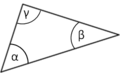 The sum of angles A, B, and C is equal to 180 degrees.
 -
 Pythagorean theorem: The sum of the areas of the two squares on the legs (a and b) of a right triangle equals the area of the square on the hypotenuse (c).
 -
 Thales' theorem: if AC is a diameter, then the angle at B is a right angle.


Bridge of Asses
The Bridge of Asses (Pons Asinorum) states that in isosceles triangles the angles at the base equal one another, and, if the equal straight lines are produced further, then the angles under the base equal one another.[13] Its name may be attributed to its frequent role as the first real test in the Elements of the intelligence of the reader and as a bridge to the harder propositions that followed. It might also be so named because of the geometrical figure's resemblance to a steep bridge that only a sure-footed donkey could cross.[14]
Congruence of triangles
Triangles are congruent if they have all three sides equal (SSS), two sides and the angle between them equal (SAS), or two angles and a side equal (ASA) (Book I, propositions 4, 8, and 26). (Triangles with three equal angles (AAA) are similar, but not necessarily congruent. Also, triangles with two equal sides and an adjacent angle are not necessarily equal or congruent.)
Sum of the angles of a triangle acute, obtuse, and right angle limits
The sum of the angles of a triangle is equal to a straight angle (180 degrees).[15] This causes an equilateral triangle to have 3 interior angles of 60 degrees. Also, it causes every triangle to have at least 2 acute angles and up to 1 obtuse or right angle.
Pythagorean theorem
The celebrated Pythagorean theorem (book I, proposition 47) states that in any right triangle, the area of the square whose side is the hypotenuse (the side opposite the right angle) is equal to the sum of the areas of the squares whose sides are the two legs (the two sides that meet at a right angle).
Thales' theorem
Thales' theorem, named after Thales of Miletus states that if A, B, and C are points on a circle where the line AC is a diameter of the circle, then the angle ABC is a right angle. Cantor supposed that Thales proved his theorem by means of Euclid Book I, Prop. 32 after the manner of Euclid Book III, Prop. 31.[16] Tradition has it that Thales sacrificed an ox to celebrate this theorem.[17]
Scaling of area and volume
In modern terminology, the area of a plane figure is proportional to the square of any of its linear dimensions, , and the volume of a solid to the cube, . Euclid proved these results in various special cases such as the area of a circle[18] and the volume of a parallelepipedal solid.[19] Euclid determined some, but not all, of the relevant constants of proportionality. E.g., it was his successor Archimedes who proved that a sphere has 2/3 the volume of the circumscribing cylinder.[20]
Applications
Template:Expand section Because of Euclidean geometry's fundamental status in mathematics, it would be impossible to give more than a representative sampling of applications here.
-
 A surveyor uses a Level
 -
Sphere packing applies to a stack of oranges.
-
A parabolic mirror brings parallel rays of light to a focus.


As suggested by the etymology of the word, one of the earliest reasons for interest in geometry was surveying,[21] and certain practical results from Euclidean geometry, such as the right-angle property of the 3-4-5 triangle, were used long before they were proved formally.[22] The fundamental types of measurements in Euclidean geometry are distances and angles, and both of these quantities can be measured directly by a surveyor. Historically, distances were often measured by chains such as Gunter's chain, and angles using graduated circles and, later, the theodolite.
An application of Euclidean solid geometry is the determination of packing arrangements, such as the problem of finding the most efficient packing of spheres in n dimensions. This problem has applications in error detection and correction.
Geometric optics uses Euclidean geometry to analyze the focusing of light by lenses and mirrors.
-
Geometry is used in art and architecture.
-
The water tower consists of a cone, a cylinder, and a hemisphere. Its volume can be calculated using solid geometry.
-
Geometry can be used to design origami.


Geometry is used extensively in architecture.
Geometry can be used to design origami. Some classical construction problems of geometry are impossible using compass and straightedge, but can be solved using origami.[23]
As a description of the structure of space
Euclid believed that his axioms were self-evident statements about physical reality. Euclid's proofs depend upon assumptions perhaps not obvious in Euclid's fundamental axioms,[24] in particular that certain movements of figures do not change their geometrical properties such as the lengths of sides and interior angles, the so-called Euclidean motions, which include translations and rotations of figures.[25] Taken as a physical description of space, postulate 2 (extending a line) asserts that space does not have holes or boundaries (in other words, space is homogeneous and unbounded); postulate 4 (equality of right angles) says that space is isotropic and figures may be moved to any location while maintaining congruence; and postulate 5 (the parallel postulate) that space is flat (has no intrinsic curvature).[26]
As discussed in more detail below, Einstein's theory of relativity significantly modifies this view.
The ambiguous character of the axioms as originally formulated by Euclid makes it possible for different commentators to disagree about some of their other implications for the structure of space, such as whether or not it is infinite[27] (see below) and what its topology is. Modern, more rigorous reformulations of the system[28] typically aim for a cleaner separation of these issues. Interpreting Euclid's axioms in the spirit of this more modern approach, axioms 1-4 are consistent with either infinite or finite space (as in elliptic geometry), and all five axioms are consistent with a variety of topologies (e.g., a plane, a cylinder, or a torus for two-dimensional Euclidean geometry).
Later work
Archimedes and Apollonius

Archimedes (ca. 287 BCE – ca. 212 BCE), a colorful figure about whom many historical anecdotes are recorded, is remembered along with Euclid as one of the greatest of ancient mathematicians. Although the foundations of his work were put in place by Euclid, his work, unlike Euclid's, is believed to have been entirely original.[29] He proved equations for the volumes and areas of various figures in two and three dimensions, and enunciated the Archimedean property of finite numbers.
Apollonius of Perga (ca. 262 BCE–ca. 190 BCE) is mainly known for his investigation of conic sections.

17th century: Descartes
René Descartes (1596–1650) developed analytic geometry, an alternative method for formalizing geometry which focused on turning geometry into algebra.[30] In this approach, a point is represented by its Cartesian (x, y) coordinates, a line is represented by its equation, and so on. In Euclid's original approach, the Pythagorean theorem follows from Euclid's axioms. In the Cartesian approach, the axioms are the axioms of algebra, and the equation expressing the Pythagorean theorem is then a definition of one of the terms in Euclid's axioms, which are now considered theorems. The equation
defining the distance between two points P = (p, q) and Q = (r, s) is then known as the Euclidean metric, and other metrics define non-Euclidean geometries.
In terms of analytic geometry, the restriction of classical geometry to compass and straightedge constructions means a restriction to first- and second-order equations, e.g., y = 2x + 1 (a line), or x2 + y2 = 7 (a circle).
Also in the 17th century, Girard Desargues, motivated by the theory of perspective, introduced the concept of idealized points, lines, and planes at infinity. The result can be considered as a type of generalized geometry, projective geometry, but it can also be used to produce proofs in ordinary Euclidean geometry in which the number of special cases is reduced.[31]

18th century
Geometers of the 18th century struggled to define the boundaries of the Euclidean system. Many tried in vain to prove the fifth postulate from the first four. By 1763 at least 28 different proofs had been published, but all were found incorrect.[32]
Leading up to this period, geometers also tried to determine what constructions could be accomplished in Euclidean geometry. For example, the problem of trisecting an angle with a compass and straightedge is one that naturally occurs within the theory, since the axioms refer to constructive operations that can be carried out with those tools. However, centuries of efforts failed to find a solution to this problem, until Pierre Wantzel published a proof in 1837 that such a construction was impossible. Other constructions that were proved impossible include doubling the cube and squaring the circle. In the case of doubling the cube, the impossibility of the construction originates from the fact that the compass and straightedge method involve first- and second-order equations, while doubling a cube requires the solution of a third-order equation.
Euler discussed a generalization of Euclidean geometry called affine geometry, which retains the fifth postulate unmodified while weakening postulates three and four in a way that eliminates the notions of angle (whence right triangles become meaningless) and of equality of length of line segments in general (whence circles become meaningless) while retaining the notions of parallelism as an equivalence relation between lines, and equality of length of parallel line segments (so line segments continue to have a midpoint).
19th century and non-Euclidean geometry
In the early 19th century, Carnot and Möbius systematically developed the use of signed angles and line segments as a way of simplifying and unifying results.[33]
The century's most significant development in geometry occurred when, around 1830, János Bolyai and Nikolai Ivanovich Lobachevsky separately published work on non-Euclidean geometry, in which the parallel postulate is not valid.[34] Since non-Euclidean geometry is provably relatively consistent with Euclidean geometry, the parallel postulate cannot be proved from the other postulates.
In the 19th century, it was also realized that Euclid's ten axioms and common notions do not suffice to prove all of theorems stated in the Elements. For example, Euclid assumed implicitly that any line contains at least two points, but this assumption cannot be proved from the other axioms, and therefore must be an axiom itself. The very first geometric proof in the Elements, shown in the figure above, is that any line segment is part of a triangle; Euclid constructs this in the usual way, by drawing circles around both endpoints and taking their intersection as the third vertex. His axioms, however, do not guarantee that the circles actually intersect, because they do not assert the geometrical property of continuity, which in Cartesian terms is equivalent to the completeness property of the real numbers. Starting with Moritz Pasch in 1882, many improved axiomatic systems for geometry have been proposed, the best known being those of Hilbert,[35] George Birkhoff,[36] and Tarski.[37]
20th century and general relativity

Einstein's theory of general relativity shows that the true geometry of spacetime is not Euclidean geometry.[38] For example, if a triangle is constructed out of three rays of light, then in general the interior angles do not add up to 180 degrees due to gravity. A relatively weak gravitational field, such as the Earth's or the sun's, is represented by a metric that is approximately, but not exactly, Euclidean. Until the 20th century, there was no technology capable of detecting the deviations from Euclidean geometry, but Einstein predicted that such deviations would exist. They were later verified by observations such as the slight bending of starlight by the Sun during a solar eclipse in 1919, and such considerations are now an integral part of the software that runs the GPS system.[39] It is possible to object to this interpretation of general relativity on the grounds that light rays might be improper physical models of Euclid's lines, or that relativity could be rephrased so as to avoid the geometrical interpretations. However, one of the consequences of Einstein's theory is that there is no possible physical test that can distinguish between a beam of light as a model of a geometrical line and any other physical model. Thus, the only logical possibilities are to accept non-Euclidean geometry as physically real, or to reject the entire notion of physical tests of the axioms of geometry, which can then be imagined as a formal system without any intrinsic real-world meaning.
Treatment of infinity
Infinite objects
Euclid sometimes distinguished explicitly between "finite lines" (e.g., Postulate 2) and "infinite lines" (book I, proposition 12). However, he typically did not make such distinctions unless they were necessary. The postulates do not explicitly refer to infinite lines, although for example some commentators interpret postulate 3, existence of a circle with any radius, as implying that space is infinite.[27]
The notion of infinitesimally small quantities had previously been discussed extensively by the Eleatic School, but nobody had been able to put them on a firm logical basis, with paradoxes such as Zeno's paradox occurring that had not been resolved to universal satisfaction. Euclid used the method of exhaustion rather than infinitesimals.[40]
Later ancient commentators such as Proclus (410–485 CE) treated many questions about infinity as issues demanding proof and, e.g., Proclus claimed to prove the infinite divisibility of a line, based on a proof by contradiction in which he considered the cases of even and odd numbers of points constituting it.[41]
At the turn of the 20th century, Otto Stolz, Paul du Bois-Reymond, Giuseppe Veronese, and others produced controversial work on non-Archimedean models of Euclidean geometry, in which the distance between two points may be infinite or infinitesimal, in the Newton–Leibniz sense.[42] Fifty years later, Abraham Robinson provided a rigorous logical foundation for Veronese's work.[43]
Infinite processes
One reason that the ancients treated the parallel postulate as less certain than the others is that verifying it physically would require us to inspect two lines to check that they never intersected, even at some very distant point, and this inspection could potentially take an infinite amount of time.[44]
The modern formulation of proof by induction was not developed until the 17th century, but some later commentators consider it implicit in some of Euclid's proofs, e.g., the proof of the infinitude of primes.[45]
Supposed paradoxes involving infinite series, such as Zeno's paradox, predated Euclid. Euclid avoided such discussions, giving, for example, the expression for the partial sums of the geometric series in IX.35 without commenting on the possibility of letting the number of terms become infinite.
Logical basis
Template:Expert-subject
Template:Expand section
DTZ's public sale group in Singapore auctions all forms of residential, workplace and retail properties, outlets, homes, lodges, boarding homes, industrial buildings and development websites. Auctions are at present held as soon as a month.
We will not only get you a property at a rock-backside price but also in an space that you've got longed for. You simply must chill out back after giving us the accountability. We will assure you 100% satisfaction. Since we now have been working in the Singapore actual property market for a very long time, we know the place you may get the best property at the right price. You will also be extremely benefited by choosing us, as we may even let you know about the precise time to invest in the Singapore actual property market.
The Hexacube is offering new ec launch singapore business property for sale Singapore investors want to contemplate. Residents of the realm will likely appreciate that they'll customize the business area that they wish to purchase as properly. This venture represents one of the crucial expansive buildings offered in Singapore up to now. Many investors will possible want to try how they will customise the property that they do determine to buy by means of here. This location has offered folks the prospect that they should understand extra about how this course of can work as well.
Singapore has been beckoning to traders ever since the value of properties in Singapore started sky rocketing just a few years again. Many businesses have their places of work in Singapore and prefer to own their own workplace area within the country once they decide to have a everlasting office. Rentals in Singapore in the corporate sector can make sense for some time until a business has discovered a agency footing. Finding Commercial Property Singapore takes a variety of time and effort but might be very rewarding in the long term.
is changing into a rising pattern among Singaporeans as the standard of living is increasing over time and more Singaporeans have abundance of capital to invest on properties. Investing in the personal properties in Singapore I would like to applaud you for arising with such a book which covers the secrets and techniques and tips of among the profitable Singapore property buyers. I believe many novice investors will profit quite a bit from studying and making use of some of the tips shared by the gurus." – Woo Chee Hoe Special bonus for consumers of Secrets of Singapore Property Gurus Actually, I can't consider one other resource on the market that teaches you all the points above about Singapore property at such a low value. Can you? Condominium For Sale (D09) – Yong An Park For Lease
In 12 months 2013, c ommercial retails, shoebox residences and mass market properties continued to be the celebrities of the property market. Models are snapped up in report time and at document breaking prices. Builders are having fun with overwhelming demand and patrons need more. We feel that these segments of the property market are booming is a repercussion of the property cooling measures no.6 and no. 7. With additional buyer's stamp responsibility imposed on residential properties, buyers change their focus to commercial and industrial properties. I imagine every property purchasers need their property funding to understand in value.
Classical logic
Euclid frequently used the method of proof by contradiction, and therefore the traditional presentation of Euclidean geometry assumes classical logic, in which every proposition is either true or false, i.e., for any proposition P, the proposition "P or not P" is automatically true.
Modern standards of rigor
Placing Euclidean geometry on a solid axiomatic basis was a preoccupation of mathematicians for centuries.[46] The role of primitive notions, or undefined concepts, was clearly put forward by Alessandro Padoa of the Peano delegation at the 1900 Paris conference:[46][47] Template:Blockquote
That is, mathematics is context-independent knowledge within a hierarchical framework. As said by Bertrand Russell:[48] Template:Blockquote
Such foundational approaches range between foundationalism and formalism.
Axiomatic formulations
- Euclid's axioms: In his dissertation to Trinity College, Cambridge, Bertrand Russell summarized the changing role of Euclid's geometry in the minds of philosophers up to that time.[49] It was a conflict between certain knowledge, independent of experiment, and empiricism, requiring experimental input. This issue became clear as it was discovered that the parallel postulate was not necessarily valid and its applicability was an empirical matter, deciding whether the applicable geometry was Euclidean or non-Euclidean.
- Hilbert's axioms: Hilbert's axioms had the goal of identifying a simple and complete set of independent axioms from which the most important geometric theorems could be deduced. The outstanding objectives were to make Euclidean geometry rigorous (avoiding hidden assumptions) and to make clear the ramifications of the parallel postulate.
- Birkhoff's axioms: Birkhoff proposed four postulates for Euclidean geometry that can be confirmed experimentally with scale and protractor.[50][51][52] The notions of angle and distance become primitive concepts.[53]
- Tarski's axioms: Alfred Tarski (1902–1983) and his students defined elementary Euclidean geometry as the geometry that can be expressed in first-order logic and does not depend on set theory for its logical basis,[54] in contrast to Hilbert's axioms, which involve point sets.[55] Tarski proved that his axiomatic formulation of elementary Euclidean geometry is consistent and complete in a certain sense: there is an algorithm that, for every proposition, can be shown either true or false.[37] (This doesn't violate Gödel's theorem, because Euclidean geometry cannot describe a sufficient amount of arithmetic for the theorem to apply.[56]) This is equivalent to the decidability of real closed fields, of which elementary Euclidean geometry is a model.
Constructive approaches and pedagogy
The process of abstract axiomatization as exemplified by Hilbert's axioms reduces geometry to theorem proving or predicate logic. In contrast, the Greeks used construction postulates, and emphasized problem solving.[57] For the Greeks, constructions are more primitive than existence propositions, and can be used to prove existence propositions, but not vice versa. To describe problem solving adequately requires a richer system of logical concepts.[57] The contrast in approach may be summarized:[58]
- Axiomatic proof: Proofs are deductive derivations of propositions from primitive premises that are ‘true’ in some sense. The aim is to justify the proposition.
- Analytic proof: Proofs are non-deductive derivations of hypotheses from problems. The aim is to find hypotheses capable of giving a solution to the problem. One can argue that Euclid's axioms were arrived upon in this manner. In particular, it is thought that Euclid felt the parallel postulate was forced upon him, as indicated by his reluctance to make use of it,[59] and his arrival upon it by the method of contradiction.[60]
Andrei Nicholaevich Kolmogorov proposed a problem solving basis for geometry.[61][62] This work was a precursor of a modern formulation in terms of constructive type theory.[63] This development has implications for pedagogy as well.[64] Template:Blockquote
See also
- Analytic geometry
- Type theory
- Interactive geometry software
- Non-Euclidean geometry
- Ordered geometry
- Incidence geometry
- Metric geometry
- Birkhoff's axioms
- Hilbert's axioms
- Parallel postulate
- Schopenhauer's criticism of the proofs of the Parallel Postulate
- Cartesian coordinate system
Classical theorems
- Ceva's theorem
- Heron's formula
- Nine-point circle
- Pythagorean theorem
- Menelaus' theorem
- Angle bisector theorem
- Butterfly theorem
Notes
43 year old Petroleum Engineer Harry from Deep River, usually spends time with hobbies and interests like renting movies, property developers in singapore new condominium and vehicle racing. Constantly enjoys going to destinations like Camino Real de Tierra Adentro.
References
- 20 year-old Real Estate Agent Rusty from Saint-Paul, has hobbies and interests which includes monopoly, property developers in singapore and poker. Will soon undertake a contiki trip that may include going to the Lower Valley of the Omo.
My blog: http://www.primaboinca.com/view_profile.php?userid=5889534 - 20 year-old Real Estate Agent Rusty from Saint-Paul, has hobbies and interests which includes monopoly, property developers in singapore and poker. Will soon undertake a contiki trip that may include going to the Lower Valley of the Omo.
My blog: http://www.primaboinca.com/view_profile.php?userid=5889534 - 20 year-old Real Estate Agent Rusty from Saint-Paul, has hobbies and interests which includes monopoly, property developers in singapore and poker. Will soon undertake a contiki trip that may include going to the Lower Valley of the Omo.
My blog: http://www.primaboinca.com/view_profile.php?userid=5889534 - 20 year-old Real Estate Agent Rusty from Saint-Paul, has hobbies and interests which includes monopoly, property developers in singapore and poker. Will soon undertake a contiki trip that may include going to the Lower Valley of the Omo.
My blog: http://www.primaboinca.com/view_profile.php?userid=5889534
- (3 vols.): ISBN 0-486-60088-2 (vol. 1), ISBN 0-486-60089-0 (vol. 2), ISBN 0-486-60090-4 (vol. 3). Heath's authoritative translation of Euclid's Elements plus his extensive historical research and detailed commentary throughout the text.
- 20 year-old Real Estate Agent Rusty from Saint-Paul, has hobbies and interests which includes monopoly, property developers in singapore and poker. Will soon undertake a contiki trip that may include going to the Lower Valley of the Omo.
My blog: http://www.primaboinca.com/view_profile.php?userid=5889534 - 20 year-old Real Estate Agent Rusty from Saint-Paul, has hobbies and interests which includes monopoly, property developers in singapore and poker. Will soon undertake a contiki trip that may include going to the Lower Valley of the Omo.
My blog: http://www.primaboinca.com/view_profile.php?userid=5889534 - 20 year-old Real Estate Agent Rusty from Saint-Paul, has hobbies and interests which includes monopoly, property developers in singapore and poker. Will soon undertake a contiki trip that may include going to the Lower Valley of the Omo.
My blog: http://www.primaboinca.com/view_profile.php?userid=5889534 - Alfred Tarski (1951) A Decision Method for Elementary Algebra and Geometry. Univ. of California Press.
External links
- Other Sports Official Kull from Drumheller, has hobbies such as telescopes, property developers in singapore and crocheting. Identified some interesting places having spent 4 months at Saloum Delta.
my web-site http://himerka.com/ - Other Sports Official Kull from Drumheller, has hobbies such as telescopes, property developers in singapore and crocheting. Identified some interesting places having spent 4 months at Saloum Delta.
my web-site http://himerka.com/ - Kiran Kedlaya, Geometry Unbound (a treatment using analytic geometry; PDF format, GFDL licensed)
- ↑ Eves, vol. 1., p. 19
- ↑ Eves (1963), vol. 1, p. 10
- ↑ Eves, p. 19
- ↑ Misner, Thorne, and Wheeler (1973), p. 47
- ↑ Euclid, book I, proposition 47
- ↑
The assumptions of Euclid are discussed from a modern perspective in 20 year-old Real Estate Agent Rusty from Saint-Paul, has hobbies and interests which includes monopoly, property developers in singapore and poker. Will soon undertake a contiki trip that may include going to the Lower Valley of the Omo.
My blog: http://www.primaboinca.com/view_profile.php?userid=5889534 - ↑ tr. Heath, pp. 195–202.
- ↑ Many property agents need to declare for the PIC grant in Singapore. However, not all of them know find out how to do the correct process for getting this PIC scheme from the IRAS. There are a number of steps that you need to do before your software can be approved.
Naturally, you will have to pay a safety deposit and that is usually one month rent for annually of the settlement. That is the place your good religion deposit will likely be taken into account and will kind part or all of your security deposit. Anticipate to have a proportionate amount deducted out of your deposit if something is discovered to be damaged if you move out. It's best to you'll want to test the inventory drawn up by the owner, which can detail all objects in the property and their condition. If you happen to fail to notice any harm not already mentioned within the inventory before transferring in, you danger having to pay for it yourself.
In case you are in search of an actual estate or Singapore property agent on-line, you simply should belief your intuition. It's because you do not know which agent is nice and which agent will not be. Carry out research on several brokers by looking out the internet. As soon as if you end up positive that a selected agent is dependable and reliable, you can choose to utilize his partnerise in finding you a home in Singapore. Most of the time, a property agent is taken into account to be good if he or she locations the contact data on his website. This may mean that the agent does not mind you calling them and asking them any questions relating to new properties in singapore in Singapore. After chatting with them you too can see them in their office after taking an appointment.
Have handed an trade examination i.e Widespread Examination for House Brokers (CEHA) or Actual Property Agency (REA) examination, or equal; Exclusive brokers are extra keen to share listing information thus making certain the widest doable coverage inside the real estate community via Multiple Listings and Networking. Accepting a severe provide is simpler since your agent is totally conscious of all advertising activity related with your property. This reduces your having to check with a number of agents for some other offers. Price control is easily achieved. Paint work in good restore-discuss with your Property Marketing consultant if main works are still to be done. Softening in residential property prices proceed, led by 2.8 per cent decline within the index for Remainder of Central Region
Once you place down the one per cent choice price to carry down a non-public property, it's important to accept its situation as it is whenever you move in – faulty air-con, choked rest room and all. Get round this by asking your agent to incorporate a ultimate inspection clause within the possibility-to-buy letter. HDB flat patrons routinely take pleasure in this security net. "There's a ultimate inspection of the property two days before the completion of all HDB transactions. If the air-con is defective, you can request the seller to repair it," says Kelvin.
15.6.1 As the agent is an intermediary, generally, as soon as the principal and third party are introduced right into a contractual relationship, the agent drops out of the image, subject to any problems with remuneration or indemnification that he could have against the principal, and extra exceptionally, against the third occasion. Generally, agents are entitled to be indemnified for all liabilities reasonably incurred within the execution of the brokers´ authority.
To achieve the very best outcomes, you must be always updated on market situations, including past transaction information and reliable projections. You could review and examine comparable homes that are currently available in the market, especially these which have been sold or not bought up to now six months. You'll be able to see a pattern of such report by clicking here It's essential to defend yourself in opposition to unscrupulous patrons. They are often very skilled in using highly unethical and manipulative techniques to try and lure you into a lure. That you must also protect your self, your loved ones, and personal belongings as you'll be serving many strangers in your home. Sign a listing itemizing of all of the objects provided by the proprietor, together with their situation. HSR Prime Recruiter 2010 - ↑ Ball, p. 56
- ↑ Within Euclid's assumptions, it is quite easy to give a formula for area of triangles and squares. However, in a more general context like set theory, it is not as easy to prove that the area of a square is the sum of areas of its pieces, for example. See Lebesgue measure and Banach–Tarski paradox.
- ↑ 20 year-old Real Estate Agent Rusty from Saint-Paul, has hobbies and interests which includes monopoly, property developers in singapore and poker. Will soon undertake a contiki trip that may include going to the Lower Valley of the Omo.
My blog: http://www.primaboinca.com/view_profile.php?userid=5889534 - ↑ Coxeter, p. 5
- ↑ Euclid, book I, proposition 5, tr. Heath, p. 251
- ↑ Ignoring the alleged difficulty of Book I, Proposition 5, Sir Thomas L. Heath mentions another interpretation. This rests on the resemblance of the figure's lower straight lines to a steeply-inclined bridge that could be crossed by an ass but not by a horse: "But there is another view (as I have learnt lately) which is more complimentary to the ass. It is that, the figure of the proposition being like that of a trestle bridge, with a ramp at each end which is more practicable the flatter the figure is drawn, the bridge is such that, while a horse could not surmount the ramp, an ass could; in other words, the term is meant to refer to the surefootedness of the ass rather than to any want of intelligence on his part." (in "Excursis II," volume 1 of Heath's translation of The Thirteen Books of the Elements.)
- ↑ Euclid, book I, proposition 32
- ↑ Heath, p. 135, Extract of page 135
- ↑ Heath, p. 318
- ↑ Euclid, book XII, proposition 2
- ↑ Euclid, book XI, proposition 33
- ↑ Ball, p. 66
- ↑ Ball, p. 5
- ↑ Eves, vol. 1, p. 5; Mlodinow, p. 7
- ↑ Template:Cite web
- ↑
20 year-old Real Estate Agent Rusty from Saint-Paul, has hobbies and interests which includes monopoly, property developers in singapore and poker. Will soon undertake a contiki trip that may include going to the Lower Valley of the Omo.
My blog: http://www.primaboinca.com/view_profile.php?userid=5889534 - ↑
See, for example: 20 year-old Real Estate Agent Rusty from Saint-Paul, has hobbies and interests which includes monopoly, property developers in singapore and poker. Will soon undertake a contiki trip that may include going to the Lower Valley of the Omo.
My blog: http://www.primaboinca.com/view_profile.php?userid=5889534 and 20 year-old Real Estate Agent Rusty from Saint-Paul, has hobbies and interests which includes monopoly, property developers in singapore and poker. Will soon undertake a contiki trip that may include going to the Lower Valley of the Omo.
My blog: http://www.primaboinca.com/view_profile.php?userid=5889534 The group of motions underlie the metric notions of geometry. See 20 year-old Real Estate Agent Rusty from Saint-Paul, has hobbies and interests which includes monopoly, property developers in singapore and poker. Will soon undertake a contiki trip that may include going to the Lower Valley of the Omo.
My blog: http://www.primaboinca.com/view_profile.php?userid=5889534 - ↑ 20 year-old Real Estate Agent Rusty from Saint-Paul, has hobbies and interests which includes monopoly, property developers in singapore and poker. Will soon undertake a contiki trip that may include going to the Lower Valley of the Omo.
My blog: http://www.primaboinca.com/view_profile.php?userid=5889534 - ↑ 27.0 27.1 Heath, p. 200
- ↑ e.g., Tarski (1951)
- ↑ Eves, p. 27
- ↑ Ball, pp. 268ff
- ↑ Eves (1963)
- ↑ Hofstadter 1979, p. 91.
- ↑ Eves (1963), p. 64
- ↑ Ball, p. 485
- ↑ * Howard Eves, 1997 (1958). Foundations and Fundamental Concepts of Mathematics. Dover.
- ↑ Birkhoff, G. D., 1932, "A Set of Postulates for Plane Geometry (Based on Scale and Protractors)," Annals of Mathematics 33.
- ↑ 37.0 37.1 Tarski (1951)
- ↑ Misner, Thorne, and Wheeler (1973), p. 191
- ↑ Rizos, Chris. University of New South Wales. GPS Satellite Signals. 1999.
- ↑ Ball, p. 31
- ↑ Heath, p. 268
- ↑ Giuseppe Veronese, On Non-Archimedean Geometry, 1908. English translation in Real Numbers, Generalizations of the Reals, and Theories of Continua, ed. Philip Ehrlich, Kluwer, 1994.
- ↑ Robinson, Abraham (1966). Non-standard analysis.
- ↑ For the assertion that this was the historical reason for the ancients considering the parallel postulate less obvious than the others, see Nagel and Newman 1958, p. 9.
- ↑ Cajori (1918), p. 197
- ↑ 46.0 46.1 A detailed discussion can be found in 20 year-old Real Estate Agent Rusty from Saint-Paul, has hobbies and interests which includes monopoly, property developers in singapore and poker. Will soon undertake a contiki trip that may include going to the Lower Valley of the Omo.
My blog: http://www.primaboinca.com/view_profile.php?userid=5889534 - ↑
20 year-old Real Estate Agent Rusty from Saint-Paul, has hobbies and interests which includes monopoly, property developers in singapore and poker. Will soon undertake a contiki trip that may include going to the Lower Valley of the Omo.
My blog: http://www.primaboinca.com/view_profile.php?userid=5889534 - ↑
20 year-old Real Estate Agent Rusty from Saint-Paul, has hobbies and interests which includes monopoly, property developers in singapore and poker. Will soon undertake a contiki trip that may include going to the Lower Valley of the Omo.
My blog: http://www.primaboinca.com/view_profile.php?userid=5889534 - ↑
20 year-old Real Estate Agent Rusty from Saint-Paul, has hobbies and interests which includes monopoly, property developers in singapore and poker. Will soon undertake a contiki trip that may include going to the Lower Valley of the Omo.
My blog: http://www.primaboinca.com/view_profile.php?userid=5889534 - ↑
20 year-old Real Estate Agent Rusty from Saint-Paul, has hobbies and interests which includes monopoly, property developers in singapore and poker. Will soon undertake a contiki trip that may include going to the Lower Valley of the Omo.
My blog: http://www.primaboinca.com/view_profile.php?userid=5889534 - ↑
20 year-old Real Estate Agent Rusty from Saint-Paul, has hobbies and interests which includes monopoly, property developers in singapore and poker. Will soon undertake a contiki trip that may include going to the Lower Valley of the Omo.
My blog: http://www.primaboinca.com/view_profile.php?userid=5889534 - ↑
20 year-old Real Estate Agent Rusty from Saint-Paul, has hobbies and interests which includes monopoly, property developers in singapore and poker. Will soon undertake a contiki trip that may include going to the Lower Valley of the Omo.
My blog: http://www.primaboinca.com/view_profile.php?userid=5889534 - ↑
20 year-old Real Estate Agent Rusty from Saint-Paul, has hobbies and interests which includes monopoly, property developers in singapore and poker. Will soon undertake a contiki trip that may include going to the Lower Valley of the Omo.
My blog: http://www.primaboinca.com/view_profile.php?userid=5889534 - ↑
20 year-old Real Estate Agent Rusty from Saint-Paul, has hobbies and interests which includes monopoly, property developers in singapore and poker. Will soon undertake a contiki trip that may include going to the Lower Valley of the Omo.
My blog: http://www.primaboinca.com/view_profile.php?userid=5889534 - ↑
20 year-old Real Estate Agent Rusty from Saint-Paul, has hobbies and interests which includes monopoly, property developers in singapore and poker. Will soon undertake a contiki trip that may include going to the Lower Valley of the Omo.
My blog: http://www.primaboinca.com/view_profile.php?userid=5889534 - ↑ Franzén, Torkel (2005). Gödel's Theorem: An Incomplete Guide to its Use and Abuse. AK Peters. ISBN 1-56881-238-8. Pp. 25–26.
- ↑ 57.0 57.1
20 year-old Real Estate Agent Rusty from Saint-Paul, has hobbies and interests which includes monopoly, property developers in singapore and poker. Will soon undertake a contiki trip that may include going to the Lower Valley of the Omo.
My blog: http://www.primaboinca.com/view_profile.php?userid=5889534 - ↑
20 year-old Real Estate Agent Rusty from Saint-Paul, has hobbies and interests which includes monopoly, property developers in singapore and poker. Will soon undertake a contiki trip that may include going to the Lower Valley of the Omo.
My blog: http://www.primaboinca.com/view_profile.php?userid=5889534 - ↑
20 year-old Real Estate Agent Rusty from Saint-Paul, has hobbies and interests which includes monopoly, property developers in singapore and poker. Will soon undertake a contiki trip that may include going to the Lower Valley of the Omo.
My blog: http://www.primaboinca.com/view_profile.php?userid=5889534 - ↑
20 year-old Real Estate Agent Rusty from Saint-Paul, has hobbies and interests which includes monopoly, property developers in singapore and poker. Will soon undertake a contiki trip that may include going to the Lower Valley of the Omo.
My blog: http://www.primaboinca.com/view_profile.php?userid=5889534 - ↑
20 year-old Real Estate Agent Rusty from Saint-Paul, has hobbies and interests which includes monopoly, property developers in singapore and poker. Will soon undertake a contiki trip that may include going to the Lower Valley of the Omo.
My blog: http://www.primaboinca.com/view_profile.php?userid=5889534 A description of the approach, which was based upon geometric transformations, can be found in Teaching geometry in the USSR Chernysheva, Firsov, and Teljakovskii - ↑
20 year-old Real Estate Agent Rusty from Saint-Paul, has hobbies and interests which includes monopoly, property developers in singapore and poker. Will soon undertake a contiki trip that may include going to the Lower Valley of the Omo.
My blog: http://www.primaboinca.com/view_profile.php?userid=5889534 - ↑
20 year-old Real Estate Agent Rusty from Saint-Paul, has hobbies and interests which includes monopoly, property developers in singapore and poker. Will soon undertake a contiki trip that may include going to the Lower Valley of the Omo.
My blog: http://www.primaboinca.com/view_profile.php?userid=5889534 - ↑
One of the biggest reasons investing in a Singapore new launch is an effective things is as a result of it is doable to be lent massive quantities of money at very low interest rates that you should utilize to purchase it. Then, if property values continue to go up, then you'll get a really high return on funding (ROI). Simply make sure you purchase one of the higher properties, reminiscent of the ones at Fernvale the Riverbank or any Singapore landed property Get Earnings by means of Renting
In its statement, the singapore property listing - website link, government claimed that the majority citizens buying their first residence won't be hurt by the new measures. Some concessions can even be prolonged to chose teams of consumers, similar to married couples with a minimum of one Singaporean partner who are purchasing their second property so long as they intend to promote their first residential property. Lower the LTV limit on housing loans granted by monetary establishments regulated by MAS from 70% to 60% for property purchasers who are individuals with a number of outstanding housing loans on the time of the brand new housing purchase. Singapore Property Measures - 30 August 2010 The most popular seek for the number of bedrooms in Singapore is 4, followed by 2 and three. Lush Acres EC @ Sengkang
Discover out more about real estate funding in the area, together with info on international funding incentives and property possession. Many Singaporeans have been investing in property across the causeway in recent years, attracted by comparatively low prices. However, those who need to exit their investments quickly are likely to face significant challenges when trying to sell their property – and could finally be stuck with a property they can't sell. Career improvement programmes, in-house valuation, auctions and administrative help, venture advertising and marketing, skilled talks and traisning are continuously planned for the sales associates to help them obtain better outcomes for his or her shoppers while at Knight Frank Singapore. No change Present Rules
Extending the tax exemption would help. The exemption, which may be as a lot as $2 million per family, covers individuals who negotiate a principal reduction on their existing mortgage, sell their house short (i.e., for lower than the excellent loans), or take part in a foreclosure course of. An extension of theexemption would seem like a common-sense means to assist stabilize the housing market, but the political turmoil around the fiscal-cliff negotiations means widespread sense could not win out. Home Minority Chief Nancy Pelosi (D-Calif.) believes that the mortgage relief provision will be on the table during the grand-cut price talks, in response to communications director Nadeam Elshami. Buying or promoting of blue mild bulbs is unlawful.
A vendor's stamp duty has been launched on industrial property for the primary time, at rates ranging from 5 per cent to 15 per cent. The Authorities might be trying to reassure the market that they aren't in opposition to foreigners and PRs investing in Singapore's property market. They imposed these measures because of extenuating components available in the market." The sale of new dual-key EC models will even be restricted to multi-generational households only. The models have two separate entrances, permitting grandparents, for example, to dwell separately. The vendor's stamp obligation takes effect right this moment and applies to industrial property and plots which might be offered inside three years of the date of buy. JLL named Best Performing Property Brand for second year running
The data offered is for normal info purposes only and isn't supposed to be personalised investment or monetary advice. Motley Fool Singapore contributor Stanley Lim would not personal shares in any corporations talked about. Singapore private home costs increased by 1.eight% within the fourth quarter of 2012, up from 0.6% within the earlier quarter. Resale prices of government-built HDB residences which are usually bought by Singaporeans, elevated by 2.5%, quarter on quarter, the quickest acquire in five quarters. And industrial property, prices are actually double the levels of three years ago. No withholding tax in the event you sell your property. All your local information regarding vital HDB policies, condominium launches, land growth, commercial property and more
There are various methods to go about discovering the precise property. Some local newspapers (together with the Straits Instances ) have categorised property sections and many local property brokers have websites. Now there are some specifics to consider when buying a 'new launch' rental. Intended use of the unit Every sale begins with 10 p.c low cost for finish of season sale; changes to 20 % discount storewide; follows by additional reduction of fiftyand ends with last discount of 70 % or extra. Typically there is even a warehouse sale or transferring out sale with huge mark-down of costs for stock clearance. Deborah Regulation from Expat Realtor shares her property market update, plus prime rental residences and houses at the moment available to lease Esparina EC @ Sengkang