Orbit: Difference between revisions
en>Dark Silver Crow →Analysis of orbital motion: Stale merge, discussion opposed, delisted |
en>Ninney Reverted 1 edit by 98.201.132.33 (talk) to last revision by ClueBot NG. (TW) |
||
| Line 1: | Line 1: | ||
== | {{Other uses}} | ||
{{Use dmy dates|date=October 2013}} | |||
{{Taxobox | |||
| name = Ostrich | |||
| fossil_range = {{fossil range|Pleistocene|present}} [[Pleistocene]] to Recent | |||
| status = LC | |||
| status_system = IUCN3.1 | |||
| status_ref = <ref name=IUCN>{{IUCN|id=22678068 |title=''Struthio camelus'' |assessors=[[BirdLife International]] |version=2013.2 |year=2012 |accessdate=26 November 2013}}</ref> | |||
| image = Ostriches cape point cropped 2.jpg | |||
| image_width = 300px | |||
| image_caption = male (left) and female ostriches | |||
| regnum = [[Animalia]] | |||
| phylum = [[Chordate|Chordata]] | |||
| subphylum = [[Vertebrate|Vertebrata]] | |||
| classis = [[Bird|Aves]] | |||
| superordo = [[Paleognathae]] | |||
| ordo = [[Struthioniformes]] | |||
| familia = [[Struthionidae]] | |||
| genus = ''[[Struthio]]'' | |||
| species = '''''S. camelus''''' | |||
| binomial = ''Struthio camelus'' | |||
| binomial_authority = [[Carl Linnaeus|Linnaeus]], [[10th edition of Systema Naturae|1758]]<ref name="SN"/> | |||
| subdivision_ranks = [[Species]] | |||
| subdivision = | |||
''Struthio camelus''<br/> | |||
''Struthio (camelus) molybdophanes'' | |||
| range_map = Struthio camelus distribution.svg | |||
| range_map_width = 250px | |||
| range_map_caption = ''Struthio camelus'' distribution map | |||
<!-- This is a table for legends in map caption - I seemed to need to use {{!}} instead of | to pass the pipe through the infobox template --> | |||
<center> | |||
{{{!}}style="text-align:left;" | |||
{{!}}- | |||
{{!}}{{colorbox|#FFA360}} ''S. c. camelus''{{!}}{{!}} {{colorbox|#FFFF3B}} ''S. c. molybdophanes'' | |||
{{!}}- | |||
{{!}}{{colorbox|#4FF55A}} ''S. c. massaicus''{{!}}{{!}} {{colorbox|#FF7166}} ''S. c. australis'' | |||
{{!}}}</center> | |||
<!-- End of legend/key table for caption... --> | |||
== | | subdivision_ranks = [[Subspecies]] | ||
| subdivision = ''S. c. australis'' <small>[[John Henry Gurney|Gurney]], 1868<ref name="SN"/><br>Southern Ostrich</small><br> | |||
''S. c. camelus'' <small>[[Linnaeus]], 1758<ref name="SN"/><br>North African Ostrich</small><br> | |||
''S. c. massaicus'' <small>[[Oscar Rudolph Neumann|Neumann]], 1898<ref name="SN"/><br>Masai Ostrich</small><br> | |||
†''[[Arabian Ostrich|S. c. syriacus]]'' <small>[[Lionel Walter Rothschild, 2nd Baron Rothschild|Rothschild]], 1919<ref name="SN"/><br>Arabian Ostrich</small><br> | |||
''[[Somali Ostrich|S. c. molybdophanes]]'' <small>[[Reichenow]], 1883<ref name="SN"/><br>Somali Ostrich</small> | |||
}} | |||
The '''Ostrich''' or '''Common Ostrich''' (''Struthio camelus'') is either one or two [[species]] of large [[flightless bird]]s native to [[Africa]], the only living member(s) of the [[genus]] ''[[Struthio]]'', which is in the [[ratite]] family. Some analyses indicate that the [[Somali Ostrich]] may be better considered a full species separate from the Common Ostrich, but most taxonomists consider it to be a subspecies. | |||
== | The ostrich shares the [[order (biology)|order]] [[Struthioniformes]] with the [[kiwi]]s, [[emu]]s, [[Rhea (bird)|rhea]]s, and [[cassowary|cassowaries]]. It is distinctive in its appearance, with a long neck and legs, and can run at up to about {{Convert|70|km/h|mph|abbr=on}},<ref name="Davies"/> the fastest land speed of any bird.<ref name=Doherty/> The ostrich is the [[Largest organisms|largest living species]] of [[bird]] and lays the largest eggs of any living bird (extinct [[elephant bird]]s of Madagascar and the [[giant moa]] of New Zealand laid larger eggs). | ||
The ostrich's diet consists mainly of plant matter, though it also eats [[invertebrate]]s. It lives in nomadic groups of 5 to 50 birds. When threatened, the ostrich will either hide itself by lying flat against the ground, or run away. If cornered, it can attack with a kick of its powerful legs. Mating patterns differ by geographical region, but territorial males fight for a harem of two to seven females. | |||
The ostrich is [[farming|farmed]] around the world, particularly for its feathers, which are decorative and are also used as [[feather duster]]s. Its skin is used for [[leather]] products and its meat is marketed commercially.<ref name="Davies"/> | |||
==Description== | |||
Ostriches usually weigh from {{convert|63|to(-)|145|kg|lb}},<ref name="Davies">{{cite book|title=Ratites and Tinamous |author=Stephen Davies |year=2002 |isbn=978-0198549963}}</ref><ref name="Gilman 1903"/> Ostriches of the East African race (''S. c. massaicus'') averaged {{convert|115|kg|lb|abbr=on}} in males and {{convert|100|kg|lb|abbr=on}} in females, while the nominate subspecies{{clarify|date=February 2013}} was found to average {{convert|111|kg|lb|abbr=on}} in unsexed adults.<ref name="Davies"/> Exceptional male ostriches (in the nominate subspecies) can weigh up to {{convert|156.8|kg|lb|abbr=on}}.<ref name="Davies"/> At sexual maturity (two to four years), male ostriches can be from {{convert|2.1|to|2.8|m|ftin|0|abbr=on}} in height, while female ostriches range from {{convert|1.7|to|2|m|ftin|0|abbr=on}} tall.<ref name="Davies"/> New chicks are [[wiktionary:fawn|fawn]] in colour, with dark brown spots.<ref name = "Perrins"/> During the first year of life, chicks grow at about {{convert|25|cm|in|sigfig=2|abbr=on}} per month. At one year of age, ostriches weigh approximately {{convert|45|kg|lb|sigfig=2}}. Their lifespan is up to 40–45 years. | |||
== | The feathers of adult males are mostly black, with white [[flight feathers#Primaries|primaries]] and a white tail. However, the tail of one subspecies is [[Buff (colour)|buff]]. Females and young males are greyish-brown and white. The head and neck of both male and female ostriches is nearly bare, with a thin layer of [[Down feather|down]].<ref name="Gilman 1903"/><ref name="Perrins"/> The skin of the female's neck and thighs is pinkish gray,<ref name="Perrins"/> while the male's is blue-gray, gray or pink dependent on subspecies. | ||
<gallery> | |||
Afrikanischer Strauss Portrait.jpg|Head | |||
Ostrich, mouth open.jpg|Beak open | |||
File:The Childrens Museum of Indianapolis - Ostrich skull.jpg|Ostrich skull | |||
Ostrich foot.jpg|Foot | |||
OstrichWing.jpg|Claws on the wings | |||
</gallery> | |||
The long neck and legs keep their head up to {{Convert|2.8|m|ft|sigfig=1|abbr=on}} above the ground, and their eyes are said to be the largest of any land vertebrate: {{Convert|50|mm|in|1|abbr=on}} in diameter;<ref name=Brown/> they can therefore perceive predators at a great distance. The eyes are shaded from sunlight from above.<ref name=Martin2000/><ref name=Martin2001/> However, the head and [[Beak|bill]] are relatively small for the birds' huge size, with the bill measuring {{convert|12|to|14.3|cm|in|abbr=on}}.<ref name="Davies"/> | |||
Their skin varies in colour depending on the subspecies, with some having light or dark gray skin and others having pinkish or even reddish skin.<ref name="Davies"/> The strong legs of the ostrich are unfeathered and show bare skin, with the [[Tarsus (skeleton)|tarsus]] (the lowest upright part of the leg) being covered in scales: red in the male, black in the female.<ref name="Davies"/> The tarsus of the ostrich is the largest of any living bird, measuring {{convert|39|to|53|cm|in|abbr=on}} in length.<ref name="Davies"/> The bird has just two toes on each foot (most birds have four), with the [[nail (anatomy)|nail]] on the larger, inner toe resembling a [[hoof]]. The outer toe has no nail.{{Citation needed|date=October 2013}} The reduced number of toes is an adaptation that appears to aid in running, useful for getting away from predators. Ostriches can run at a speed over {{Convert|70|km/h|mph|abbr=on}} and can cover {{convert|3|to|5|m|ft|abbr=on}} in a single stride.<ref>[http://www.sandiegozoo.org/animalbytes/t-ostrich.html San Diego Zoo's Animal Bytes: Ostrich]. Sandiegozoo.org. Retrieved on 21 August 2012.</ref> The wings reach a span of about 2 metres (6 ft 7 in), and the [[Wing chord (biology)|wing chord]] measurement of {{convert|90|cm|in|abbr=on}} is around the same size as for the largest flying birds.<ref name="Davies"/><ref name="Donegan 2002"/> The wings are used in mating displays and to shade chicks. The feathers lack the tiny hooks that lock together the smooth external feathers of flying birds, and so are soft and fluffy and serve as insulation. Ostriches can tolerate a wide range of temperatures. In much of their habitat, temperatures vary as much as {{Convert|40|C|F|sigfig=2}} between night and day. Their temperature control mechanism relies on action by the bird, which uses its wings to cover the naked skin of the upper legs and flanks to conserve heat, or leaves these areas bare to release heat. They have 50–60 tail feathers, and their wings have 16 primary, four [[alular]] and 20–23 secondary feathers.<ref name="Davies"/> | |||
The ostrich's [[sternum]] is flat, lacking the [[Keel (bird)|keel]] to which wing muscles attach in flying birds.<ref name="Nell 2003"/> The [[beak]] is flat and broad, with a rounded tip.<ref name="Gilman 1903"/> Like all [[ratites]], the ostrich has no crop,<ref name=Brand2006/> and it also lacks a [[gallbladder]].<ref name=Marshall/> They have three stomachs, and the [[caecum]] is {{convert|71|cm|in|abbr=on}} long. Unlike all other living birds, the ostrich secretes urine separately from faeces.<ref name=coprodeum/> All other birds store the urine and faeces combined in the [[coprodeum]], but the ostrich stores the faeces in the terminal rectum.<ref name=coprodeum/> They also have unique [[pubic bones]] that are fused to hold their gut. Unlike most birds, the males have a copulatory organ, which is retractable and {{convert|8|in|cm|abbr=on}} long. Their [[palate]] differs from other ratites in that the [[Sphenoid bone|sphenoid]] and [[palatal]] bones are unconnected.<ref name="Davies"/> | |||
==Taxonomy== | |||
The ostrich was originally described by [[Carolus Linnaeus|Linnaeus]] in his 18th-century work, ''[[Systema Naturae]]'' under its current [[Binomial nomenclature|binomial name]].<ref name=Linnaeus/> Its [[scientific name]] is derived from [[Latin]], ''struthio'' meaning "ostrich" and ''camelus'' meaning "camel", alluding to its dry habitat.<ref name=Gotch/> | |||
The ostrich belongs to the [[ratite]] [[order (biology)|order]] [[Struthioniformes]]. Other members include [[rhea (bird)|rheas]], [[emu]]s, [[cassowary|cassowaries]], [[moa]], [[kiwi]] and the largest bird ever, the now-extinct [[Elephant Bird]] (''Aepyornis''). However, the classification of the ratites as a single order has always been questioned, with the alternative classification restricting the Struthioniformes to the ostrich lineage and elevating the other groups. | |||
===Subspecies=== | |||
[[File:Somali ostrich.jpg|thumb|300px|[[Somali Ostrich]] in the Lewa Conservancy near [[Isiolo]], [[Kenya]]]] | |||
Five [[subspecies]] are recognized: | |||
*'''Common Ostrich (S. camelus) complex''': | |||
**'''''S. c. australis''''', '''Southern Ostrich''', [[southern Africa]]. It is found south of the [[Zambezi]] and [[Cunene River|Cunene]] rivers. It is farmed for its meat, leather and feathers in the [[Little Karoo]] area of [[Cape Province]].<ref name=Stocker/> | |||
**'''''S. c. camelus''''', '''North African Ostrich''', or '''Red-necked Ostrich''', [[North Africa]]. Historically it was the most widespread subspecies, ranging from [[Ethiopia]] and [[Sudan]] in the east throughout the [[Sahel]]<ref name="Clements"/> to [[Senegal]] and [[Mauritania]] in the west, and north to [[Egypt]] and southern [[Morocco]], respectively. It has now disappeared from large parts of this range,<ref name=Thiollay/> and it only remains in 6 of the 18 countries where it originally occurred, leading some to consider it [[Critically Endangered]].<ref name = CITES/> It is the largest subspecies, at {{convert|2.74|m|ft|abbr=on}} in height and up to {{convert|154|kg|lb}} in weight.<ref name="Roots 2006"/> The neck is pinkish-red, the plumage of males is black and white, and the plumage of females is grey.<ref name="Roots 2006"/> | |||
**'''''S. c. massaicus''''', '''Masai Ostrich''', [[East Africa]]. It has some small feathers on its head, and its neck and thighs are pink. During the [[mating season]], the male's neck and thighs become brighter. Its range is essentially limited to southern [[Kenya]] and eastern [[Tanzania]]<ref name="Clements" /> and [[Ethiopia]] and parts of Southern [[Somalia]].<ref name="Roots 2006"/> | |||
**'''''S. c. syriacus''''', '''[[Arabian Ostrich]]''' or '''Middle Eastern Ostrich''', [[Middle East]]. Was formerly very common in the [[Arabian Peninsula]], [[Syria]],<ref name="Clements" /> and [[Iraq]]; it became extinct around 1966. | |||
**'''''S. c. molybdophanes''''', '''[[Somali Ostrich]]''', southern [[Ethiopia]], northeastern [[Kenya]], and [[Somalia]].<ref name="Clements" /> The neck and thighs are grey-blue, and during the mating season, the male's neck and thighs become brighter and bluer. The females are more brown than those of other subspecies.<ref name="Roots 2006"/> It generally lives in pairs or alone, rather than in flocks. Its range overlaps with ''S. c. massaicus'' in northeastern Kenya.<ref name="Roots 2006"/> | |||
Some analyses indicate that the Somali Ostrich may be better considered a full species, but there is no consensus among experts about this. The [[Tree of Life Web Project|Tree of Life Project]] and [[Birds of the World: Recommended English Names|IOC]] recognize it as a different species, but ''[[The Clements Checklist of Birds of the World]]'', ''[[Howard and Moore Complete Checklist of the Birds of the World]]'' and [[BirdLife International]] do not. As of 2010 BirdLife International is reviewing the proposed split.<ref name=IUCN/> [[Mitochondrial DNA]] [[haplotype]] comparisons suggest that it diverged from the other ostriches not quite four [[mya (unit)|mya]] due to formation of the [[East African Rift]]. Hybridization with the subspecies that evolved southwestwards of its range, ''S. c. massaicus'', has apparently been prevented from occurring on a significant scale by ecological separation, the Somali Ostrich preferring bushland where it browses middle-height vegetation for food while the Masai Ostrich is, like the other subspecies, a [[grazing]] bird of the open [[savanna]] and ''[[miombo]]'' habitat.<ref name=Freitag/> | |||
The population from [[Río de Oro]] was once separated as ''Struthio camelus spatzi'' because its eggshell pores were shaped like a teardrop and not round. However, as there is considerable variation of this character and there were no other differences between these birds and adjacent populations of ''S. c. camelus'', the separation is no longer considered valid.<ref name=Bezuidenhout/> This population disappeared in the latter half of the 20th century. There were 19th-century reports of the existence of small ostriches in North Africa; these are referred to as Levaillant's Ostrich (''Struthio bidactylus'') but remain a hypothetical form not supported by material evidence.<ref name=Fuller/> | |||
===Evolution=== | |||
The earliest fossil of ostrich-like birds is the ''[[Palaeotis]]'' living near the Asiatic steppes<ref name="Davies"/> from the Middle [[Eocene]], a mid-sized flightless bird that was originally believed to be a [[bustard]]. Apart from this enigmatic bird, the [[fossil record]] of the ostriches continues with several species of the modern genus ''Struthio'' which are known from the Early [[Miocene]] onwards. While the relationship of the African species is comparatively straightforward, a large number of Asian species of ostrich have been described from fragmentary remains, and their interrelationships and how they relate to the African Ostriches are confusing. In [[China]], ostriches are known to have become extinct only around or even after the end of the [[last ice age]]; images of ostriches have been found there on prehistoric pottery and [[petroglyph]]s. | |||
Several of these fossil forms are [[ichnotaxa]] (that is, classified according to the organism's footprints or other trace rather than its body) and their association with those described from distinctive bones is contentious and in need of revision pending more good material.<ref name=Bibi/> | |||
* '''''[[Struthio coppensi]]''''' (Early Miocene of Elizabethfeld, Namibia) | |||
* '''''[[Struthio linxiaensis]]''''' (Liushu Late Miocene of Yangwapuzijifang, China)<!-- ChinSciBull50:1808 --> | |||
* '''''[[Struthio orlovi]]''''' (Late Miocene of Moldavia) | |||
* '''''Struthio karingarabensis''''' (Late Miocene – Early Pliocene of SW and CE Africa) – [[Trace fossil classification|oospecies]](?)<!-- *CRAcadSciIIA328:639 Paleontol.Electr.9.1.2.A --> | |||
* '''''Struthio karatheodoris''''' (Late Miocene of Greece and Bulgaria) | |||
* '''''Struthio kakesiensis''''' (Laetolil Early Pliocene of Laetoli, Tanzania) – oospecies <!-- Paleontol.Electr.9.1.2.A --> | |||
* '''''[[Struthio wimani]]''''' (Early Pliocene of China and Mongolia) | |||
* '''''Struthio daberasensis''''' (Early – Middle Pliocene of Namibia) – oospecies <!-- *Geobios28:85; Paleontol.Electr.9.1.2.A --> | |||
* '''''Struthio brachydactylus''''' (Pliocene of Ukraine) | |||
* '''''Struthio chersonensis''''' (Pliocene of SE Europe to WC Asia) – oospecies <!-- Paleontol.Electr.9.1.2.A --> | |||
* '''[[Asian Ostrich]]''', '''''Struthio asiaticus''''' (Early Pliocene – Late Pleistocene of Central Asia to China ?and Morocco) | |||
* '''[[Giant Ostrich]]''', '''''Struthio dmanisensis''''' (Late Pliocene/Early Pleistocene of [[Dmanisi]], Georgia) | |||
* '''''Struthio oldawayi''''' (Early Pleistocene of Tanzania) – probably subspecies of ''S. camelus'' | |||
* '''''Struthio anderssoni''''' – oospecies (?) <!-- The Yellow River Elephant (Stratigraphy & History of Research; Paleontol.Electr.9.1.2.A --> | |||
==Distribution and habitat== | |||
Ostriches formerly occupied Africa north and south of the [[Sahara]], East Africa, Africa south of the rain forest belt, and much of [[Asia Minor]].<ref name="Davies"/> Today ostriches prefer open land and are native to the [[savanna]]s and [[Sahel]] of [[Africa]], both north and south of the equatorial forest zone.<ref name="Donegan 2002"/> In Southwest Africa they inhabit the semi-desert or true desert. They rarely go above {{convert|100|m|ft|abbr=on}}.<ref name="Davies"/> Farmed ostriches in Australia have established [[wiktionary:feral|feral]] populations.<ref name=IUCN/> The [[Arabian Ostrich]]es in the Near and [[Middle East]] were hunted to extinction by the middle of the 20th century. Ostriches have occasionally been seen inhabiting islands on the [[Dahlak Archipelago]], in the [[Red Sea]] near [[Eritrea]]. | |||
==Behaviour and ecology== | |||
[[File:FlappingOstriches.jpg|thumb|Pair "dancing".]] | |||
[[File:Ostriches-Sleep-like-Platypuses-pone.0023203.s003.ogv|thumb|Ostriches sleeping, with [[Rapid eye movement sleep|REM sleep]] and [[slow-wave sleep]] phases.<ref>{{Cite doi|10.1371/journal.pone.0023203}}</ref>]] | |||
Ostriches normally spend the winter months in pairs or alone. Only 16 percent of ostrich sightings were of more than two birds.<ref name="Davies"/> During breeding season and sometimes during extreme rainless periods ostriches live in [[nomad]]ic groups of five to 100 birds (led by a top hen) that often travel together with other [[grazing]] animals, such as [[zebra]]s or [[antelope]]s.<ref name="Donegan 2002"/> Ostriches are [[Diurnality|diurnal]], but may be active on moonlit nights. They are most active early and late in the day.<ref name="Davies"/> | |||
The male ostrich territory is between {{convert|2|and|20|km2|mi2|abbr=on}}.<ref name="Perrins"/> | |||
With their acute eyesight and hearing, ostriches can sense [[predator]]s such as [[lion]]s from far away. When being pursued by a predator, they have been known to reach speeds in excess of {{Convert|70|km/h|mph|abbr=on}},<ref name="Davies"/> and can maintain a steady speed of {{Convert|50|km/h|mph|abbr=on}}, which makes the ostrich the world's fastest two-legged animal.<ref name=DesertUSA/> When lying down and hiding from predators, the birds lay their heads and necks flat on the ground, making them appear like a mound of earth from a distance, aided by the heat haze in their hot, dry habitat.<ref name=Werness/><ref name=Hiskey/> | |||
When threatened, ostriches run away, but they can cause serious injury and death with kicks from their powerful legs.<ref name="Donegan 2002"/> Their legs can only kick forward.<ref name=Halcombe/> Contrary to popular belief, ostriches do not [[ostrich effect|bury their heads in sand]] to avoid danger.<ref name=Gosselin/> This myth likely began with [[Pliny the Elder]] (AD 23–79), who wrote that ostriches "imagine, when they have thrust their head and neck into a bush, that the whole of their body is concealed."<ref name=Kruszelnicki/> This may have been a misunderstanding of their sticking their heads in the sand to swallow sand and pebbles,<ref name=Thomas/> or, as [[National Geographic Society|National Geographic]] suggests, of the defensive behavior of lying low, so that they may appear from a distance to have their head buried.<ref name=NationalGeog/> | |||
===Feeding=== | |||
They mainly feed on seeds, shrubs, grass, fruit and flowers;<ref name="Davies"/><ref name="Perrins"/> occasionally they also eat insects such as [[locust]]s. Lacking teeth, they swallow pebbles that act as [[gastrolith]]s to grind food in the [[gizzard]]. When eating, they will fill their [[gullet]] with food, which is in turn passed down their esophagus in the form of a ball called a [[Bolus (digestion)|bolus]]. The bolus may be as much as {{convert|210|ml|USoz|abbr=on}}. After passing through the neck (there is no [[Crop (anatomy)|crop]]) the food enters the [[gizzard]] and is worked on by the aforementioned pebbles. The gizzard can hold as much as {{convert|1300|g|oz|abbr=on}}, of which up to 45% may be sand and pebbles.<ref name="Perrins"/> Ostriches can go without drinking for several days, using [[metabolic water]] and moisture in ingested plants,<ref name=Maclean/> but they enjoy liquid water and frequently take baths where it is available.<ref name="Donegan 2002"/> They can survive losing up to 25% of their body weight through [[dehydration]].<ref name=Perrins2/> | |||
===Mating=== | |||
Ostriches become [[sexual maturity|sexually mature]] when they are 2 to 4 years old; females mature about six months earlier than males. As with other birds, an individual may [[Iteroparity|reproduce several times over its lifetime]]. The [[mating season]] begins in March or April and ends sometime before September. The mating process differs in different geographical regions. [[Territory (animal)|Territorial]] males typically boom in defence of their territory and harem of two to seven hens;<ref name="Bertram 1992"/> the successful male may then mate with several females in the area, but will only form a pair bond with a 'major' female.<ref name="Bertram 1992"/> | |||
The cock performs with his wings, alternating wing beats, until he attracts a mate. They will go to the mating area and he will maintain privacy by driving away all intruders. They graze until their behaviour is synchronized, then the feeding becomes secondary and the process takes on a ritualistic appearance. The cock will then excitedly flap alternate wings again, and start poking on the ground with his bill. He will then violently flap his wings to symbolically clear out a nest in the soil. Then, while the hen runs a circle around him with lowered wings, he will wind his head in a spiral motion. She will drop to the ground and he will mount for copulation.<ref name="Davies"/> Ostriches raised entirely by humans may direct their courtship behaviour not at other ostriches, but toward their human keepers.<ref name=BBC/> | |||
<gallery> | |||
Ostriches Kgalagadi Transfrontier Park.jpeg|Only 15% of the surviving chicks reach 1 year of age | |||
Struthio camelus - Strausskueken.jpg|Ostrich chick | |||
Ostrich hen with chicks, northern Serengeti.jpg|Ostrich hen with chicks | |||
Struthio camelus -Serengeti, Tanzania -female on nest-8.jpg|A female incubating eggs in a shallow nest on the ground in the [[Serengeti]], Tanzania | |||
Struthio camelus - strus (2).JPG|Ostrich nest | |||
</gallery> | |||
The female ostrich lays her fertilised [[egg (biology)|eggs]] in a single communal nest, a simple pit, {{convert|30|to(-)|60|cm|in|abbr=on}} deep and {{convert|3|m|ft|abbr=on}} wide,<ref name=Harrison/> scraped in the ground by the male. The dominant female lays her eggs first, and when it is time to cover them for incubation she discards extra eggs from the weaker females, leaving about 20 in most cases.<ref name="Davies"/> | |||
A female ostrich can distinguish her own eggs from the others in a communal nest.<ref name=Bertram1979/> Ostrich eggs are the largest of all eggs,<ref name=Hyde/> though they are actually the smallest eggs relative to the size of the adult bird — on average they are {{convert|15|cm|in|abbr=on}} long, {{convert|13|cm|in|abbr=on}} wide, and weigh {{convert|1.4|kg|lb}}, over 20 times the weight of a [[chicken]]'s egg and only 1 to 4% the size of the female.<ref name=Perrins/> They are glossy cream-coloured, with thick shells marked by small pits.<ref name="Nell 2003"/> The eggs are incubated by the females by day and by the males by night.<ref name="Bertram 1992"/> This uses the colouration of the two sexes to escape detection of the nest, as the drab female blends in with the sand, while the black male is nearly undetectable in the night.<ref name="Nell 2003"/> The [[Avian incubation|incubation]] period is 35 to 45 days, which is rather short compared to other [[ratite]]s. This is believed to be the case due to the high rate of predation.<ref name=Perrins/> Typically, the male defends the hatchlings and teaches them to feed, although males and females cooperate in rearing chicks. Fewer than 10% of nests survive the 9 week period of laying and incubation, and of the surviving chicks, only 15% of those survive to 1 year of age.<ref name="Perrins"/> However, among those ostriches who survive to adulthood, the species is one of the longest-living bird species. Ostriches in captivity have lived to 62 years and 7 months.<ref name = "Wood"/> | |||
===Predators=== | |||
As a flightless species in the rich biozone of the African savanna, the ostrich must face a variety of formidable predators throughout its life cycle. Animals that prey on ostriches of all ages may include [[cheetah]]s, [[lion]]s, [[leopard]]s, [[African hunting dog]]s, and [[spotted hyena]].<ref name="Davies"/> Ostriches can often outrun most of their predators in a pursuit, so most predators will try to ambush an unsuspecting bird using obstructing vegetation or other objects.<ref>[http://www.wildwatch.com/sightings/leopard-kills-ostrich-on-an-open-plain Namibia Wildlife | Leopard kills ostrich on an open plain | Wildlife sightings in Sossusvlei]. Wildwatch.com. 15 May 2008.</ref> A notable exception is the cheetah, which is the most prolific predator of adult ostriches due to its own great running speeds.<ref>[http://www.theanimalfiles.com/birds/ostrich/ostrich.html Ostrich]. The Animal Files. Retrieved on 21 August 2012.</ref> | |||
Common predators of nests and young ostriches include [[jackal]]s, various [[birds of prey]], [[warthog]]s, [[mongoose]] and [[Egyptian vulture]]s.<ref name="Bertram 1992"/><ref name=Thouless/> If the nest or young are threatened, either or both of the parents may create a distraction, feigning injury.<ref name=Perrins/> However, they may sometimes fiercely fight predators, especially when chicks are being defended, and have been capable of killing even their largest enemies, the lions, in such confrontations.<ref name=NationalGeog/> | |||
==Physiology== | |||
===Respiration=== | |||
====Anatomy==== | |||
[[File:Ostrich Respiratory Anatomy.svg|thumb|x150px|Diagrammatic location of the air sacs of the Ostrich]] | |||
Morphology of the ostrich [[lung]] indicates that the structure conforms to that of the other [[bird anatomy|avian species]], but still retains parts of its primitive avian species, [[ratite]], structure.<ref name=Makanya /> The opening to the respiratory pathway begins with the [[larynx|laryngeal]] cavity lying posterior to the [[posterior nasal apertures|choanae]] within the [[Mouth|buccal cavity]].<ref name=Deeming /> The tip of the tongue then lies [[anatomical terms of location|anterior]] to the choanae, excluding the nasal respiratory pathway from the buccal cavity.<ref name=Deeming /> The trachea lies [[Anatomical terms of location|ventrally]] to the cervical vertebrae extending from the [[larynx]] to the [[syrinx]], where the trachea enters the [[thorax]], dividing into two primary [[bronchus|bronchi]], one to each lung, in which they continue directly through to become mesobronchi.<ref name=Deeming /> Ten different air sacs attach to the lungs to form areas for respiration.<ref name=Deeming /> The most [[Anatomical terms of location|posterior]] [[air sacs]] (abdominal and post-thoracic) differ in that the right abdominal air sac is relatively small, lying to the right of the [[mesentery]], and [[Anatomical terms of location|dorsally]] to the liver.<ref name=Deeming /> While the left abdominal air sac is large and lies to the left of the mesentery.<ref name=Deeming /> The connection from the main mesobronchi to the more [[Anatomical terms of location|anterior]] air sacs including the [[clavicle|interclavicular]], lateral clavicular, and pre-thoracic sacs known as the ventrobronchi region. While the [[Anatomical terms of location|caudal]] end of the mesobronchus branches into several dorsobronchi. Together, the ventrobronchi and dorsobronchi are connected by intra-pulmonary airways, the [[bird anatomy|parabronchi]], which form an arcade structure within the lung called the paleopulmo. It is the only structure found in primitive birds such as ratites.<ref name=Deeming /> The largest air sacs found within the respiratory system are those of the post-thoracic region, while the others decrease in size respectively, the [[clavicle|interclavicular]] (unpaired), abdominal, pre-thoracic, and lateral clavicular sacs.<ref name=Shmidt-Nielsen /> The adult ostrich lung lacks connective tissue known as interparabronchial septa, which render strength to the non-compliant avian lung in other bird species. Due to this the lack of connective tissue surrounding the parabronchi and adjacent parabronchial lumen, they exchange blood capillaries or [[blood vessel|avascular]] epithelial plates.<ref name=Makanya /> Like mammals, ostrich lungs contain an abundance of type II cells at gas exchange sites; an adaptation for preventing lung collapse during slight volume changes.<ref name=Makanya /> | |||
====Function==== | |||
The ostrich is a [[thermoregulator]] and maintains a body temperature of 38.1–39.7 °C in its extreme living temperature conditions, such as the heat of the savanna and desert regions of Africa.<ref name=King /> The ostrich utilizes its respiratory system via a costal pump for ventilation rather than a [[thoracic diaphragm|diaphragmatic pump]] as seen in most mammals.<ref name=Deeming /> Thus, they are able to use a series of air sacs connected to the [[bird anatomy|lungs]]. The use of air sacs forms the basis for the three main avian respiratory characteristics: | |||
# Air is able to flow continuously in one direction through the lung, making it more efficient than the mammalian lung. | |||
# It provides birds with a large residual volume, allowing them to breathe much more slowly and deeply than a mammal of the same body mass. | |||
# It provides a large source of air that is used not only for gaseous exchange, but also for the transfer of heat by evaporation.<ref name=Deeming /> | |||
Inhalation begins at the mouth and the nostrils located at the front of the beak. The air then flows through the anatomical dead space of a highly vascular trachea (~78 cm) and expansive bronchial system, where it is further conducted to the posterior air sacs.<ref name=zool241 /> Air flow through the [[bird anatomy|parabronchi]] of the paleopulmo is in the same direction to the dorsobronchi during inspiration and expiration. Inspired air moves into the respiratory system as a result of the expansion of thoraco abdominal cavity; controlled by [[bird anatomy|inspiratory muscles]]. During expiration, oxygen poor air flows to the anterior air sacs<ref name=Shmidt-Nielsen /> and is expelled by the action of the [[bird anatomy|expiratory muscles]]. The ostrich air sacs play a key role in respiration since they are capacious, and increase surface area (as described by the [[Fick Principle]]).<ref name=zool241 /> The oxygen rich air flows [[wikt:unidirectional|unidirectionally]] across the respiratory surface of the lungs; providing the blood that has a crosscurrent flow with a high concentration of oxygen.<ref name=zool241 /> | |||
To compensate for the large “dead” space, the ostrich trachea lacks valves to allow faster inspiratory air flow.<ref name=MainaSingh /> In addition, the [[lung volumes|total lung capacity]] of the respiratory system, (including the lungs and ten air sacs) of a 100 kg ostrich is about 15 L, with a [[tidal volume]] ranging from 1.2 to 1.5 L.<ref name=Shmidt-Nielsen /><ref name=MainaSingh>{{cite pmid|19786124}}</ref> The tidal volume is seen to double resulting in a 16-fold increase in ventilation.<ref name=Deeming /> Overall, ostrich respiration can be thought of as a high velocity-low pressure system.<ref name=Shmidt-Nielsen /> At rest, there is small pressure differences between the ostrich air sacs and the atmosphere, suggesting simultaneous filling and emptying of the air sacs.<ref name=MainaSingh /> | |||
The increase in respiration rate from the low range to the high range is sudden and occurs in response to [[hyperthermia]]. Birds lack sweat glands, so when placed under stress due to heat, they heavily rely upon increased evaporation from the respiratory system for heat transfer. This rise in [[respiration rate]] however is not necessarily associated with a greater rate of oxygen consumption.<ref name=Deeming /> Therefore, unlike other birds, the ostrich is able to dissipate heat through panting without experiencing [[respiratory alkalosis]] by modifying ventilation of the respiratory medium. During [[hyperpnea]] ostriches pant at a respiratory rate of 40–60 cycles/minute, versus their resting rate of 6–12 cycles/minute.<ref name=Shmidt-Nielsen /> Hot, dry and moisture lacking properties of the ostrich respiratory medium affects oxygen's diffusion rate ([[Henry's Law]]).<ref name=zool241>Hill, W. R., Wyse, A. G., & Anderson, M. (2012). ''Animal Physiology'' 3rd ed. Sinauer Associates, Inc. Sunderland, Massachusetts.{{page needed|date=November 2013}}</ref> | |||
Ostriches develop via [[Angiogenesis|Intussusceptive angiogenesis]], a mechanism of [[blood vessel]] formation, characterizing many organs.<ref name=Makanya /> It is not only involved in vasculature expansion, but also in angioadaptation<ref>{{cite journal |pmid=12270956 |year=2002 |last1=Zakrzewicz |first1=A |last2=Secomb |first2=TW |last3=Pries |first3=AR |title=Angioadaptation: Keeping the vascular system in shape |volume=17 |pages=197–201 |journal=News in Physiological Sciences}}</ref> of vessels to meet physiological requirements.<ref name=Makanya /> The use of such mechanisms demonstrates an increase in the later stages of [[lung]] development, along with elaborate parabronchial [[vasculature]], and reorientation of the [[gas exchange]] blood capillaries to establish the crosscurrent system at the blood-gas barrier.<ref name=Makanya /> The [[blood-air barrier|blood–gas barrier]] (BGB) of their lung tissue is thick. The advantage of this thick barrier may be protection from damage by large volumes of blood flow in times of activity, such as running,<ref name=Maina /> since air is pumped by the air sacs rather than the lung itself. As a result the [[capillaries]] in the parabronchi have thinner walls, permitting more efficient gaseous exchange.<ref name=Deeming /> In combination with separate pulmonary and systemic circulatory systems, it helps to reduce stress on the BGB.<ref name=Makanya /> | |||
===Circulation=== | |||
====Heart Anatomy==== | |||
The ostrich heart is a closed system, contractile chamber. It is composed of [[myogenic]] muscular tissue associated with heart contraction features. There is a double circulatory plan in place possessing both a [[pulmonary circuit]] and systemic circuit.<ref name=zool241 /> | |||
The ostrich’s heart has similar features to other avian species like having a [[Cone|conically]] shaped heart, and being enclosed by a [[Fibrous pericardium|pericardium]] layer.<ref name=heartanatomy>{{cite journal|author=Tadjalli, M., Ghazi, S. R., & Parto, P. |url=http://www.shirazu.ac.ir/en/files/extract_file.php?file_id=1026|year=2009|title= Gross anatomy of the heart in Ostrich (''Struthio camelus'')|journal= Iran J. Vet. Res.|volume= 10 |issue=1|pages= 21–7}}</ref> Moreover, similarities also include a larger [[right atrium]] volume, and a thicker [[left ventricle]] to fulfil the [[Circulatory system|systemic circuit]].<ref name=heartanatomy /> The ostrich heart has three features that are absent in related birds: | |||
# The right [[Heart valve|atrioventricular valve]] is fixed to the [[interventricular septum]], by a thick muscular stock, which prevents back-flow of blood into the atrium when [[Cardiac cycle|ventricular systole]] is occurring.<ref name=heartanatomy /> In the [[fowl]] this valve is only connected by a short septal attachment.<ref name=heartanatomy /> | |||
# [[Pulmonary vein]]s attach to the left atrium separately, and also the opening to the pulmonary veins are separated by a septum.<ref name=heartanatomy /> | |||
# [[Septomarginal trabecula|moderator bands]], full of [[purkinje fibers]], are found in different locations in the left and right ventricles.<ref name=heartanatomy /> These bands are associated with contractions of the heart and suggests this difference causes the left ventricle to contract harder to create more pressure for a completed circulation of blood around the body.<ref name=heartanatomy /> | |||
The [[atrioventricular node]] position differs from other fowl. It is located in the [[endocardium]] of the atrial surface of the right atrioventricular valve. It is not covered by connective tissue, which is characteristic of vertebrate heart anatomy. It also contains fewer [[myofibrils]] than usual myocardial cells. The AV node connects the atrial and ventricular chambers. It functions to carry the electrical impulse from the atria to the ventricle. Upon view, the myocardial cells are observed to have large densely packed chromosomes within the nucleus.<ref name =Parto/> | |||
The [[coronary]] [[arteries]] start in the right and left aortic sinus and provide blood to the heart muscle in a similar fashion to most other vertebrates.<ref name =Henriquez/> Other domestic birds capable of flight have three or more [[coronary]] arteries that supply blood to the heart muscle. The blood supply by the coronary arteries are fashioned starting as a large branch over the surface of the heart. It then moves along the [[coronary groove]] and continues on into the tissue as [[Ventricle (heart)|interventricular]] branches toward the [[apex of the heart|apex]] of the heart. The [[atrium (heart)|atria]], [[ventricle (heart)|ventricle]]s, and [[septum]] are supplied of blood by this modality. The deep branches of the coronary arteries found with in the heart tissue are small and supply the interventricular and right [[atrioventricular node|atrioventricular]] valve with blood nutrients for which to carry out their processes. The interatrial artery of the ostrich is small in size and exclusively supplies blood to only part of the left auricle and interatrial [[septum]].<ref name =Bezuidenhout/> | |||
These [[purkinje fibers]] (p-fibers) found in the hearts moderator bands are a specialized cardiac muscle fiber that causes the heart to contract.<ref name=purkinje>{{cite journal|author=Parto, P., Tadjalli, M., Ghazi, S. R., & Salamat, M. A.|year=2013|title=Distribution and Structure of Purkinje Fibers in the Heart of Ostrich (''Struthio camelus'') with the Special References on the Ultrastructure|journal= International Journal of Zoology|doi=10.1155/2013/293643|volume=2013|page=1}}</ref> The purkinje cells are mostly found within both the [[endocardium]] and the sub-endocardium.<ref name=purkinje /> The [[sinoatrial node]] shows a small concentration of purkinje fibers, however, continuing through the [[Electrical conduction system of the heart|conducting pathway]] of the heart the [[bundle of his]] shows the highest amount of these purkinje fibers.<ref name=purkinje /> | |||
====Blood composition==== | |||
The [[red blood cell]] count per unit volume in the ostrich is about 40% of that of a human; however, the red blood cells of the ostrich are about three times larger than the red blood cells of a human.<ref name=metabolism1>{{cite doi|10.1111/j.1432-1033.1977.tb11700.x}}</ref> The blood oxygen affinity, known as [[P50 (pressure)|P<sub>50</sub>]], is higher than that of both humans and similar avian species.<ref name=metabolism1 /> The reason for this decreased [[Oxygen–haemoglobin dissociation curve|oxygen affinity]] is due to the hemoglobin configuration found in the ostrich blood.<ref name=metabolism1 /> The ostrich’s [[tetramer]] is composed of [[hemoglobin]] type A and D, compared to typical mammalian tetramers composed of hemoglobin type A and B; hemoglobin D configuration causes a decreased oxygen affinity at the site of the respiratory surface.<ref name=metabolism1 /> | |||
During the [[embryo]]nic stage [[Hemoglobin E]] is present.<ref name=metabolism2>{{cite pmid|2411}}</ref> This subtype increases oxygen affinity in order to transport oxygen across the allantoic membrane of the embryo.<ref name=metabolism2 /> This can be attributed to the high metabolic need of the developing embryo, thus high oxygen affinity serves to satisfy this demand. When the chick hatches hemoglobin E diminishes while hemoglobin A and D increase in concentration.<ref name=metabolism2 /> This shift in hemoglobin concentration results in both decreased oxygen affinity and increased P<sub>50</sub> value.<ref name=metabolism2 /> | |||
Furthermore, the P<sub>50</sub> value is influenced by differing organic modulators.<ref name=metabolism2 /> In the typical mammalian RBC 2,3 – DPG causes a lower affinity for oxygen. 2,3- DPG constitutes approximately 42–47%, of the cells phosphate of the embryonic ostrich.<ref name=metabolism2 /> However, the adult ostrich have no traceable 2,3- DPG.In place of 2,3-DPG the ostrich uses inositol [[polyphosphate]]s (IPP), which vary from 1–6 phosphates per molecule.<ref name=metabolism2 /> In relation to the IPP, the ostrich also uses [[Adenosine triphosphate|ATP]] to lower oxygen affinity.<ref name=metabolism2 /> ATP has a consistent concentration of phosphate in the cell.<ref name=metabolism2 /> Around 31% at [[incubation period]]s, and dropping to 16–20% in 36 day old chicks.<ref name=metabolism2 /> However, IPP has low concentrations, around 4%, of total phosphate concentration in embryonic stages; However, the IPP concentration jumps to 60% of total phosphate of the cell.<ref name=metabolism2 /> The majority of phosphate concentration switches from 2,3- DPG to IPP, suggesting the result of the overall low oxygen affinity is due to these varying polyphosphates.<ref name=metabolism2 /> | |||
Concerning immunological adaptation, it was discovered that wild ostrich's have a pronounced non specific immunity defense, with blood content reflecting high values of [[lysosome]], and [[phagocyte]] cells in medium. This is in contrast to domesticated ostriches, who in captivity develop high concentration of [[immunoglobulin]] [[antibodies]] in their circulation, indicating an acquired immunological response. It is suggested that this immunological adaptability may allow this species to have a high success rate of survival in variable environmental settings.<ref name= Cooper/> | |||
===Osmoregulation=== | |||
====Physiological challenges==== | |||
The ostrich is an [[Xerocole|xeric]] animal, due to the fact that it lives in habitats that are both dry and hot.<ref name=zool241 /> Water is scarce in dry and hot environment, and this poses a challenge to the ostrich's water consumption. Also the ostrich is a ground bird and cannot fly to find water sources, which poses a further challenge. Because of their size, ostriches cannot easily escape the heat of their environment; however, they dehydrate less than their small bird counterparts because of their large [[surface area to volume ratio]].<ref name=Skadhaugeetal>{{cite journal|last=Skadhauge|first=E|coauthors=Warüi CN, Kamau JM, Maloiy GM|title=Function of the lower intestine and osmoregulation in the ostrich: preliminary anatomical and physiological observations|journal=Q J Exp Physiol.|year=1984|volume=69|issue=4|pages=809–18|pmid=6514998}}</ref> Hot, arid habitats pose osmotic stress, such as [[dehydration]], which triggers the ostrich’s [[Homeostasis|homeostatic]] response to osmoregulate. | |||
====System overview==== | |||
The ostrich is well adapted to hot, arid environments through specialization of [[excretory]] organs. The ostrich has an extremely long and developed [[colon (anatomy)|colon]] the length of approximately 11-13m between the [http://medical-dictionary.thefreedictionary.com/coprodeum coprodeum] and the paired [[Pyloric caeca|caeca]], which are around 80 cm long.<ref name=Skadhaugeetal /> A well developed caeca is also found and in combination with the [[rectum]] forms the [[microbial fermentation]] chambers used for [[carbohydrate]] breakdown.<ref name=Skadhaugeetal /> The [[catabolism]] of carbohydrates produces ~ 0.56 g of water that can be used internally.<ref name=zool241 /> The majority of their [[urine]] is stored in the coprodeum, and the [[faeces]] are separately stored in the terminal colon.<ref name=Skadhaugeetal /> The coprodeum is located ventral to the terminal rectum and urodeum (where the [[ureters]] open).<ref name=Deeming /> Found between the terminal rectum and coprodeum is a strong sphincter.<ref name=Deeming /> The coprodeum and cloaca are the main osmoregulatory mechanisms used for the regulation and reabsorption of ions and water, or net water conservation.<ref name=Deeming /> As expected in a species inhabiting arid regions, dehydration causes a reduction in faecal water, or dry feces.<ref name=Deeming /> This reduction is believed to be caused by high levels of plasma [[aldosterone]], which leads to rectal absorption of sodium and water.<ref name=Deeming /> Also expected is the production of [[hyperosmotic]] urine; cloacal urine has been found to be 800 mosmol/L.<ref name=Deeming /> The U:P (urine:plasma) ratio of the ostrich is therefore greater than one. Diffusion of water to the coprodeum (where urine is stored) from plasma across the [[epithelium]] is voided.<ref name=Deeming /> This void is believed to be caused by the thick [[mucosal]] layering of the coprodeum.<ref name=Deeming /> | |||
Ostriches have two [[kidney]]s, which are chocolate brown in color, granular in texture, and lie in a depression in the [[bird anatomy|pelvic cavity]] of the dorsal wall.<ref name=Shanawany /> They are covered by [[peritoneum]] and a layer of fat.<ref name=Deeming /> Each kidney is about 300 mm long, 70 mm wide, and divided into a [[Anatomical terms of location|cranial]], middle, and [[caudal (anatomical term)|caudal]] sections by large veins.<ref name=Deeming /> The caudal section is the largest, extends into the middle of the pelvis.<ref name=Deeming /> The [[ureters]] leave the ventral caudomedial surface and continue caudally, near the midline into the opening of the urodeum of the cloaca.<ref name=Deeming /> Although there is no bladder, a dilated pouch of ureter stores the urine until it is secreted continuously down from the [[ureter]]s to the urodeum until discharged.<ref name=Shanawany>{{cite book|last=Shanawany|first=M.M.|title=Ostrich Production Systems|year=1999|publisher=Food and Agriculture Organization of the United Nations|isbn=92-5-104300-0|page=32|url=http://books.google.com/?id=BfjUW8ZVinkC&pg=PA253}}</ref> | |||
=====Kidney function===== | |||
Ostrich kidneys are fairly large, and so are able to hold significant amounts of [[solutes]]. Hence, ostriches drink relatively large volumes of water daily, and [[excretion|excrete]] generous quantities of highly concentrated [[urine osmolality|urine]]. It is when drinking water is unavailable or withdrawn, that the urine becomes highly concentrated with [[uric acid|uric acid and urates]].<ref name=Deeming /> It seems that ostriches who normally drink relatively large amounts of water tend to rely on [[renal function|renal conservation]] of water when drinking water is scarce within the kidney system. Though there have been no official detailed [[renal function|renal studies]] conducted<ref>{{cite journal|last=Bennett|first=Darin C.|coauthors=Yutaka Karasawa|title=Effect of Protein Intake on Kidney Function in Adult Female Ostriches (''Struthio Camelus'')|year=2003|pages=vii|url=http://www.publish.csiro.au/?act=view_file&file_id=EAv48n10posters.pdf}}</ref> on the [[Hagen-Poiseuille equation|flow rate]] ([[Hagen-Poiseuille equation|Poiseuille's Law]]) and composition of the ureteral urine in the ostrich, knowledge of [[renal function]] has been based on samples of [[urine|cloacal urine]], and samples or quantitative collections of [[urine|voided urine]].<ref name=Deeming /> Studies have shown that the amount of water intake, and [[dehydration]] impacts the [[plasma osmolality]] and [[urine osmolality]] within various sized ostriches. During a normal hydration state of the kidneys, young ostriches tend to have a measured plasma osmolality of 284 [[mOsm]], and urine osmolality of 62 mOsm. Adults have higher rates with a plasma osmolality of 330 mOsm, and a urine osmolality of 163 mOsm. The [[osmolality]] of both plasma and urine can alter in regards to whether there is an excess or depleted amount of water present within the kidneys. An interesting fact of ostriches is that when water is freely available, the [[urine osmolality]] can reduce to 60–70 [[mOsm]], not losing any necessary solutes from the kidneys when excess water is excreted.<ref name=Deeming /> Dehydrated or salt-loaded ostriches can reach a maximal [[urine osmolality]] of approximately 800 mOsm. When the plasma osmolality has been measured simultaneously with the maximal osmotic urine, it is seen that the urine:plasma ratio is 2.6:1, the highest encountered among [[bird|avian species]].<ref name=Deeming /> Along with dehydration, there is also a reduction in [[Hagen-Poiseuille equation|flow rate]] from 20 L/day to only a mere 0.3–0.5 L/day. | |||
In mammals and ostriches, the increase of the [[renal function|glomerular filtration rate (GFR)]] and [[urine flow rate| urine flow rate (UFR)]] is due to a high protein diets. As seen in various studies, scientists have measured [[clearance (medicine)|clearance of]] [[creatinine]], a fairly reliable marker of glomerular filtration rate (GFR).<ref name=Deeming /> It has been seen that during normal hydration within the kidneys, the glomerular filtration rate is approximately 92 ml/min. However, when an ostrich experiences [[dehydration]] for at least 48 hours (2 days), this value diminishes to only a mere 25% of the hydrated GFR rate. Thus in response to the dehydration, ostrich kidneys [[secretion|secrete]] small amounts of very viscous glomerular filtrates that have not been broken down, and return them to the [[circulatory system]] through [[blood vessels]]. The reduction of GFR during dehydration is extremely high, and so the fractional excretion of water (urine flow rate as a percentage of GFR) drops down from 15% at normal hydration to 1% during dehydration.<ref name=Deeming /> | |||
=====Water intake and turnover===== | |||
Ostriches employ adaptive features to manage the dry heat and [[solar radiation]] in their habitat. Ostriches will drink available water; however, they are limited in accessing water by being flightless. They are also able to harvest water through dietary means, consuming plants such as the [[Euphorbia heterochroma]] that hold up to 87% water.<ref name=Deeming /> | |||
Water mass accounts for 68% of body mass in adult ostriches; this is down from 84% water mass in 35-day-old chicks. The differing degrees of water retention are thought to be a result of varying body fat mass.<ref name=Deeming /> In comparison to smaller birds ostriches have a lower evaporative water loss resulting from their small body surface area per unit weight.<ref name=zool241 /> | |||
When heat stress is at its maximum, ostriches are able to recover evaporative loss by using a [[metabolic water]] mechanism to counter the loss by urine, feces, and respiratory evaporation. An experiment to determine the primary source of water intake in the ostrich indicated that while the ostrich does employ a [[metabolic water]] production mechanism as a source of hydration, the most important source of water is food. When ostriches were restricted to the no food or water condition, the metabolic water production was only 0.5 L/day ^-1, while total water lost to urine, feces and evaporation was 2.3 L/day^-1. When the birds were given both water and food, total water gain was 8.5 L/day ^-1. In the food only condition total water gain was 10.1 /day^-1. These results show that the [[metabolic water]] mechanism is not able to sustain water loss independently, and that food intake, specifically of plants with a high water content such as [[Euphorbia heterochroma]], is necessary to overcome water loss challenges in the ostrich's arid habitat.<ref name=Deeming /> | |||
In times of water deprivation, urine [[electrolyte]] and [[osmotic concentration]] increases while urination rate decreases. Under these conditions [[Urine]] [[solute]]:Plasma{{disambiguation needed|date=November 2013}} [[solute]] ratio is approximately 2.5, or [[hyperosmotic]]; that is to say that the ratio of solutes to water in the plasma is shifted down whereby reducing osmotic pressure in the plasma. Water is then able to be held back from [[excretion]], keeping the ostrich hydrated, while the passed urine contains higher concentrations of solute. This mechanism exemplifies how renal function facilitates water retention during periods of dehydration stress.<ref name=zool241 /><ref name="Withers" /> | |||
=====Nasal glands===== | |||
A number of avian species use [[Salt gland|nasal salt glands]], alongside their kidneys, to control [[Tonicity|hypertonicity]] in their [[blood plasma]].<ref name=saltglands>{{cite journal|title=Saline-Infusion-Induced Increase in Plasma osmolality Do Not Stimulate Nasal Gland Secretion in the Ostrich (''Struthio camelus'') |journal=Physiological Zoology|jstor=30163924|year=1995|volume=68|issue=1|pages=164–175}}</ref> However, the ostrich shows no nasal glandular function in regard to this homeostatic process.<ref name=saltglands /> Even in a state of dehydration, which increases the [[Osmotic concentration|osmolality]] of the blood, nasal salt glands show no sizeable contribution of salt elimination.<ref name=saltglands /> Also, the overall mass of the glands was less than that of the duck’s nasal gland.<ref name=saltglands /> The ostrich, having a heavier body weight, should have larger, heavier nasal glands to more effectively excrete salt from a larger volume of blood, but this is not the case. These unequal proportions contribute to the assumption that the ostrich’s nasal glands do not play any role in salt excretion. The nasal glands may be the result of an ancestral trait, which is no longer needed by the ostrich, but has not been bred out of their gene pool.{{citation needed|date=December 2013}} | |||
=====Biochemistry===== | |||
The majority of the ostrich’s internal solutes are made up of [[sodium]] ions (Na+), [[potassium]] ions (K+), [[chloride]] ions (Cl-), total [[short-chain fatty acid]]s (SCFA), and [[acetate]].<ref name=Skadhaugeetal /> The caecum contains a high water concentration with reduced levels nearing the terminal colon, and exhibits a rapid fall in Na+ concentrations and small changes in K+ and Cl-.<ref name=Skadhaugeetal /> | |||
The colon is divided into three sections and take part in solute absorption. The upper colon largely absorbs Na+ and SCFA, and partially absorbs KCl.<ref name=Skadhaugeetal /> The middle colon absorbs Na+, SCFA, with little net transfer of K+ and Cl-.<ref name=Skadhaugeetal /> The lower colon then slightly absorbs Na+ and water, and secretes K+. There is no net movements of Cl- and SCFA found in the lower colon.<ref name=Skadhaugeetal /> | |||
When the ostrich is in a dehydrated state plasma osmolality, Na+, K+, and Cl- ions all increase, however, K+ ions returned to controlled concentration.<ref name=hormones>{{cite journal |doi=10.1016/0300-9629(88)91088-2 |title=Plasma arginine vasotocin and angiotensin II in the water deprived ostrich (''Struthio camelus'') |year=1988 |last1=Gray |first1=D.A. |last2=Naudé |first2=R.J. |last3=Erasmus |first3=T. |journal=Comparative Biochemistry and Physiology Part A: Physiology |volume=89 |issue=2 |pages=251}}</ref> The ostrich also experiences an increase in [[haematocrit]], resulting in a [[Hypovolemia|hypovolemic state]].<ref name=hormones /> Two antidiuretic hormones, [[Vasopressin|Arginine vasotocin (AVT)]] and [[angiotensin]] (AII) are increased in blood plasma as a response to [http://www.merriam-webster.com/medical/hyperosmolality hyperosmolality] and [[hypovolemia]].<ref name=hormones /> AVT triggers [[Vasopressin|antidiuretic hormone]] (ADH) which targets the [[nephrons]] of the kidney.<ref name=zool241 /> ADH causes a reabsorption of water from the lumen of the [[nephron]] to the [[extracellular fluid]] osmotically.<ref name=zool241 /> These extracellular fluids then drain into blood vessels, causing a rehydrating effect.<ref name=zool241 /> This drainage prevents loss of water by both lowering volume and increasing concentration of the urine.<ref name=zool241 /> Angiotensin, on the other hand, causes [[vasoconstriction]] on the systemic arterioles, and acts as a [[dipsogen]] for ostriches.<ref name=zool241 /> Both of these antidiuretic hormones work together to maintain water levels in the body that would normally be lost due to the osmotic stress of the arid environment. | |||
The end-product of catabolism of protein metabolism in animals is nitrogen.<ref name=zool241 /> Animals must excrete this in the form of nitrogenous compounds.<ref name=zool241 /> Ostriches are [[uricotelic]]. They excrete nitrogen as the complex nitrogenous waste compound uric acid, and related derivatives.<ref name=zool241 /> Uric acid's low solubility in water gives a semi-solid paste consistency to the ostrich's nitrogenous waste.<ref name=zool241 /> | |||
===Thermoregulation=== | |||
Ostriches are [[Homeothermy|homeothermic]] [[endotherm]]s; they regulate a constant body temperature via regulating their metabolic heat rate.<ref name=zool241 /> They closely regulate their core body temperature, but their [[appendage]]s may be cooler in comparison as found with regulating species.<ref name=zool241 /> The temperature of their beak, neck surfaces, lower legs, feet and toes are regulated through heat exchange with the environment.<ref name=polly /> Up to 40% of their produced [[Warm-blooded|metabolic heat]] is [[Dissipation|dissipated]] across these structures, which account for about 12% of their total surface area.<ref name=polly>{{cite journal|author=Polly K., Phillips, and Sanborn Allen F.|doi=10.1016/0306-4565(94)90042-6|title=An infrared, thermographic study of surface temperature in three ratites: Ostrich, emu and double-wattled cassowary|year=1994|journal=Journal of Thermal Biology|volume=19|issue=6|pages=423 }}</ref> Total evaporative water loss (TEWL) is statistically lower in the ostrich than in membering ratites.<ref name=Mitchell /> | |||
As ambient temperature increases, dry heat loss decreases, but evaporative heat loss increases because of increased [[Respiration (physiology)|respiration]].<ref name=polly /> As ostriches experience high ambient temperatures, ~50 °C, they become slightly hyperthermic; however, they can maintain a stable body temperature, ~40 °C, for up to 8 hours in these conditions.<ref name=resp /> When dehydrated, the ostrich minimises water loss, causing the body temperature to increase further.<ref name=resp /> When the body heat is allowed to increase the [[temperature gradient]] between the ostrich and ambient heat is [[Thermodynamic equilibrium|equilibrated]].<ref name=zool241 /> | |||
====Physical adaptations==== | |||
Ostriches have developed a comprehensive set of behavioural adaptations for [[thermoregulation]], such as altering their feathers.<ref name=Deeming /> Ostriches display a feather fluffing behaviour that aids them in thermoregulation by regulating [[Convective heat transfer|convective heat loss]] at high ambient temperatures.<ref name=polly /> They may also physically seek out shade in times of high ambient temperatures. When feather fluffing, they contract their muscles to raise their feathers to increase the air space next to their skin.<ref name=zool241 /> This air space provides an insulating thickness of 7 cm.<ref>Mitchell</ref> The ostrich will also expose the thermal windows of their unfeathered skin to enhance convective and radiative loss in times of heat stress.<ref name=Mitchell>{{cite journal|last=Mitchell|first=Malcolm|title=Ostrich Welfare and Transport|journal=Ostrich Welfare|series=Ratite Science Newsletter|pages=1–4|url=http://www.worldpoultry.net/PageFiles/28775/001_boerderij-download-WP6727D01.pdf}}</ref> At higher ambient temperatures lower appendage temperature increases to 5 °C difference from ambient temperature.<ref name=polly /> Neck surfaces are around 6–7 °C difference at most ambient temperatures, except when temperatures are around 25 °C, it was only 4 °C above ambient.<ref name=polly /> | |||
At low ambient temperatures the ostrich utilizes feather flattening, which conserves body heat through insulation. The low [[Thermal conduction|conductance coefficient]] of air allows less heat to be lost to the environment.<ref name=zool241 /> This flattening behavior compensate for ostrich's rather poor cutaneous evaporative water loss (CEWL).<ref name=Louw>{{cite journal|last=Louw|first=Gideon|coauthors=Belonje, Coetzee|title=Renal Function, Respiration, Heart Rate and Thermoregulation In The Ostrich (''Struthio Camelus'')|journal=Scient. Pap. Namib Dessert Res. STN|year=1969|volume=42|pages=43–54|url=http://www.the-eis.com/data/literature/Louw_1969_sci_pap_NDRS_ostrich.pdf|accessdate=29 November 2013}}</ref> These feather heavy areas such as the body, thighs and wings do not usually vary much from ambient temperatures due to this behavioural controls.<ref name=polly /> This ostrich will also cover its legs to reduce heat loss to the environment, along with undergoing [[piloerection]] and [[shiver]]ing when faced with low ambient temperatures. | |||
====Internal adaptations==== | |||
The use of [[Countercurrent exchange|countercurrent]] heat exchange with blood flow allows for regulated conservation/ elimination of heat of appendages.<ref name=zool241 /> When ambient temperatures are low, [[Heterothermy|heterotherms]] will constrict their arterioles to reduce heat loss along skin surfaces.<ref name=zool241 /> The reverse occurs at high ambient temperatures, arterioles [[Vasodilation|dilate]] to increase heat loss.<ref name=zool241 /> | |||
At [[Room temperature|ambient temperatures]] below their body temperatures ([[thermal neutral zone]] (TNZ)), ostriches decrease body surface temperatures so that heat loss occurs only across about 10% of total surface area.<ref name=polly /> This 10% include critical areas that require blood flow to remain high to prevent freezing, such as their eyes.<ref name=polly /> Their eyes and ears tend to be the warmest regions.<ref name=polly /> It has been found that temperatures of lower appendages were no more than 2.5 °C above ambient temperature, which minimizes heat exchange between feet, toes, wings, and legs.<ref name=polly /> | |||
Both the Gular and air sacs, being close to body temperature, are the main contributors to heat and water loss.<ref name=resp /> Surface temperature can be affected by the rate of blood flow to a certain area, and also by the surface area of the surrounding tissue.<ref name=zool241 /> The Ostrich reduces blood flow to the trachea to cool itself, and [[Vasodilation|vasodilates]] its blood vessels around the gular region to raise the temperature of the tissue.<ref name=resp /> The air sacs are poorly vascularized but show an increased temperature, which aids in heat loss.<ref name=resp /> | |||
Ostriches have evolved a 'selective brain cooling' mechanism as a means of thermoregulation. This modality allows the ostrich to manage the temperature of the blood going to the brain in response to the extreme [[ambient temperature]] of the surroundings. The morphology for heat exchange occurs via [[cerebral arteries]] and the [[Ophthalmic artery|ophthalmic]] [[Blood vessel|rete]], a network of arteries originating from the [[ophthalmic artery]]. The [[Ophthalmic artery|ophthalmic]] [[Blood vessel|rete]] is [[analogous]] to the [[carotid rete]] found in mammals, as it also facilitates transfer of heat from arterial blood coming from the core to venous blood returning from the evaporative surfaces at the head. | |||
<ref name="Maloney" /> | |||
Researchers suggest that ostriches also employ a ‘selective brain warming’ mechanism in response to cooler surrounding temperatures in the evenings. The brain was found to maintain a warmer temperature when compared to [[carotid]] [[arterial]] blood supply. Researchers hypothesize three mechanisms for this finding. They first suggest a possible increase in [[metabolic]] heat production within the brain tissue itself to compensate for the colder [[arterial]] blood arriving from the core. They also speculate that there is an overall decrease in cerebral blood flow to the brain. Finally, they suggest that warm venous blood [[perfusion]] at the [[Ophthalmic artery|ophthalmic]] [[Blood vessel|rete]] facilitates warming of [[cerebral blood]] that supplies the [[hypothalamus]]. Further research will need to be done to find how this occurs.<ref name="Maloney" /> | |||
====Breathing adaptations==== | |||
The ostrich has no [[sweat glands]], and under heat stress they rely on panting to reduce their body temperature.<ref name=resp>{{cite journal|jstor=1365733|title=Temperature Regulation and Respiration in the Ostrich |journal= The Condor|year=1969|volume=71|issue=4|pages=341–352|doi=10.2307/1365733|url=https://www.msu.edu/~dimitri6/ostrich.pdf}}</ref> [[endotherm|Panting]] increases [[heat transfer|evaporative heat]] (and water) loss from its respiratory surfaces, therefore forcing air and heat removal without the loss of metabolic salts.<ref name=Mitchell /> Panting allows the ostrich to have a very effective respiratory evaporative water loss (REWL). Heat dissipated by respiratory evaporation increases linearly with ambient temperature, matching the rate of heat production.<ref name=Deeming /> As a result of panting the ostrich should eventually experience alkalosis.<ref name=zool241 /> However, The CO<sub>2</sub> concentration in the blood does not change when hot ambient temperatures are experienced.<ref name=resp /> This effect is caused by a [[Shunt (medical)|lung surface shunt]].<ref name=resp /> The lung is not completely shunted, allowing enough oxygen to fulfill the bird’s [[Metabolism|metabolic]] needs.<ref name=resp /> The ostrich utilizes [[Gular fluttering#Endotherms|gular fluttering]], rapid rhythmic contraction and relaxation of throat muscles, in a similar way to panting.<ref name=zool241 /> Both these behaviors allow the ostrich to actively increase the rate of evaporative cooling.<ref name=zool241 /> | |||
In hot temperatures water is lost via respiration.<ref name=zool241 /> Moreover, varying surface temperatures within the respiratory tract contribute differently to overall heat and water loss through panting.<ref name=resp /> The surface temperature of the [[Gular skin|gular area]] is 38 °C; that of the [[Vertebrate trachea|tracheal area]], between 34 °C and 36 °C; and that of both anterior and posterior air sacs, 38 °C.<ref name=resp /> The long trachea, being cooler than body temperature, is a site of water evaporation.<ref name=resp /> | |||
As ambient air becomes hotter, additional evaporation can take place lower in the trachea making its way to the posterior sacs, shunting the lung surface.<ref name=resp /> The trachea acts as a buffer for evaporation because of the length, and the controlled vascularization.<ref name=resp /> The Gular is also heavily vascularized; its purpose is for cooling blood, but also evaporation, as previously stated. Air flowing through the trachea can be either [[Laminar flow|laminar]] or [[Turbulence|turbulent]] depending on the state of the bird.<ref name=zool241 /> When the ostrich is breathing normally, under no heat stress, air flow is laminar.<ref name=resp /> When the ostrich is experiencing heat stress from the environment the air flow is considered turbulent.<ref name=resp /> This suggests that laminar air flow causes little to no heat transfer, while under heat stress turbulent airflow can cause maximum heat transfer within the trachea.<ref name=resp /> | |||
====Development==== | |||
Ostrich embryos during development transition from [[ectotherms]] to [[endotherms]]. This change requires an increase in energy production or [[Adenosine triphosphate|ATP]]. Research has found that increased [[phosphorylation]] of AMP activated protein [[kinase]] is part of a positive feedback mechanism influencing an increase of [[transcription factor]] concentrations that facilitate an increase of [[mitochondrial]] [[biosynthesis]]. Part of the mechanism behind the increase in [[mitochondrial]] abundance has been described here and is a key factor in transitioning from an [[ectotherm]] to an [[endotherm]] for these developing chicks. | |||
<ref name="Walter" /> | |||
====Metabolism==== | |||
Ostriches are able to attain their necessary energetic requirements via the [[redox|oxidation]] of absorbed nutrients. Much of the metabolic rate in animals is dependent upon their [[allometry]], the relationship between body size to shape, anatomy, physiology and behaviour of an animal. Hence, it is plausible to state that metabolic rate in animals with larger masses is greater than animals with a smaller mass. | |||
When a bird is inactive, unfed, and the [[Room temperature|ambient temperature]] (i.e. in the [[thermal neutral zone|thermo-neutral zone]]) is high, the energy expended is at its minimum. This level of expenditure is better known as the [[Basal metabolic rate|basal metabolic rate (BMR)]], and can be calculated by measuring the amount of oxygen consumed during various activities.<ref name=Deeming/> Therefore in ostriches we see use of more energy when compared to smaller birds in absolute terms, but less per unit mass. | |||
A key point when looking at the ostrich metabolism is to note that it is a [[passerine|non-passerine]] bird. Thus, BMR in ostriches is particularly low with a value of only 0.113 ml O<sub>2</sub> g<sup>−1</sup> h<sup>−1</sup>. This value can further be described using [[Kleiber's law]], which relates the BMR to the body mass of an animal.<ref name="Willmer_2009">{{cite book|last=Willmer|first=Pat|title=Environmental Physiology of Animals|year=2009|publisher=Wiley-Blackwell|isbn=1405107243}}</ref> | |||
<math>\mathrm{Metabolic\ Rate} = 70 M^{0.75}</math> | |||
where <math>M</math> is body mass, and metabolic rate is measured in [[Calorie|kcal]] per day. | |||
In ostriches, a BMR (ml O<sub>2</sub> g<sup>−1</sup> h<sup>−1</sup>) = 389 kg<sup>0.73</sup>, describing a line parallel to the intercept with only about 60% in relation to other non-passerine birds.<ref name= Deeming/> | |||
Along with BMR, energy is also needed for a range of other activities. If the [[Room temperature|ambient temperature]] is lower than the [[thermal neutral zone|thermo-neutral zone]], heat is produced to maintain [[Thermoregulation|body temperature]].<ref name=Deeming/> So, the metabolic rate in a resting, unfed bird, that is producing heat is known as the [[Basal metabolic rate|standard metabolic rate (SMR)]] or [[Basal metabolic rate|resting metabolic rate(RMR)]]. The ostrich SMR has been seen to be approximately 0.26 ml O<sub>2</sub> g<sup>−1</sup> h<sup>−1</sup>, almost 2.3 times the BMR.<ref name=Deeming/> On another note, animals that engage in extensive physical activity employ substantial amounts of energy for power. This is known as the maximum [[Allometry|metabolic scope]]. In an ostrich, it is seen to be at least 28 times greater than the BMR. Likewise, the daily energy [[Enzyme kinetics|turnover rate]] for an ostrich with access to free water is 12,700 kJ day<sup>−1</sup>, equivalent to 0.26 ml O<sub>2</sub> g<sup>−1</sup> h<sup>−1</sup>.<ref name=Deeming/> | |||
==Status and conservation== | |||
The wild ostrich population has declined drastically in the last 200 years, with most surviving birds in reserves or on farms.<ref name="Davies"/> However, its range remains very large ({{convert|9,800,000|km2|sqmi}}), leading the [[IUCN]] and [[BirdLife International]] to treat it as a species of [[Least Concern]].<ref name=IUCN/> Of its 5 subspecies, the [[Middle Eastern Ostrich]] (''S. c. syriacus'') became extinct around 1966, and the North African Ostrich (''S. c. camelus'') has declined to the point where it now is included on [[CITES Appendix I]] and some treat it as [[Critically Endangered]].<ref name=Thiollay/><ref name=CITES/><ref name="Roots 2006"/> | |||
==Ostriches and humans== | |||
[[File:Killing ostriches on the Zliten mosaic.JPG|thumb|Scene with ostriches, Roman mosaic, 2nd century AD]] | |||
Ostriches have inspired cultures and civilizations for 5,000 years in [[Mesopotamia]] and [[Egypt]]. A | |||
statue of [[Arsinoe II of Egypt]] riding an ostrich was found in a tomb in Egypt.<ref name=Thompson/> The [[Kalahari]] bushmen still use their eggs as water jugs.<ref name="Davies"/><ref name=Laufer/> | |||
[[Hunter-gatherer]]s in the [[Kalahari]] use ostrich eggshells as water containers in which they puncture a hole to enable them to be used as canteens. The presence of such eggshells with engraved hatched symbols dating from the [[Howiesons Poort]] period of the [[Middle Stone Age]] at [[Diepkloof Rock Shelter]] in [[South Africa]] suggests ostriches were an important part of human life as early as 60,000 BP.<ref name="Texier"/> | |||
===Hunting and farming=== | |||
In [[Roman Empire|Roman]] times, there was a demand for ostriches to use in ''[[venatio]]'' games or cooking. They have been hunted and farmed for their feathers, which at various times have been popular for ornamentation in [[fashion]]able clothing (such as [[hat]]s during the 19th century). Their skins are valued for their [[Leather#From other animals|leather]]. In the 18th century they were almost hunted to extinction; farming for feathers began in the 19th century. At the start of the 20th century there were over 700,000 birds in captivity.<ref name=Perrins/> The market for feathers collapsed after [[World War I]], but commercial farming for feathers and later for skins and meat became widespread during the 1970s. Ostriches are so adaptable that they can be farmed in climates ranging from [[South Africa]] to [[Alaska]]. | |||
Ostriches were farmed for their feathers in South Africa beginning in the 19th century. According to [[Frank G. Carpenter]], the [[English people|English]] are credited with first taming ostriches outside [[Cape Town]]. Farmers captured baby ostriches and raised them successfully on their property, and were able to obtain a crop of feathers every seven to eight months instead of killing wild ostriches for their feathers.<ref name="WDL">{{cite web |url = http://www.wdl.org/en/item/566/ |title = Africa—Cape of Good Hope, Ostrich Farm |work = [[World Digital Library]] |date = 1910-1920 |accessdate = 30 May 2013 }}</ref> | |||
It is claimed that ostriches produce the strongest commercial leather.<ref name=Best/> Ostrich meat tastes similar to lean [[beef]] and is low in fat and cholesterol, as well as high in calcium, protein and iron. Uncooked, it is dark red or cherry red, a little darker than beef.<ref name=COA/> | |||
===Attacks=== | |||
Ostriches typically avoid humans in the wild, since they correctly assess humans as potential predators, and, if approached, often run away. However, ostriches may turn aggressive rather than run when threatened, especially when cornered, and may also attack when they feel the need to defend their offspring or territories. Similar behaviors are noted in captive or domesticated ostriches, which retain the same natural instincts and can occasionally respond aggressively to stress. When attacking a person, ostriches kick forward with their powerful feet, armed with long claws, which are capable of [[Disembowelment|disemboweling]] or killing a person with a single blow.<ref>{{cite book|author=Coyne, Jerry A. |title=Why Evolution Is True |url=http://books.google.com/books?id=XK31XqoKJKoC&pg=PT76 |year=2010 |publisher=Penguin |isbn=978-0-14-311664-6 |pages=76–}}</ref> In one study of ostrich attacks, it was estimated that two to three attacks that result in serious injury or death occur each year in the area of [[Oudtshoorn]], [[South Africa]], where a large number of ostrich farms are set next to both feral and wild ostrich populations.<ref name="Wood"/> | |||
[[File:OstrichCartJacksonville1.jpg|thumb|A [[Jacksonville, Florida]], man with an ostrich-drawn cart, circa 1911]] | |||
===Racing=== | |||
{{See also|List of racing forms#Animal racing}} | |||
In some countries, people [[racing|race each other]] on the backs of ostriches. The practice is common in [[Africa]]<ref name="jhbradley"/> and is relatively unusual elsewhere.<ref name=park/> The ostriches are ridden in the same way as [[horse racing|horses]] with special saddles, reins, and bits. However, they are harder to manage than horses.<ref name=mech/> | |||
The racing is also a part of modern [[South African]] [[Culture of South Africa|culture]].<ref name=Pyke/> Within the [[United States]], a [[tourist attraction]] in [[Jacksonville, Florida]] called 'The Ostrich Farm' opened up in 1892; it and its races became one of the most famous early [[tourist attraction|attractions]] in the [[history of Florida]].<ref name=Clark/> | |||
In the United States, [[Chandler, Arizona]] hosts the annual '[[Ostrich Festival]]' which features ostrich races.<ref name=Scott/><ref name=Hedding/> Racing has also occurred at many other locations such as [[Virginia City]] in [[Nevada]], [[Canterbury Park]] in [[Minnesota]],<ref name=midwest/> [[Prairie Meadows]] in [[Iowa]], and [[Ellis Park Racecourse|Ellis Park]] in [[Kentucky]].<ref name=Ethridge/> | |||
==References== | |||
{{Reflist|30em|refs= | |||
<ref name=BBC>{{cite news| url=http://news.bbc.co.uk/1/hi/scotland/2834025.stm | title=Ostriches "Flirt With Farmers" | work=BBC News | date=9 March 2003}}</ref> | |||
<ref name=Bertram1979>{{cite journal|last=Bertram|first=B.C.R.|title=Ostriches recognise their own eggs and discard others|journal=Nature|year=1979|volume=279|pages=233–234|issue=5710|pmid=440431|doi=10.1038/279233a0}}</ref> | |||
<ref name="Bertram 1992">Bertram, Brian C.R. (1992). ''[http://books.google.com/books?id=xaNiQgAACAAJ The Ostrich Communal Nesting System]''. Princeton University Press.{{page needed|date=November 2013}}</ref> | |||
<ref name=Best>{{cite web| title=Ostrich Facts | access |last=Best | first=Brendan | year=2003 | publisher=The New Zealand Ostrich Association | archiveurl=http://web.archive.org/web/20050208083829/Ostrich-association.co.nz/index.cfm/Facts| url=http://Ostrich-association.co.nz/index.cfm/Facts | archivedate=17 October 2007}}</ref> | |||
<ref name=Bezuidenhout>{{cite web |last1=Bezuidenhout|first1=Cornelius Carlos | year=1999 |title=Studies of the population structure and genetic diversity of domesticated and 'wild' ostriches (''Struthio camelus'') |work=PhD thesis|url=http://eprints.ru.ac.za/2423/1/BEZUIDENHOUT-PhD-TR00-9.pdf}}</ref> | |||
<ref name=Bibi>{{cite journal |last1=Bibi|first1=Faysal | last2=Shabel|first2=Alan B.|last3=Kraatz|first3=Brian P. | last4=Stidham|first4=Thomas A. |year=2006|title=New Fossil Ratite (Aves: Palaeognathae) Eggshell Discoveries from the Late Miocene Baynunah Foramation of the United Arab Emirates, Arabian Peninsula |journal=Palaeontologia Electronica |volume=9 |issue=1 |page=2A |issn=1094-8074 |url=http://palaeo-electronica.org/2006_1/eggshell/eggs.pdf |format=PDF }}</ref> | |||
<ref name="jhbradley">{{cite web|url=http://www.capetowntocairo.com/travelogue/riding-and-racing-ostriches-in-oudtshoorn-south-africa.htm|title=Riding and racing ostriches in Oudtshoorn, South Africa|last=Bradley|first=John H. |date=June 2009|work=Cape Town to Cairo Website|publisher=CapeTowntoCairo.com|accessdate=10 November 2009}}</ref> | |||
<ref name=Brand2006>{{cite book |last1=Brand|first1=T. S.|last2=Gous|first2=R. M. |editor1-first=Vincent L. |editor1-last=Bels |title=Feeding in Domestic Vertebrates |url=http://books.google.com/books?id=2pjkMUEhScAC&pg=PA136 |publisher=Cabi Publishing |location=Wallingford, UK |isbn=1-84593-063-0 |pages=136–155 |chapter=Feeding ostriches |chapterurl=http://books.google.com/books?id=2pjkMUEhScAC&pg=PA1 |year= 2006}}</ref> | |||
<ref name="SN">{{cite web| url= http://www.taxonomy.nl/Main/Classification/51244.htm| title=Systema Naturae 2000 / Classification, Genus Struthio| accessdate=4 February 2009 | last=Brands| first=Sheila | date=14 August 2008 | work=Project: The Taxonomicon }}</ref> | |||
<ref name=Brown>{{Cite encyclopedia |last1=Brown |first1=L. H.|last2=Urban |first2=E.K.|last3=Newman |first3=K. |editor=Curry-Lindahl, Kai |encyclopedia=The Birds of Africa|title= Ostriches and to Birds of Prey |year=1982 |publisher=Academic Press |volume=I |location=London, UK |isbn=978-0-12-137301-6 |pages=32–37 }}</ref> | |||
<ref name=COA>{{cite web| url=http://www.ostrich.ca/cooking/index.htm | title=Cooking Tips| last=Canadian Ostrich Association |date=April 2008}}</ref> | |||
<ref name=Clark>{{cite book |last1=Clark|first1=James C. |title=200 Quick Looks at Florida History |year=2000 |publisher=Pineapple Press, Inc |location=Sarasota, FL |isbn=1-56164-200-2 |pages=86–87}}</ref> | |||
<ref name=CITES>{{cite web| url=http://www.cites.org/eng/app/appendices.php | title=Appendices I, II and III| last=CITES | date=3 April 2012 | work=Convention on International Trade in Endangered Species of Wild Fauna and Flora}}</ref> | |||
<ref name="Clements">{{Cite book|last1=Clements |first1=James |title=The Clements Checklist of the Birds of the World |edition=6th |year=2007 |publisher= Cornell University Press|location=Ithaca, NY |isbn=978-0-8014-4501-9 }}</ref> | |||
<ref name="Davies">{{Cite encyclopedia |last=Davies |first=S.J.J.F.|editor=Hutchins, Michael |encyclopedia=Grzimek's Animal Life Encyclopedia |title= Birds I Tinamous and Ratites to Hoatzins |edition=2 |year=2003 |publisher=Gale Group |volume=8 |location=Farmington Hills, MI|isbn=0-7876-5784-0 |pages=99–101}}</ref> | |||
<ref name="Perrins">{{Cite encyclopedia |last1=Davies |first1=S. J. J. F. |last2=Bertram|first2=B. C. R.|editor1-last=Perrins |editor1-first=Christopher|encyclopedia= Firefly Encyclopedia of Birds|title=Ostrich |year=2003 |publisher=Firefly Books, Ltd. |location=Buffalo, NY |isbn=1-55297-777-3 |pages=34–37 }}</ref> | |||
<ref name=DesertUSA>{{cite web| url=http://www.desertusa.com/animals/ostrich.html | title=Ostrich | accessdate=17 February 2011 | last=Desert USA | year=1996 | publisher=Digital West Media}}</ref> | |||
<ref name=Doherty>{{cite journal |last1=Doherty|first1=James G. |date=March 1974 |journal=Natural History|publisher=The American Museum of Natural History }}</ref> | |||
<ref name="Donegan 2002">{{cite web| url=http://animaldiversity.ummz.umich.edu/site/accounts/information/Struthio_camelus.html | title=Struthio camelus | last=Donegan | first=Keenan | year=2002 | work=Animal Diversity Web | publisher=University of Michigan Museum of Zoology}}</ref> | |||
<ref name=Ethridge>{{Cite news|url=http://www.courierpress.com/news/2009/jul/18/king-of-the-roxy-seeks-another-crown-at-ellis/|date=18 July 2009|accessdate=30 July 2009|title=King of the Roxy seeks another crown at Ellis|first=Tim|last=Ethridge|publisher=[[Evansville Courier & Press]]}}</ref> | |||
<!--<ref name=Fleming>{{cite book |last1=Fleming|first1=John |title=Canterbury brings the Middle East to the Midwest |url=http://www.letsgosouthwest.com/canterbury-brings-middle-east-midwest |volume=2 |year=1822 |publisher=Archibald Constable & Co. |location=Edinburgh, UK |page=258}}</ref>--> | |||
<ref name=midwest>{{cite web|url=http://www.letsgosouthwest.com/canterbury-brings-middle-east-midwest|accessdate=30 July 2009|date=July 2007|publisher= Southwest Newspapers|first=Meryn|last=Fluker|title=Canterbury brings the Middle East to the Midwest}}</ref> | |||
<ref name=Freitag>{{cite journal |last1=Freitag|first1=Stefanie | last2=Robinson|first2=Terence J. |year=1993 |title=Phylogeographic patterns in mitochondrial DNA of the Ostrich (''Struthio camelus'') |journal=[[Auk (journal)|Auk]] |volume=110 |issue=3 |pages=614–622 |url=http://sora.unm.edu/sites/default/files/journals/auk/ |format=PDF |doi=10.2307/4088425 }}</ref> | |||
<ref name=Fuller>{{cite book |last1=Fuller|first1=Errol|editor1-first=Sarah |editor1-last=Bunney |title=Extinct Birds |edition=2nd |year=2001|origyear=1987 |publisher=Cornell University Press|location=Ithaca, NY |isbn=0-19-850837-9 }}</ref> | |||
<ref name="Gilman 1903">{{cite encyclopedia |editor1-last=Gilman|editor1-first=Daniel Coit|editor2-last=Peck|editor2-first=Harry Thurston|editor3-last=Colby|editor3-first=Frank Moore|encyclopedia=The New International Encyclopædia |title=Ostrich |url=http://books.google.com/books?id=m5UMAAAAYAAJ&pg=PA497|year=1903 |publisher=Dodd, Mead and Company|location=New York, NY |volume=XIII |pages=497–498 }}</ref> | |||
<ref name=Gosselin>{{cite web| url=http://nature.ca/notebooks/english/ostrich.htm | title=Ostrich | last=Gosselin | first=Michael |date=December 2010 | work=Natural History Notebooks | publisher=Canadian Museum of Nature}}</ref> | |||
<ref name=Gotch>{{Cite book|last1=Gotch|first1=A.F. |title=Latin Names Explained. A Guide to the Scientific Classifications of Reptiles, Birds & Mammals|year= 1995 |origyear=1979 |publisher=Facts on File |location=London|isbn=0-8160-3377-3|page=176|chapter=Ostriches}}</ref> | |||
<ref name=Halcombe>{{cite book |last1=Halcombe|first1=John Joseph|title=Mission life |url=http://books.google.com/books?id=nkEEAAAAQAAJ |volume=Vol. 3, Part 1 |year=1872 |publisher=W. Wells Gardner |page= 304}}</ref> | |||
<ref name=Harrison>{{Cite book|last1= Harrison |first1= C. |last2= Greensmith|first2=A. |editor1-first=E. |editor1-last=Bunting |title= Birds of the World|year=1993 |publisher=Dorling Kindersley |location=New York, NY |isbn= 1-56458-295-7|page=39}}</ref> | |||
<ref name=Hedding>{{cite web|publisher=[[About.com]]|url=http://phoenix.about.com/od/arizonapicturesandphotos/ig/Ostrich-Festival/Ostrich-Festival-17.htm|last=Hedding|first=Judy|year=2008|accessdate=30 July 2009|title=Ostrich Festival}}</ref> | |||
<ref name=Hiskey>{{cite web|url=http://www.todayifoundout.com/index.php/2010/08/ostriches-dont-hide-their-heads-in-the-sand/ |last=Hiskey|first=Daven|title=Ostriches Don't Hide Their Heads in the Sand |publisher=Todayifoundout.com |date=12 August 2010 |accessdate=7 November 2012}}</ref> | |||
<ref name=Hyde>{{cite book |last1=Hyde |first1=Kenneth |title=Zoology: An Inside View of Animals |edition=3rd |year=2004 |publisher=Kendall Hunt Publishing |location=Dubuque, IA |isbn=0-7575-0170-2 |page=475 }}</ref> | |||
<ref name=King>{{cite book |last1=King |first1=J. R. |last2=Farner |first2=D.S. |chapter=Energy Metabolism, thermoregulation, and body temperature |title=Biology and Comparative Physiology of Birds |year=1961 |volume=2 |pages=215–88 |editor1-first=A. J. |editor1-last=Marshall |publisher=Academic Press |location=New York |doi=10.1016/B978-1-4832-3143-3.50014-9 |isbn=978-1-4832-3143-3}}</ref> | |||
<ref name=Kruszelnicki>{{cite web| url=http://www.abc.net.au/science/articles/2006/11/02/1777947.htm | title=Ostrich head in sand | date=2 November 2006 | last=Kruszelnicki | first=Karl | work=ABC Science: In Depth | publisher=[[Australian Broadcasting Corporation]]}}</ref> | |||
<ref name=Laufer>{{Cite journal|last1=Laufer|first1=B. |year=1926 |title=Ostrich Eggshell Cups of Mesopotamia and the Ostrich in Ancient and Modern Times |journal=Anthropology Leaflet |volume=23 |publisher=Chicago Field Museum of Natural History, |location=Chicago, IL |url=http://archive.org/details/ostricheggshellc24lauf }}</ref> | |||
<ref name=Linnaeus>{{cite book |last1=Linnaeus|first1=Carolus |authorlink1=Linnaeus |title=Systema naturae per regna tria naturae, secundum classes, ordines, genera, species, cum characteribus, differentiis, synonymis, locis. Tomus I. Editio decima, reformata |year=1758 |language=latin |page=155 }} <!-- Holmiae. (Laurentii Salvii)., . "S. pedibus didactylis" Preceeding was left off when converted to template form. Please add if you know latin and/or where it belongs --></ref> | |||
<ref name=Maina>{{cite journal|last=Maina|first=J.N.|coauthors=Nathaniel C.|title=A qualitative and quantitative study of the lung of an ostrich, ''Struthio camelus''|journal=The Journal of Experimental Biology|year=2001|volume=204|pages=2313–2330|pmid=11507114|issue=Pt 13}}</ref> | |||
<ref name=Maclean>{{cite book |last1=Maclean|first1=Gordon Lindsay|title=The Ecophysiology of Desert Birds |url=http://books.google.com/books?id=YvmC2sU-LqgC&dq |publisher=Springer-Verlag |location=Berlin |isbn=3-540-59269-5 |page=26 |year=1996 }}</ref><ref name=Maloney>{{cite journal|last1=Maloney|first1=Shane K|title=Termoregulation in ratities:a review|journal=Australian Journal of Experimenal Agriculture|volume=48|pages=1293–1301|doi=10.1071/EA08142|year=2008|issue=10}}</ref> | |||
<ref name=Marshall>{{cite book |last1=Marshall|first1=Alan John |title=Biology and Comparative Physiology of Birds |url=http://books.google.com/books?id=fsE9AAAAIAAJ|year=1960 |publisher=Academic Press |page=446}}</ref> | |||
<ref name=Martin2000>{{Cite journal|last1=Martin |first1=G. R. | last2=Katzir|first2=G. |year=2000 |title=Sun Shades and Eye Size in Birds |journal=Brain Behavior and Evolution |volume=56 |issue=6 |pages=340–344 |doi= 10.1159/000047218 }}</ref> | |||
<ref name=Martin2001>{{Cite journal|last1=Martin| first1=G. R. | last2=Ashash|first2=U. |last3=Katzir|year=2001|title=Ostrich ocular optics |journal=Brain Behavior and Evolution |volume=58|issue=2|pages=115–120 |doi= 10.1159/000047265 |first3=Gadi}}</ref> | |||
<ref name=mech>{{cite web|publisher=[[Mechanix Illustrated]]|title='They're Off!' Thrills of the Turf in Ostrich Racing |year= 1929|last = Modern Mechanix| accessdate=30 July 2009|url=http://blog.modernmechanix.com/2008/03/03/theyre-off%E2%80%94thrills-of-the-turf-in-ostrich-racing/}}</ref> | |||
<ref name=NationalGeog>{{cite web| url=http://animals.nationalgeographic.com/animals/birds/ostrich/ | title=Ostrich Struthio camelus |author=National Geographic Society |year=2009}}</ref> | |||
<ref name="Nell 2003">{{cite book |last1=Nell|first1=Leon|title=The Garden Route and Little Karoo |url=http://books.google.com/books?id=Sjatn8zolvsC&pg=PA164 |year=2003 |publisher=Struik Publishers |location=Cape Town |isbn=1-86872-856-0 |page=164 }}</ref> | |||
<ref name=park>{{Cite news|title=Extreme Race Day at Canterbury Park|publisher=''[[City Pages]]''|first=Ben |last=Palosaari |date=19 July 2008|url=http://blogs.citypages.com/sports/2008/07/extreme_race_da.php|accessdate=30 July 2009}}</ref> | |||
<ref name=Perrins>{{cite book|last=Perrins |first=Christopher |title= Birds: Their Lifes, Their Ways, Their World|accessorigyear=1979 |year=1987 |publisher=Reader's Digest Association, Inc |isbn=0895770652 |pages=168–170 |editor2-last=Harrison |editor2-first=C.J.O.}}</ref> | |||
<ref name=Perrins2>{{cite encyclopedia |last1=Perrins |first1=C.M. |last2=Jackson |first2=J.A. |last3=Ford |first3=H. |editor=Elphick, J. |encyclopedia=The Illustrated Encyclopedia of Birds |title=Order Struthioniformes |year= 1996|publisher= Barnes and Noble Inc|isbn=0-7607-0152-0 }}</ref> | |||
<ref name=Pyke>{{Cite book|title=Weird and Wonderful Science Facts|first=Magnus|last=Pyke|year=1985|page=82|isbn=0-8069-6254-2|publisher=Sterling Pub Co. Inc}}</ref> | |||
<ref name="Roots 2006">{{cite book |last1=Roots|first1=Clive |url=http://books.google.com/books?id=Sb1IJYzXZhUC|title=Flightless Birds|publisher=Greenwood Press |location=Westport, CT |isbn=0-313-33545-1 |page=26 |year=2006}}</ref> | |||
<ref name=Shmidt-Nielsen>{{cite journal|last=Schmidt-Nielsen|first=K.|coauthors=Kanwish, J. Lawsiewski R. C.|title=Temperature Regulation and Respiration In The Ostrich|journal=The Condor|year=1969|volume=71|pages=341–352|doi=10.2307/1365733|issue=4|url=https://www.msu.edu/~dimitri6/ostrich.pdf}}</ref> | |||
<ref name=Scott>{{cite web| url=http://www.azcentral.com/community/chandler/articles/2011/03/08/20110308chandler-ostrich-festival0308.html | title=Shake a tail feather, get out to Ostrich Festival | last=Scott | first=Luci | date=8 March 2011 | work=AZCentral.com | publisher=Arizona Republic}}</ref> | |||
<ref name=coprodeum>{{cite journal |last1=Skadhauge|first1=E. | last2=Erlwanger|first2= K. H. |last3=Ruziwa|first3=S. D. | last4=Dantzer|first4=V. |last5=Elbrønd |first5=V. S. | last6=Chamunorwa |first6=J. P. |year=2003 |title=Does the ostrich (''Struthio camelus'') have the electrophysiological properties and microstructure of other birds? |journal=Comparative Biochemistry and Physiology – Part A: Molecular & Integrative Physiology |volume=134 |issue=4 |pages=749–755 |pmid= 12814783|doi= 10.1016/S1095-6433(03)00006-0}}</ref> | |||
<ref name=Stocker>{{cite encyclopedia|editor1-first=Friedrich W. |editor1-last=Stöcker|editor2-first=Gerhard |editor2-last=Dietrich|encyclopedia=Concise Encyclopedia Biology |title=Ostrich |url= http://books.google.com/books?id=LorrYj5pkKYC&dq|year=1995 |publisher=Walter de Gruyter |isbn=3-11-010661-2 |page=1149 }}</ref> | |||
<ref name="Texier">{{Cite journal|last=Texier |first=P. J. |last2=Porraz |first2=G. |last3=Parkington |first3=J. |last4=Rigaud |first4=J. P. |last5=Poggenpoel |first5=C. |last6=Miller |first6=C. |last7=Tribolo |first7=C. |last8=Cartwright |first8=C. |last9=Coudenneau |first9=A.|displayauthors=9|year=2010|format=PDF |title=A Howiesons Poort tradition of engraving ostrich eggshell containers dated to 60,000 years ago at Diepkloof Rock Shelter, South Africa |journal=[[Proceedings of the National Academy of Science|PNAS]] |volume=107 |issue=14 |pages=6180–6185 |doi=10.1073/pnas.0913047107 |pmid=20194764 |pmc=2851956|first10=R.|first11=T.|first12=C.}}</ref> | |||
<ref name=Thiollay>{{cite journal |last1=Thiollay|first1= J.M.| year=2006 |title=Severe decline of large birds in the Northern Sahel of West Africa: a long-term assessment |journal=Bird Conservation International |volume=16 |pages=353–365 |doi=10.1017/S0959270906000487 |issue=4}}</ref> | |||
<ref name=Thomas>{{cite news|url=http://www.dailymail.co.uk/news/article-566719/Why-ostriches-DONT-bury-heads-sand--surprising-truths-great-animal-myths.html |last=Thomas|first=David|title=Why ostriches DON'T bury their heads in the sand... and the surprising truths behind other great animal myths|newspaper=Daily Mail |date=15 May 2008 |accessdate=7 November 2012}}</ref> | |||
<ref name=Thompson>{{Cite journal|last1=Thompson|first1=Dorothy Burr | year=1955 |title=A Portrait of Arsinoe Philadelphos |journal=American Journal of Archaeology |volume=59 |issue=3 |pages=199–206 |doi= 10.2307/500319|jstor=500319 }}</ref> | |||
<ref name=Thouless>{{cite journal|last=Thouless|first=C.R.|coauthors=Fanshawe, J.H. & Bertram, B.C.R.|title=Egyptian Vultures Neophron percnopterus and Ostrich Struthio camelus eggs: the origins of stone-throwing behaviour|journal=Ibis|year=1989|volume=131|pages=9–15|doi=10.1111/j.1474-919X.1989.tb02737.x}}</ref><ref name=Withers>{{cite journal|last=Withers|first=Philip|title=Energy Water and Solute Balance of the Ostrich Struthio camelus|journal=Physiology Zoology|year=1983|volume=56|pages=568–579|doi=10.2307/30155880}}</ref><ref name=Walter>{{cite journal|author=Walter I, Hegarty B, Seebacher F|pmid=20802119|title=AMP-activated protein kinase controls metabolism and heat production during embryonic development in birds|journal=The Journal of Experimental Biology|volume=213|pages=3167–3176|doi=10.1242/jeb.043349|year=2010|issue=18}}</ref> | |||
<ref name = "Wood">{{Cite book|publisher=Sterling Publishing Co|title=The Guinness Book of Animal Facts & Feats|first=Gerald|last=Wood|year=1983|isbn=978-0-85112-235-9}}</ref> | |||
<ref name=Werness>{{Cite book|last=Werness|first=Hope B.|title=The Continuum Encyclopedia of Animal Symbolism in Art|location=London|publisher=Continuum|year=2006|page=300|url=http://books.google.com/books?id=iBSDddO-9PoC&pg=PA300|isbn=9780826419132}}</ref> | |||
<ref name=Makanya>{{cite journal|last=Makanya|first=A.N.|coauthors=T. Koller, R. Hulshchuck, V. Djonov|title=Pre-hatch lung development in the ostrich|journal=Respiratory Physiology & Neurobiology|date=15 March 2012|volume=180|issue=2–3|pages=183–192|doi=10.1016/j.resp.2011.11.005}}</ref> | |||
<ref name=Deeming>{{cite book|last=Deeming|first=D.C.|title=The ostrich : biology, production, and health|year=1999|publisher=CABi|location=Wallingford [u.a.]|isbn=0-85199-350-8|pages=62–64|url=http://chickclinicegypt.com/The%20Ostrich%20Biology%20Production%20and%20Health.pdf}}</ref> | |||
<ref name =Parto>{{cite journal|author= Parto P. |title=The Structure of the Atrioventricular Node in the Heart of the Female Laying Ostrich (''Struthio camelus'')|year=2012|volume= 41|pages=75–78|doi=10.1111/j.1439-0264.2011.01109.x|journal= Anatomia, Histologia, Embryologia}}</ref> | |||
<ref name =Henriquez>{{cite journal|author=Henriquez, H., Henriquez, J., & Olave, E.|title=The distribution patterns of the coronary arteries and ventricular branches in the heart of the ostrich (''Struthio Camelus'')|journal= International Journal of morphology|doi=10.4067/S0717-95022012000300040|year=2012|volume=30|pages=1013–1018.|issue=3}}</ref> | |||
<ref name= Cooper>{{cite pmid|19693684}}</ref> | |||
<ref name =Bezuidenhout>{{cite pmid|6735902}}</ref> | |||
}} | |||
==Further reading== | |||
* {{cite book |last1=Cooper|first1=J. C. |title=Symbolic and Mythological Animals |year=1992 |publisher=Harpercollins |location=New York, NY |isbn=1-85538-118-4 |pages=170–171}} | |||
* {{cite encyclopedia |last=Folch |first= A. |editor1-last=del Hoya|editor1-first=Josep|editor2-last=Sargatal|editor2-first=Jordi|encyclopedia=Handbook of the Birds of the World |title=Family Struthionidae (Ostrich) |year=1992 |publisher=Lynx Edicions|location=Barcelona |volume=1, Ostrich to Ducks |isbn=84-87334-09-1 |pages=76–83 }} | |||
* {{cite encyclopedia |editor1-first=Michael Vincent |editor1-last=O'Shea |editor2-first=Ellsworth D. |editor2-last=Foster |editor3-first=George Herbert |editor3-last=Locke |title=Ostrich |url=http://books.google.com/books?id=bHNs2i9IYDMC&pg=PA4423|year=1918 |publisher=The World Book, Inc | location=Chicago, IL|volume=6 |pages=4422–4424 }} | |||
==External links== | |||
{{Wiktionary|Ostrich}} | |||
{{Commons|Struthio camelus}} | |||
*{{Wikisource-inline|Littell's Living Age/Volume 134/Issue 1732/Capturing Ostriches|a description of traditional methods used by Arabs to capture wild ostriches.}} | |||
* (Common) Ostrich – [http://sabap2.adu.org.za/docs/sabap1/001.pdf Species text in The Atlas of Southern African Birds]. | |||
* [http://www.ostrich.org.uk/industry/potential.html British Domesticated Ostrich Association] | |||
* [http://www.blue-mountain.net/research.htm Index for various ostrich studies and papers] | |||
* [http://www.world-ostrich.org/ World Ostrich Association]. | |||
{{Meat}} | |||
[[Category:Domesticated birds]] | |||
[[Category:Flightless birds]] | |||
[[Category:Bird genera]] | |||
[[Category:Livestock]] | |||
[[Category:Ratites]] | |||
[[Category:Struthio]] | |||
[[Category:Birds of Africa]] | |||
[[Category:Birds of Angola]] | |||
[[Category:Birds of Botswana]] | |||
[[Category:Birds of Cameroon]] | |||
[[Category:Birds of Chad]] | |||
[[Category:Birds of Djibouti]] | |||
[[Category:Birds of Eritrea]] | |||
[[Category:Birds of Ethiopia]] | |||
[[Category:Birds of Tunisia]] | |||
[[Category:Birds of Kenya]] | |||
[[Category:Birds of Mali]] | |||
[[Category:Birds of Mauritania]] | |||
[[Category:Birds of Namibia]] | |||
[[Category:Birds of Niger]] | |||
[[Category:Birds of Somalia]] | |||
[[Category:Birds of Sudan]] | |||
[[Category:Birds of Tanzania]] | |||
[[Category:Birds of Uganda]] | |||
[[Category:Birds of Zambia]] | |||
[[Category:Birds of Zimbabwe]] | |||
[[Category:Megafauna of Africa]] | |||
[[Category:Animals described in 1758]] | |||
[[Category:Birds of Western Sahara]] | |||
{{Link FA|de}} | |||
Revision as of 02:35, 4 February 2014
I'm Fernando (21) from Seltjarnarnes, Iceland.
I'm learning Norwegian literature at a local college and I'm just about to graduate.
I have a part time job in a the office.
my site; wellness [continue reading this..]
30 year-old Entertainer or Range Artist Wesley from Drumheller, really loves vehicle, property developers properties for sale in singapore singapore and horse racing. Finds inspiration by traveling to Works of Antoni Gaudí.
Before you decide whether stainless steel cookware is worth shopping for, lets first discuss what chrome steel cookware is. Chrome steel is made from an alloy, or a mixture of metals. Mostly, fundamental iron with chromium, nickel or another minor metals. The chromium supplies rust safety and provides your cookware durability. The nickel provides rust safety as properly, and provides a sophisticated look. Most effectively made stainless steel cookware has copper or aluminum added to the underside of the pan or pot. That is accomplished to increases the power of the pot or pan to conduct warmth.
In case you loved this post and you would like to receive more information regarding stainless steel cookware reviews please visit our page. The most effective stainless steel cookware is the primary category, however nonetheless it is divided into a number of subcategories based mostly on the standard and the price vary. It can be confusing to decide on the perfect stainless-steel cookware out of the categories that can meet your requirements. This is where we took a step ahead to elucidate you all the data that will likely be useful for you to understand how to choose the best stainless steel cookware. One of the best chrome steel cookware set is manufactured from low-cost to costly and high quality constructed pots and pans.
You can find magnetic stainless-steel in the layer on the outside of some quality pieces of stainless-steel. That is to make it appropriate with induction stovetops, which involve the use of a quickly charging electromagnetic subject to heat cookware. High-high quality chrome steel, like All-Clad , makes use of three layers of steel—the austenite layer of steel on the inside, ferrite metal on the outside, and a layer of aluminum sandwiched between the two for optimum warmth conductivity (steel alone does not conduct heat evenly). Lesser-high quality stainless-steel is normally only one layer of austenitic chrome steel.
Aesthetically speaking, stainless steel is a clever selection if you prefer to display or hang pots or pans. The clear, crisp look of all chrome steel kitchenware can transform a mishmash of cookware into a complicated décor statement. Chrome steel kettles, such because the Cuisinart Tea Kettle will combine individual kitchenware into a cohesive and pleasant entity. Contemplate purchasing stainless steel utensils as effectively. Already acquired a beautiful chrome steel cookware collection? The Cuisinart Chef’s Collection stainless pot rack could be the completion for a kitchen, liberating up house and making those pots and pans readily accessible. Get the chrome steel cookware of your culinary dreams at Macy’s!
Hard-anodized aluminum cookware is likely one of the most popular sorts of material, though many people do not quite understand the development. Laborious-anodized aluminum is plain aluminum that has been processed in a series of chemical baths charged with an electric present. The result is a cloth that has the same superior heat conductivity as aluminum however is non-reactive with acidic meals, resembling tomatoes, and twice as onerous as stainless steel. Two drawbacks to onerous-anodized cookware are that it isn't dishwasher-secure and, as a result of it's not magnetic, it will not work with induction vary tops.
The enamel over steel method creates a bit that has the heat distribution of carbon metal and a non-reactive, low-stick surface. Such pots are a lot lighter than most different pots of comparable dimension, are cheaper to make than chrome steel pots, and would not have the rust and reactivity issues of forged iron or carbon metal. quotation needed Enamel over metal is good for large stockpots and for other giant pans used principally for water-primarily based cooking. Due to its gentle weight and simple cleanup, enamel over metal can also be common for cookware used while camping. Clad aluminium or copper edit
Unique specialty cookware pieces served a la carte to compliment any cookware set are constructed of a durable Stainless Metal with a brushed exterior end. Designed with an affect bonded, aluminum disk encapsulated base which distributes heat shortly and evenly to permit exact temperature management. Handles are riveted for durability and efficiency. The New Specialty Cookware is compatible for all range varieties including induction. In addition to the multi use operate, one other distinctive characteristic is backside to high interior quantity markings in each quarts and metric measurement; and each piece comes with a tempered glass lid, oven secure to 350°F.
Whether you're a cooking lovers, knowledgeable chef or simply cooking for your family you know the importance of having a completely stocked kitchen. Not only do you want the proper ingredients, however you also need the fitting instruments to get the job carried out. In any type of primary cooking training lesson, you'll study that chrome steel is your new best buddy in terms of kitchen cookware. What additionally, you will be taught is that quality cooking gear doesn't usually come at a reduced price. For this reason, it is very important take excellent care of your cookware! Listed below are some fundamentals for stainless steel care.
To combat the uneven heating drawback, most stainless steel pans are laminations of aluminum or copper on the underside to unfold the heat around, and chrome steel inside the pan to provide a cooking floor that's impervious to whatever you may put inside. In my expertise, this chrome steel surface remains to be too sticky to fry on, and for those who ever burn it you get a permanent hassle spot. However, sometimes a stainless steel cooking floor is useful when you can't use aluminum (see beneath) so I maintain some around. Choose one thing with a reasonably thick aluminum layer on the bottom.
Nicely, except you’re a metals skilled and go examine the factory where the steel is made to see whether or not their manufacturing course of creates a pure austenite with out corrosive supplies formed, you’re not going to know for sure whether or not or not the craftsmanship of your stainless is of the best quality. I feel your finest guess is to simply purchase excessive-high quality stainless steel from the start, from a brand with a repute for good quality. But, I believe I have figured out one way that you can decide if the stainless cookware you already have is potentially reactive.
The Ostrich or Common Ostrich (Struthio camelus) is either one or two species of large flightless birds native to Africa, the only living member(s) of the genus Struthio, which is in the ratite family. Some analyses indicate that the Somali Ostrich may be better considered a full species separate from the Common Ostrich, but most taxonomists consider it to be a subspecies.
The ostrich shares the order Struthioniformes with the kiwis, emus, rheas, and cassowaries. It is distinctive in its appearance, with a long neck and legs, and can run at up to about Template:Convert,[1] the fastest land speed of any bird.[2] The ostrich is the largest living species of bird and lays the largest eggs of any living bird (extinct elephant birds of Madagascar and the giant moa of New Zealand laid larger eggs).
The ostrich's diet consists mainly of plant matter, though it also eats invertebrates. It lives in nomadic groups of 5 to 50 birds. When threatened, the ostrich will either hide itself by lying flat against the ground, or run away. If cornered, it can attack with a kick of its powerful legs. Mating patterns differ by geographical region, but territorial males fight for a harem of two to seven females.
The ostrich is farmed around the world, particularly for its feathers, which are decorative and are also used as feather dusters. Its skin is used for leather products and its meat is marketed commercially.[1]
Description
Ostriches usually weigh from Template:Convert,[1][3] Ostriches of the East African race (S. c. massaicus) averaged Template:Convert in males and Template:Convert in females, while the nominate subspeciesTemplate:Clarify was found to average Template:Convert in unsexed adults.[1] Exceptional male ostriches (in the nominate subspecies) can weigh up to Template:Convert.[1] At sexual maturity (two to four years), male ostriches can be from Template:Convert in height, while female ostriches range from Template:Convert tall.[1] New chicks are fawn in colour, with dark brown spots.[4] During the first year of life, chicks grow at about Template:Convert per month. At one year of age, ostriches weigh approximately Template:Convert. Their lifespan is up to 40–45 years.
The feathers of adult males are mostly black, with white primaries and a white tail. However, the tail of one subspecies is buff. Females and young males are greyish-brown and white. The head and neck of both male and female ostriches is nearly bare, with a thin layer of down.[3][4] The skin of the female's neck and thighs is pinkish gray,[4] while the male's is blue-gray, gray or pink dependent on subspecies.
-
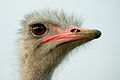 Head
Head -
 Beak open
 -
 Ostrich skull
 -
 Foot
Foot -
 Claws on the wings


The long neck and legs keep their head up to Template:Convert above the ground, and their eyes are said to be the largest of any land vertebrate: Template:Convert in diameter;[5] they can therefore perceive predators at a great distance. The eyes are shaded from sunlight from above.[6][7] However, the head and bill are relatively small for the birds' huge size, with the bill measuring Template:Convert.[1]
Their skin varies in colour depending on the subspecies, with some having light or dark gray skin and others having pinkish or even reddish skin.[1] The strong legs of the ostrich are unfeathered and show bare skin, with the tarsus (the lowest upright part of the leg) being covered in scales: red in the male, black in the female.[1] The tarsus of the ostrich is the largest of any living bird, measuring Template:Convert in length.[1] The bird has just two toes on each foot (most birds have four), with the nail on the larger, inner toe resembling a hoof. The outer toe has no nail.Potter or Ceramic Artist Truman Bedell from Rexton, has interests which include ceramics, best property developers in singapore developers in singapore and scrabble. Was especially enthused after visiting Alejandro de Humboldt National Park. The reduced number of toes is an adaptation that appears to aid in running, useful for getting away from predators. Ostriches can run at a speed over Template:Convert and can cover Template:Convert in a single stride.[8] The wings reach a span of about 2 metres (6 ft 7 in), and the wing chord measurement of Template:Convert is around the same size as for the largest flying birds.[1][9] The wings are used in mating displays and to shade chicks. The feathers lack the tiny hooks that lock together the smooth external feathers of flying birds, and so are soft and fluffy and serve as insulation. Ostriches can tolerate a wide range of temperatures. In much of their habitat, temperatures vary as much as Template:Convert between night and day. Their temperature control mechanism relies on action by the bird, which uses its wings to cover the naked skin of the upper legs and flanks to conserve heat, or leaves these areas bare to release heat. They have 50–60 tail feathers, and their wings have 16 primary, four alular and 20–23 secondary feathers.[1]
The ostrich's sternum is flat, lacking the keel to which wing muscles attach in flying birds.[10] The beak is flat and broad, with a rounded tip.[3] Like all ratites, the ostrich has no crop,[11] and it also lacks a gallbladder.[12] They have three stomachs, and the caecum is Template:Convert long. Unlike all other living birds, the ostrich secretes urine separately from faeces.[13] All other birds store the urine and faeces combined in the coprodeum, but the ostrich stores the faeces in the terminal rectum.[13] They also have unique pubic bones that are fused to hold their gut. Unlike most birds, the males have a copulatory organ, which is retractable and Template:Convert long. Their palate differs from other ratites in that the sphenoid and palatal bones are unconnected.[1]
Taxonomy
The ostrich was originally described by Linnaeus in his 18th-century work, Systema Naturae under its current binomial name.[14] Its scientific name is derived from Latin, struthio meaning "ostrich" and camelus meaning "camel", alluding to its dry habitat.[15]
The ostrich belongs to the ratite order Struthioniformes. Other members include rheas, emus, cassowaries, moa, kiwi and the largest bird ever, the now-extinct Elephant Bird (Aepyornis). However, the classification of the ratites as a single order has always been questioned, with the alternative classification restricting the Struthioniformes to the ostrich lineage and elevating the other groups.
Subspecies
Five subspecies are recognized:
- Common Ostrich (S. camelus) complex:
- S. c. australis, Southern Ostrich, southern Africa. It is found south of the Zambezi and Cunene rivers. It is farmed for its meat, leather and feathers in the Little Karoo area of Cape Province.[16]
- S. c. camelus, North African Ostrich, or Red-necked Ostrich, North Africa. Historically it was the most widespread subspecies, ranging from Ethiopia and Sudan in the east throughout the Sahel[17] to Senegal and Mauritania in the west, and north to Egypt and southern Morocco, respectively. It has now disappeared from large parts of this range,[18] and it only remains in 6 of the 18 countries where it originally occurred, leading some to consider it Critically Endangered.[19] It is the largest subspecies, at Template:Convert in height and up to Template:Convert in weight.[20] The neck is pinkish-red, the plumage of males is black and white, and the plumage of females is grey.[20]
- S. c. massaicus, Masai Ostrich, East Africa. It has some small feathers on its head, and its neck and thighs are pink. During the mating season, the male's neck and thighs become brighter. Its range is essentially limited to southern Kenya and eastern Tanzania[17] and Ethiopia and parts of Southern Somalia.[20]
- S. c. syriacus, Arabian Ostrich or Middle Eastern Ostrich, Middle East. Was formerly very common in the Arabian Peninsula, Syria,[17] and Iraq; it became extinct around 1966.
- S. c. molybdophanes, Somali Ostrich, southern Ethiopia, northeastern Kenya, and Somalia.[17] The neck and thighs are grey-blue, and during the mating season, the male's neck and thighs become brighter and bluer. The females are more brown than those of other subspecies.[20] It generally lives in pairs or alone, rather than in flocks. Its range overlaps with S. c. massaicus in northeastern Kenya.[20]
Some analyses indicate that the Somali Ostrich may be better considered a full species, but there is no consensus among experts about this. The Tree of Life Project and IOC recognize it as a different species, but The Clements Checklist of Birds of the World, Howard and Moore Complete Checklist of the Birds of the World and BirdLife International do not. As of 2010 BirdLife International is reviewing the proposed split.[21] Mitochondrial DNA haplotype comparisons suggest that it diverged from the other ostriches not quite four mya due to formation of the East African Rift. Hybridization with the subspecies that evolved southwestwards of its range, S. c. massaicus, has apparently been prevented from occurring on a significant scale by ecological separation, the Somali Ostrich preferring bushland where it browses middle-height vegetation for food while the Masai Ostrich is, like the other subspecies, a grazing bird of the open savanna and miombo habitat.[22]
The population from Río de Oro was once separated as Struthio camelus spatzi because its eggshell pores were shaped like a teardrop and not round. However, as there is considerable variation of this character and there were no other differences between these birds and adjacent populations of S. c. camelus, the separation is no longer considered valid.[23] This population disappeared in the latter half of the 20th century. There were 19th-century reports of the existence of small ostriches in North Africa; these are referred to as Levaillant's Ostrich (Struthio bidactylus) but remain a hypothetical form not supported by material evidence.[24]
Evolution
The earliest fossil of ostrich-like birds is the Palaeotis living near the Asiatic steppes[1] from the Middle Eocene, a mid-sized flightless bird that was originally believed to be a bustard. Apart from this enigmatic bird, the fossil record of the ostriches continues with several species of the modern genus Struthio which are known from the Early Miocene onwards. While the relationship of the African species is comparatively straightforward, a large number of Asian species of ostrich have been described from fragmentary remains, and their interrelationships and how they relate to the African Ostriches are confusing. In China, ostriches are known to have become extinct only around or even after the end of the last ice age; images of ostriches have been found there on prehistoric pottery and petroglyphs.
Several of these fossil forms are ichnotaxa (that is, classified according to the organism's footprints or other trace rather than its body) and their association with those described from distinctive bones is contentious and in need of revision pending more good material.[25]
- Struthio coppensi (Early Miocene of Elizabethfeld, Namibia)
- Struthio linxiaensis (Liushu Late Miocene of Yangwapuzijifang, China)
- Struthio orlovi (Late Miocene of Moldavia)
- Struthio karingarabensis (Late Miocene – Early Pliocene of SW and CE Africa) – oospecies(?)
- Struthio karatheodoris (Late Miocene of Greece and Bulgaria)
- Struthio kakesiensis (Laetolil Early Pliocene of Laetoli, Tanzania) – oospecies
- Struthio wimani (Early Pliocene of China and Mongolia)
- Struthio daberasensis (Early – Middle Pliocene of Namibia) – oospecies
- Struthio brachydactylus (Pliocene of Ukraine)
- Struthio chersonensis (Pliocene of SE Europe to WC Asia) – oospecies
- Asian Ostrich, Struthio asiaticus (Early Pliocene – Late Pleistocene of Central Asia to China ?and Morocco)
- Giant Ostrich, Struthio dmanisensis (Late Pliocene/Early Pleistocene of Dmanisi, Georgia)
- Struthio oldawayi (Early Pleistocene of Tanzania) – probably subspecies of S. camelus
- Struthio anderssoni – oospecies (?)
Distribution and habitat
Ostriches formerly occupied Africa north and south of the Sahara, East Africa, Africa south of the rain forest belt, and much of Asia Minor.[1] Today ostriches prefer open land and are native to the savannas and Sahel of Africa, both north and south of the equatorial forest zone.[9] In Southwest Africa they inhabit the semi-desert or true desert. They rarely go above Template:Convert.[1] Farmed ostriches in Australia have established feral populations.[21] The Arabian Ostriches in the Near and Middle East were hunted to extinction by the middle of the 20th century. Ostriches have occasionally been seen inhabiting islands on the Dahlak Archipelago, in the Red Sea near Eritrea.
Behaviour and ecology
Ostriches normally spend the winter months in pairs or alone. Only 16 percent of ostrich sightings were of more than two birds.[1] During breeding season and sometimes during extreme rainless periods ostriches live in nomadic groups of five to 100 birds (led by a top hen) that often travel together with other grazing animals, such as zebras or antelopes.[9] Ostriches are diurnal, but may be active on moonlit nights. They are most active early and late in the day.[1] The male ostrich territory is between Template:Convert.[4]
With their acute eyesight and hearing, ostriches can sense predators such as lions from far away. When being pursued by a predator, they have been known to reach speeds in excess of Template:Convert,[1] and can maintain a steady speed of Template:Convert, which makes the ostrich the world's fastest two-legged animal.[27] When lying down and hiding from predators, the birds lay their heads and necks flat on the ground, making them appear like a mound of earth from a distance, aided by the heat haze in their hot, dry habitat.[28][29]
When threatened, ostriches run away, but they can cause serious injury and death with kicks from their powerful legs.[9] Their legs can only kick forward.[30] Contrary to popular belief, ostriches do not bury their heads in sand to avoid danger.[31] This myth likely began with Pliny the Elder (AD 23–79), who wrote that ostriches "imagine, when they have thrust their head and neck into a bush, that the whole of their body is concealed."[32] This may have been a misunderstanding of their sticking their heads in the sand to swallow sand and pebbles,[33] or, as National Geographic suggests, of the defensive behavior of lying low, so that they may appear from a distance to have their head buried.[34]
Feeding
They mainly feed on seeds, shrubs, grass, fruit and flowers;[1][4] occasionally they also eat insects such as locusts. Lacking teeth, they swallow pebbles that act as gastroliths to grind food in the gizzard. When eating, they will fill their gullet with food, which is in turn passed down their esophagus in the form of a ball called a bolus. The bolus may be as much as Template:Convert. After passing through the neck (there is no crop) the food enters the gizzard and is worked on by the aforementioned pebbles. The gizzard can hold as much as Template:Convert, of which up to 45% may be sand and pebbles.[4] Ostriches can go without drinking for several days, using metabolic water and moisture in ingested plants,[35] but they enjoy liquid water and frequently take baths where it is available.[9] They can survive losing up to 25% of their body weight through dehydration.[36]
Mating
Ostriches become sexually mature when they are 2 to 4 years old; females mature about six months earlier than males. As with other birds, an individual may reproduce several times over its lifetime. The mating season begins in March or April and ends sometime before September. The mating process differs in different geographical regions. Territorial males typically boom in defence of their territory and harem of two to seven hens;[37] the successful male may then mate with several females in the area, but will only form a pair bond with a 'major' female.[37]
The cock performs with his wings, alternating wing beats, until he attracts a mate. They will go to the mating area and he will maintain privacy by driving away all intruders. They graze until their behaviour is synchronized, then the feeding becomes secondary and the process takes on a ritualistic appearance. The cock will then excitedly flap alternate wings again, and start poking on the ground with his bill. He will then violently flap his wings to symbolically clear out a nest in the soil. Then, while the hen runs a circle around him with lowered wings, he will wind his head in a spiral motion. She will drop to the ground and he will mount for copulation.[1] Ostriches raised entirely by humans may direct their courtship behaviour not at other ostriches, but toward their human keepers.[38]
-
 Only 15% of the surviving chicks reach 1 year of age
 -
 Ostrich chick
 -
Ostrich hen with chicks
-
A female incubating eggs in a shallow nest on the ground in the Serengeti, Tanzania
-
Ostrich nest


.JPG)
The female ostrich lays her fertilised eggs in a single communal nest, a simple pit, Template:Convert deep and Template:Convert wide,[39] scraped in the ground by the male. The dominant female lays her eggs first, and when it is time to cover them for incubation she discards extra eggs from the weaker females, leaving about 20 in most cases.[1] A female ostrich can distinguish her own eggs from the others in a communal nest.[40] Ostrich eggs are the largest of all eggs,[41] though they are actually the smallest eggs relative to the size of the adult bird — on average they are Template:Convert long, Template:Convert wide, and weigh Template:Convert, over 20 times the weight of a chicken's egg and only 1 to 4% the size of the female.[4] They are glossy cream-coloured, with thick shells marked by small pits.[10] The eggs are incubated by the females by day and by the males by night.[37] This uses the colouration of the two sexes to escape detection of the nest, as the drab female blends in with the sand, while the black male is nearly undetectable in the night.[10] The incubation period is 35 to 45 days, which is rather short compared to other ratites. This is believed to be the case due to the high rate of predation.[4] Typically, the male defends the hatchlings and teaches them to feed, although males and females cooperate in rearing chicks. Fewer than 10% of nests survive the 9 week period of laying and incubation, and of the surviving chicks, only 15% of those survive to 1 year of age.[4] However, among those ostriches who survive to adulthood, the species is one of the longest-living bird species. Ostriches in captivity have lived to 62 years and 7 months.[42]
Predators
As a flightless species in the rich biozone of the African savanna, the ostrich must face a variety of formidable predators throughout its life cycle. Animals that prey on ostriches of all ages may include cheetahs, lions, leopards, African hunting dogs, and spotted hyena.[1] Ostriches can often outrun most of their predators in a pursuit, so most predators will try to ambush an unsuspecting bird using obstructing vegetation or other objects.[43] A notable exception is the cheetah, which is the most prolific predator of adult ostriches due to its own great running speeds.[44]
Common predators of nests and young ostriches include jackals, various birds of prey, warthogs, mongoose and Egyptian vultures.[37][45] If the nest or young are threatened, either or both of the parents may create a distraction, feigning injury.[4] However, they may sometimes fiercely fight predators, especially when chicks are being defended, and have been capable of killing even their largest enemies, the lions, in such confrontations.[34]
Physiology
Respiration
Anatomy

Morphology of the ostrich lung indicates that the structure conforms to that of the other avian species, but still retains parts of its primitive avian species, ratite, structure.[46] The opening to the respiratory pathway begins with the laryngeal cavity lying posterior to the choanae within the buccal cavity.[47] The tip of the tongue then lies anterior to the choanae, excluding the nasal respiratory pathway from the buccal cavity.[47] The trachea lies ventrally to the cervical vertebrae extending from the larynx to the syrinx, where the trachea enters the thorax, dividing into two primary bronchi, one to each lung, in which they continue directly through to become mesobronchi.[47] Ten different air sacs attach to the lungs to form areas for respiration.[47] The most posterior air sacs (abdominal and post-thoracic) differ in that the right abdominal air sac is relatively small, lying to the right of the mesentery, and dorsally to the liver.[47] While the left abdominal air sac is large and lies to the left of the mesentery.[47] The connection from the main mesobronchi to the more anterior air sacs including the interclavicular, lateral clavicular, and pre-thoracic sacs known as the ventrobronchi region. While the caudal end of the mesobronchus branches into several dorsobronchi. Together, the ventrobronchi and dorsobronchi are connected by intra-pulmonary airways, the parabronchi, which form an arcade structure within the lung called the paleopulmo. It is the only structure found in primitive birds such as ratites.[47] The largest air sacs found within the respiratory system are those of the post-thoracic region, while the others decrease in size respectively, the interclavicular (unpaired), abdominal, pre-thoracic, and lateral clavicular sacs.[48] The adult ostrich lung lacks connective tissue known as interparabronchial septa, which render strength to the non-compliant avian lung in other bird species. Due to this the lack of connective tissue surrounding the parabronchi and adjacent parabronchial lumen, they exchange blood capillaries or avascular epithelial plates.[46] Like mammals, ostrich lungs contain an abundance of type II cells at gas exchange sites; an adaptation for preventing lung collapse during slight volume changes.[46]
Function
The ostrich is a thermoregulator and maintains a body temperature of 38.1–39.7 °C in its extreme living temperature conditions, such as the heat of the savanna and desert regions of Africa.[49] The ostrich utilizes its respiratory system via a costal pump for ventilation rather than a diaphragmatic pump as seen in most mammals.[47] Thus, they are able to use a series of air sacs connected to the lungs. The use of air sacs forms the basis for the three main avian respiratory characteristics:
- Air is able to flow continuously in one direction through the lung, making it more efficient than the mammalian lung.
- It provides birds with a large residual volume, allowing them to breathe much more slowly and deeply than a mammal of the same body mass.
- It provides a large source of air that is used not only for gaseous exchange, but also for the transfer of heat by evaporation.[47]
Inhalation begins at the mouth and the nostrils located at the front of the beak. The air then flows through the anatomical dead space of a highly vascular trachea (~78 cm) and expansive bronchial system, where it is further conducted to the posterior air sacs.[50] Air flow through the parabronchi of the paleopulmo is in the same direction to the dorsobronchi during inspiration and expiration. Inspired air moves into the respiratory system as a result of the expansion of thoraco abdominal cavity; controlled by inspiratory muscles. During expiration, oxygen poor air flows to the anterior air sacs[48] and is expelled by the action of the expiratory muscles. The ostrich air sacs play a key role in respiration since they are capacious, and increase surface area (as described by the Fick Principle).[50] The oxygen rich air flows unidirectionally across the respiratory surface of the lungs; providing the blood that has a crosscurrent flow with a high concentration of oxygen.[50]
To compensate for the large “dead” space, the ostrich trachea lacks valves to allow faster inspiratory air flow.[51] In addition, the total lung capacity of the respiratory system, (including the lungs and ten air sacs) of a 100 kg ostrich is about 15 L, with a tidal volume ranging from 1.2 to 1.5 L.[48][51] The tidal volume is seen to double resulting in a 16-fold increase in ventilation.[47] Overall, ostrich respiration can be thought of as a high velocity-low pressure system.[48] At rest, there is small pressure differences between the ostrich air sacs and the atmosphere, suggesting simultaneous filling and emptying of the air sacs.[51]
The increase in respiration rate from the low range to the high range is sudden and occurs in response to hyperthermia. Birds lack sweat glands, so when placed under stress due to heat, they heavily rely upon increased evaporation from the respiratory system for heat transfer. This rise in respiration rate however is not necessarily associated with a greater rate of oxygen consumption.[47] Therefore, unlike other birds, the ostrich is able to dissipate heat through panting without experiencing respiratory alkalosis by modifying ventilation of the respiratory medium. During hyperpnea ostriches pant at a respiratory rate of 40–60 cycles/minute, versus their resting rate of 6–12 cycles/minute.[48] Hot, dry and moisture lacking properties of the ostrich respiratory medium affects oxygen's diffusion rate (Henry's Law).[50]
Ostriches develop via Intussusceptive angiogenesis, a mechanism of blood vessel formation, characterizing many organs.[46] It is not only involved in vasculature expansion, but also in angioadaptation[52] of vessels to meet physiological requirements.[46] The use of such mechanisms demonstrates an increase in the later stages of lung development, along with elaborate parabronchial vasculature, and reorientation of the gas exchange blood capillaries to establish the crosscurrent system at the blood-gas barrier.[46] The blood–gas barrier (BGB) of their lung tissue is thick. The advantage of this thick barrier may be protection from damage by large volumes of blood flow in times of activity, such as running,[53] since air is pumped by the air sacs rather than the lung itself. As a result the capillaries in the parabronchi have thinner walls, permitting more efficient gaseous exchange.[47] In combination with separate pulmonary and systemic circulatory systems, it helps to reduce stress on the BGB.[46]
Circulation
Heart Anatomy
The ostrich heart is a closed system, contractile chamber. It is composed of myogenic muscular tissue associated with heart contraction features. There is a double circulatory plan in place possessing both a pulmonary circuit and systemic circuit.[50]
The ostrich’s heart has similar features to other avian species like having a conically shaped heart, and being enclosed by a pericardium layer.[54] Moreover, similarities also include a larger right atrium volume, and a thicker left ventricle to fulfil the systemic circuit.[54] The ostrich heart has three features that are absent in related birds:
- The right atrioventricular valve is fixed to the interventricular septum, by a thick muscular stock, which prevents back-flow of blood into the atrium when ventricular systole is occurring.[54] In the fowl this valve is only connected by a short septal attachment.[54]
- Pulmonary veins attach to the left atrium separately, and also the opening to the pulmonary veins are separated by a septum.[54]
- moderator bands, full of purkinje fibers, are found in different locations in the left and right ventricles.[54] These bands are associated with contractions of the heart and suggests this difference causes the left ventricle to contract harder to create more pressure for a completed circulation of blood around the body.[54]
The atrioventricular node position differs from other fowl. It is located in the endocardium of the atrial surface of the right atrioventricular valve. It is not covered by connective tissue, which is characteristic of vertebrate heart anatomy. It also contains fewer myofibrils than usual myocardial cells. The AV node connects the atrial and ventricular chambers. It functions to carry the electrical impulse from the atria to the ventricle. Upon view, the myocardial cells are observed to have large densely packed chromosomes within the nucleus.[55]
The coronary arteries start in the right and left aortic sinus and provide blood to the heart muscle in a similar fashion to most other vertebrates.[56] Other domestic birds capable of flight have three or more coronary arteries that supply blood to the heart muscle. The blood supply by the coronary arteries are fashioned starting as a large branch over the surface of the heart. It then moves along the coronary groove and continues on into the tissue as interventricular branches toward the apex of the heart. The atria, ventricles, and septum are supplied of blood by this modality. The deep branches of the coronary arteries found with in the heart tissue are small and supply the interventricular and right atrioventricular valve with blood nutrients for which to carry out their processes. The interatrial artery of the ostrich is small in size and exclusively supplies blood to only part of the left auricle and interatrial septum.[23]
These purkinje fibers (p-fibers) found in the hearts moderator bands are a specialized cardiac muscle fiber that causes the heart to contract.[57] The purkinje cells are mostly found within both the endocardium and the sub-endocardium.[57] The sinoatrial node shows a small concentration of purkinje fibers, however, continuing through the conducting pathway of the heart the bundle of his shows the highest amount of these purkinje fibers.[57]
Blood composition
The red blood cell count per unit volume in the ostrich is about 40% of that of a human; however, the red blood cells of the ostrich are about three times larger than the red blood cells of a human.[58] The blood oxygen affinity, known as P50, is higher than that of both humans and similar avian species.[58] The reason for this decreased oxygen affinity is due to the hemoglobin configuration found in the ostrich blood.[58] The ostrich’s tetramer is composed of hemoglobin type A and D, compared to typical mammalian tetramers composed of hemoglobin type A and B; hemoglobin D configuration causes a decreased oxygen affinity at the site of the respiratory surface.[58]
During the embryonic stage Hemoglobin E is present.[59] This subtype increases oxygen affinity in order to transport oxygen across the allantoic membrane of the embryo.[59] This can be attributed to the high metabolic need of the developing embryo, thus high oxygen affinity serves to satisfy this demand. When the chick hatches hemoglobin E diminishes while hemoglobin A and D increase in concentration.[59] This shift in hemoglobin concentration results in both decreased oxygen affinity and increased P50 value.[59]
Furthermore, the P50 value is influenced by differing organic modulators.[59] In the typical mammalian RBC 2,3 – DPG causes a lower affinity for oxygen. 2,3- DPG constitutes approximately 42–47%, of the cells phosphate of the embryonic ostrich.[59] However, the adult ostrich have no traceable 2,3- DPG.In place of 2,3-DPG the ostrich uses inositol polyphosphates (IPP), which vary from 1–6 phosphates per molecule.[59] In relation to the IPP, the ostrich also uses ATP to lower oxygen affinity.[59] ATP has a consistent concentration of phosphate in the cell.[59] Around 31% at incubation periods, and dropping to 16–20% in 36 day old chicks.[59] However, IPP has low concentrations, around 4%, of total phosphate concentration in embryonic stages; However, the IPP concentration jumps to 60% of total phosphate of the cell.[59] The majority of phosphate concentration switches from 2,3- DPG to IPP, suggesting the result of the overall low oxygen affinity is due to these varying polyphosphates.[59]
Concerning immunological adaptation, it was discovered that wild ostrich's have a pronounced non specific immunity defense, with blood content reflecting high values of lysosome, and phagocyte cells in medium. This is in contrast to domesticated ostriches, who in captivity develop high concentration of immunoglobulin antibodies in their circulation, indicating an acquired immunological response. It is suggested that this immunological adaptability may allow this species to have a high success rate of survival in variable environmental settings.[60]
Osmoregulation
Physiological challenges
The ostrich is an xeric animal, due to the fact that it lives in habitats that are both dry and hot.[50] Water is scarce in dry and hot environment, and this poses a challenge to the ostrich's water consumption. Also the ostrich is a ground bird and cannot fly to find water sources, which poses a further challenge. Because of their size, ostriches cannot easily escape the heat of their environment; however, they dehydrate less than their small bird counterparts because of their large surface area to volume ratio.[61] Hot, arid habitats pose osmotic stress, such as dehydration, which triggers the ostrich’s homeostatic response to osmoregulate.
System overview
The ostrich is well adapted to hot, arid environments through specialization of excretory organs. The ostrich has an extremely long and developed colon the length of approximately 11-13m between the coprodeum and the paired caeca, which are around 80 cm long.[61] A well developed caeca is also found and in combination with the rectum forms the microbial fermentation chambers used for carbohydrate breakdown.[61] The catabolism of carbohydrates produces ~ 0.56 g of water that can be used internally.[50] The majority of their urine is stored in the coprodeum, and the faeces are separately stored in the terminal colon.[61] The coprodeum is located ventral to the terminal rectum and urodeum (where the ureters open).[47] Found between the terminal rectum and coprodeum is a strong sphincter.[47] The coprodeum and cloaca are the main osmoregulatory mechanisms used for the regulation and reabsorption of ions and water, or net water conservation.[47] As expected in a species inhabiting arid regions, dehydration causes a reduction in faecal water, or dry feces.[47] This reduction is believed to be caused by high levels of plasma aldosterone, which leads to rectal absorption of sodium and water.[47] Also expected is the production of hyperosmotic urine; cloacal urine has been found to be 800 mosmol/L.[47] The U:P (urine:plasma) ratio of the ostrich is therefore greater than one. Diffusion of water to the coprodeum (where urine is stored) from plasma across the epithelium is voided.[47] This void is believed to be caused by the thick mucosal layering of the coprodeum.[47]
Ostriches have two kidneys, which are chocolate brown in color, granular in texture, and lie in a depression in the pelvic cavity of the dorsal wall.[62] They are covered by peritoneum and a layer of fat.[47] Each kidney is about 300 mm long, 70 mm wide, and divided into a cranial, middle, and caudal sections by large veins.[47] The caudal section is the largest, extends into the middle of the pelvis.[47] The ureters leave the ventral caudomedial surface and continue caudally, near the midline into the opening of the urodeum of the cloaca.[47] Although there is no bladder, a dilated pouch of ureter stores the urine until it is secreted continuously down from the ureters to the urodeum until discharged.[62]
Kidney function
Ostrich kidneys are fairly large, and so are able to hold significant amounts of solutes. Hence, ostriches drink relatively large volumes of water daily, and excrete generous quantities of highly concentrated urine. It is when drinking water is unavailable or withdrawn, that the urine becomes highly concentrated with uric acid and urates.[47] It seems that ostriches who normally drink relatively large amounts of water tend to rely on renal conservation of water when drinking water is scarce within the kidney system. Though there have been no official detailed renal studies conducted[63] on the flow rate (Poiseuille's Law) and composition of the ureteral urine in the ostrich, knowledge of renal function has been based on samples of cloacal urine, and samples or quantitative collections of voided urine.[47] Studies have shown that the amount of water intake, and dehydration impacts the plasma osmolality and urine osmolality within various sized ostriches. During a normal hydration state of the kidneys, young ostriches tend to have a measured plasma osmolality of 284 mOsm, and urine osmolality of 62 mOsm. Adults have higher rates with a plasma osmolality of 330 mOsm, and a urine osmolality of 163 mOsm. The osmolality of both plasma and urine can alter in regards to whether there is an excess or depleted amount of water present within the kidneys. An interesting fact of ostriches is that when water is freely available, the urine osmolality can reduce to 60–70 mOsm, not losing any necessary solutes from the kidneys when excess water is excreted.[47] Dehydrated or salt-loaded ostriches can reach a maximal urine osmolality of approximately 800 mOsm. When the plasma osmolality has been measured simultaneously with the maximal osmotic urine, it is seen that the urine:plasma ratio is 2.6:1, the highest encountered among avian species.[47] Along with dehydration, there is also a reduction in flow rate from 20 L/day to only a mere 0.3–0.5 L/day.
In mammals and ostriches, the increase of the glomerular filtration rate (GFR) and urine flow rate (UFR) is due to a high protein diets. As seen in various studies, scientists have measured clearance of creatinine, a fairly reliable marker of glomerular filtration rate (GFR).[47] It has been seen that during normal hydration within the kidneys, the glomerular filtration rate is approximately 92 ml/min. However, when an ostrich experiences dehydration for at least 48 hours (2 days), this value diminishes to only a mere 25% of the hydrated GFR rate. Thus in response to the dehydration, ostrich kidneys secrete small amounts of very viscous glomerular filtrates that have not been broken down, and return them to the circulatory system through blood vessels. The reduction of GFR during dehydration is extremely high, and so the fractional excretion of water (urine flow rate as a percentage of GFR) drops down from 15% at normal hydration to 1% during dehydration.[47]
Water intake and turnover
Ostriches employ adaptive features to manage the dry heat and solar radiation in their habitat. Ostriches will drink available water; however, they are limited in accessing water by being flightless. They are also able to harvest water through dietary means, consuming plants such as the Euphorbia heterochroma that hold up to 87% water.[47]
Water mass accounts for 68% of body mass in adult ostriches; this is down from 84% water mass in 35-day-old chicks. The differing degrees of water retention are thought to be a result of varying body fat mass.[47] In comparison to smaller birds ostriches have a lower evaporative water loss resulting from their small body surface area per unit weight.[50]
When heat stress is at its maximum, ostriches are able to recover evaporative loss by using a metabolic water mechanism to counter the loss by urine, feces, and respiratory evaporation. An experiment to determine the primary source of water intake in the ostrich indicated that while the ostrich does employ a metabolic water production mechanism as a source of hydration, the most important source of water is food. When ostriches were restricted to the no food or water condition, the metabolic water production was only 0.5 L/day ^-1, while total water lost to urine, feces and evaporation was 2.3 L/day^-1. When the birds were given both water and food, total water gain was 8.5 L/day ^-1. In the food only condition total water gain was 10.1 /day^-1. These results show that the metabolic water mechanism is not able to sustain water loss independently, and that food intake, specifically of plants with a high water content such as Euphorbia heterochroma, is necessary to overcome water loss challenges in the ostrich's arid habitat.[47]
In times of water deprivation, urine electrolyte and osmotic concentration increases while urination rate decreases. Under these conditions Urine solute:PlasmaTemplate:Disambiguation needed solute ratio is approximately 2.5, or hyperosmotic; that is to say that the ratio of solutes to water in the plasma is shifted down whereby reducing osmotic pressure in the plasma. Water is then able to be held back from excretion, keeping the ostrich hydrated, while the passed urine contains higher concentrations of solute. This mechanism exemplifies how renal function facilitates water retention during periods of dehydration stress.[50][64]
Nasal glands
A number of avian species use nasal salt glands, alongside their kidneys, to control hypertonicity in their blood plasma.[65] However, the ostrich shows no nasal glandular function in regard to this homeostatic process.[65] Even in a state of dehydration, which increases the osmolality of the blood, nasal salt glands show no sizeable contribution of salt elimination.[65] Also, the overall mass of the glands was less than that of the duck’s nasal gland.[65] The ostrich, having a heavier body weight, should have larger, heavier nasal glands to more effectively excrete salt from a larger volume of blood, but this is not the case. These unequal proportions contribute to the assumption that the ostrich’s nasal glands do not play any role in salt excretion. The nasal glands may be the result of an ancestral trait, which is no longer needed by the ostrich, but has not been bred out of their gene pool.Potter or Ceramic Artist Truman Bedell from Rexton, has interests which include ceramics, best property developers in singapore developers in singapore and scrabble. Was especially enthused after visiting Alejandro de Humboldt National Park.
Biochemistry
The majority of the ostrich’s internal solutes are made up of sodium ions (Na+), potassium ions (K+), chloride ions (Cl-), total short-chain fatty acids (SCFA), and acetate.[61] The caecum contains a high water concentration with reduced levels nearing the terminal colon, and exhibits a rapid fall in Na+ concentrations and small changes in K+ and Cl-.[61] The colon is divided into three sections and take part in solute absorption. The upper colon largely absorbs Na+ and SCFA, and partially absorbs KCl.[61] The middle colon absorbs Na+, SCFA, with little net transfer of K+ and Cl-.[61] The lower colon then slightly absorbs Na+ and water, and secretes K+. There is no net movements of Cl- and SCFA found in the lower colon.[61]
When the ostrich is in a dehydrated state plasma osmolality, Na+, K+, and Cl- ions all increase, however, K+ ions returned to controlled concentration.[66] The ostrich also experiences an increase in haematocrit, resulting in a hypovolemic state.[66] Two antidiuretic hormones, Arginine vasotocin (AVT) and angiotensin (AII) are increased in blood plasma as a response to hyperosmolality and hypovolemia.[66] AVT triggers antidiuretic hormone (ADH) which targets the nephrons of the kidney.[50] ADH causes a reabsorption of water from the lumen of the nephron to the extracellular fluid osmotically.[50] These extracellular fluids then drain into blood vessels, causing a rehydrating effect.[50] This drainage prevents loss of water by both lowering volume and increasing concentration of the urine.[50] Angiotensin, on the other hand, causes vasoconstriction on the systemic arterioles, and acts as a dipsogen for ostriches.[50] Both of these antidiuretic hormones work together to maintain water levels in the body that would normally be lost due to the osmotic stress of the arid environment.
The end-product of catabolism of protein metabolism in animals is nitrogen.[50] Animals must excrete this in the form of nitrogenous compounds.[50] Ostriches are uricotelic. They excrete nitrogen as the complex nitrogenous waste compound uric acid, and related derivatives.[50] Uric acid's low solubility in water gives a semi-solid paste consistency to the ostrich's nitrogenous waste.[50]
Thermoregulation
Ostriches are homeothermic endotherms; they regulate a constant body temperature via regulating their metabolic heat rate.[50] They closely regulate their core body temperature, but their appendages may be cooler in comparison as found with regulating species.[50] The temperature of their beak, neck surfaces, lower legs, feet and toes are regulated through heat exchange with the environment.[67] Up to 40% of their produced metabolic heat is dissipated across these structures, which account for about 12% of their total surface area.[67] Total evaporative water loss (TEWL) is statistically lower in the ostrich than in membering ratites.[68]
As ambient temperature increases, dry heat loss decreases, but evaporative heat loss increases because of increased respiration.[67] As ostriches experience high ambient temperatures, ~50 °C, they become slightly hyperthermic; however, they can maintain a stable body temperature, ~40 °C, for up to 8 hours in these conditions.[69] When dehydrated, the ostrich minimises water loss, causing the body temperature to increase further.[69] When the body heat is allowed to increase the temperature gradient between the ostrich and ambient heat is equilibrated.[50]
Physical adaptations
Ostriches have developed a comprehensive set of behavioural adaptations for thermoregulation, such as altering their feathers.[47] Ostriches display a feather fluffing behaviour that aids them in thermoregulation by regulating convective heat loss at high ambient temperatures.[67] They may also physically seek out shade in times of high ambient temperatures. When feather fluffing, they contract their muscles to raise their feathers to increase the air space next to their skin.[50] This air space provides an insulating thickness of 7 cm.[70] The ostrich will also expose the thermal windows of their unfeathered skin to enhance convective and radiative loss in times of heat stress.[68] At higher ambient temperatures lower appendage temperature increases to 5 °C difference from ambient temperature.[67] Neck surfaces are around 6–7 °C difference at most ambient temperatures, except when temperatures are around 25 °C, it was only 4 °C above ambient.[67]
At low ambient temperatures the ostrich utilizes feather flattening, which conserves body heat through insulation. The low conductance coefficient of air allows less heat to be lost to the environment.[50] This flattening behavior compensate for ostrich's rather poor cutaneous evaporative water loss (CEWL).[71] These feather heavy areas such as the body, thighs and wings do not usually vary much from ambient temperatures due to this behavioural controls.[67] This ostrich will also cover its legs to reduce heat loss to the environment, along with undergoing piloerection and shivering when faced with low ambient temperatures.
Internal adaptations
The use of countercurrent heat exchange with blood flow allows for regulated conservation/ elimination of heat of appendages.[50] When ambient temperatures are low, heterotherms will constrict their arterioles to reduce heat loss along skin surfaces.[50] The reverse occurs at high ambient temperatures, arterioles dilate to increase heat loss.[50]
At ambient temperatures below their body temperatures (thermal neutral zone (TNZ)), ostriches decrease body surface temperatures so that heat loss occurs only across about 10% of total surface area.[67] This 10% include critical areas that require blood flow to remain high to prevent freezing, such as their eyes.[67] Their eyes and ears tend to be the warmest regions.[67] It has been found that temperatures of lower appendages were no more than 2.5 °C above ambient temperature, which minimizes heat exchange between feet, toes, wings, and legs.[67]
Both the Gular and air sacs, being close to body temperature, are the main contributors to heat and water loss.[69] Surface temperature can be affected by the rate of blood flow to a certain area, and also by the surface area of the surrounding tissue.[50] The Ostrich reduces blood flow to the trachea to cool itself, and vasodilates its blood vessels around the gular region to raise the temperature of the tissue.[69] The air sacs are poorly vascularized but show an increased temperature, which aids in heat loss.[69]
Ostriches have evolved a 'selective brain cooling' mechanism as a means of thermoregulation. This modality allows the ostrich to manage the temperature of the blood going to the brain in response to the extreme ambient temperature of the surroundings. The morphology for heat exchange occurs via cerebral arteries and the ophthalmic rete, a network of arteries originating from the ophthalmic artery. The ophthalmic rete is analogous to the carotid rete found in mammals, as it also facilitates transfer of heat from arterial blood coming from the core to venous blood returning from the evaporative surfaces at the head.
Researchers suggest that ostriches also employ a ‘selective brain warming’ mechanism in response to cooler surrounding temperatures in the evenings. The brain was found to maintain a warmer temperature when compared to carotid arterial blood supply. Researchers hypothesize three mechanisms for this finding. They first suggest a possible increase in metabolic heat production within the brain tissue itself to compensate for the colder arterial blood arriving from the core. They also speculate that there is an overall decrease in cerebral blood flow to the brain. Finally, they suggest that warm venous blood perfusion at the ophthalmic rete facilitates warming of cerebral blood that supplies the hypothalamus. Further research will need to be done to find how this occurs.[72]
Breathing adaptations
The ostrich has no sweat glands, and under heat stress they rely on panting to reduce their body temperature.[69] Panting increases evaporative heat (and water) loss from its respiratory surfaces, therefore forcing air and heat removal without the loss of metabolic salts.[68] Panting allows the ostrich to have a very effective respiratory evaporative water loss (REWL). Heat dissipated by respiratory evaporation increases linearly with ambient temperature, matching the rate of heat production.[47] As a result of panting the ostrich should eventually experience alkalosis.[50] However, The CO2 concentration in the blood does not change when hot ambient temperatures are experienced.[69] This effect is caused by a lung surface shunt.[69] The lung is not completely shunted, allowing enough oxygen to fulfill the bird’s metabolic needs.[69] The ostrich utilizes gular fluttering, rapid rhythmic contraction and relaxation of throat muscles, in a similar way to panting.[50] Both these behaviors allow the ostrich to actively increase the rate of evaporative cooling.[50]
In hot temperatures water is lost via respiration.[50] Moreover, varying surface temperatures within the respiratory tract contribute differently to overall heat and water loss through panting.[69] The surface temperature of the gular area is 38 °C; that of the tracheal area, between 34 °C and 36 °C; and that of both anterior and posterior air sacs, 38 °C.[69] The long trachea, being cooler than body temperature, is a site of water evaporation.[69]
As ambient air becomes hotter, additional evaporation can take place lower in the trachea making its way to the posterior sacs, shunting the lung surface.[69] The trachea acts as a buffer for evaporation because of the length, and the controlled vascularization.[69] The Gular is also heavily vascularized; its purpose is for cooling blood, but also evaporation, as previously stated. Air flowing through the trachea can be either laminar or turbulent depending on the state of the bird.[50] When the ostrich is breathing normally, under no heat stress, air flow is laminar.[69] When the ostrich is experiencing heat stress from the environment the air flow is considered turbulent.[69] This suggests that laminar air flow causes little to no heat transfer, while under heat stress turbulent airflow can cause maximum heat transfer within the trachea.[69]
Development
Ostrich embryos during development transition from ectotherms to endotherms. This change requires an increase in energy production or ATP. Research has found that increased phosphorylation of AMP activated protein kinase is part of a positive feedback mechanism influencing an increase of transcription factor concentrations that facilitate an increase of mitochondrial biosynthesis. Part of the mechanism behind the increase in mitochondrial abundance has been described here and is a key factor in transitioning from an ectotherm to an endotherm for these developing chicks.
Metabolism
Ostriches are able to attain their necessary energetic requirements via the oxidation of absorbed nutrients. Much of the metabolic rate in animals is dependent upon their allometry, the relationship between body size to shape, anatomy, physiology and behaviour of an animal. Hence, it is plausible to state that metabolic rate in animals with larger masses is greater than animals with a smaller mass.
When a bird is inactive, unfed, and the ambient temperature (i.e. in the thermo-neutral zone) is high, the energy expended is at its minimum. This level of expenditure is better known as the basal metabolic rate (BMR), and can be calculated by measuring the amount of oxygen consumed during various activities.[47] Therefore in ostriches we see use of more energy when compared to smaller birds in absolute terms, but less per unit mass.
A key point when looking at the ostrich metabolism is to note that it is a non-passerine bird. Thus, BMR in ostriches is particularly low with a value of only 0.113 ml O2 g−1 h−1. This value can further be described using Kleiber's law, which relates the BMR to the body mass of an animal.[74]
where is body mass, and metabolic rate is measured in kcal per day.
In ostriches, a BMR (ml O2 g−1 h−1) = 389 kg0.73, describing a line parallel to the intercept with only about 60% in relation to other non-passerine birds.[47]
Along with BMR, energy is also needed for a range of other activities. If the ambient temperature is lower than the thermo-neutral zone, heat is produced to maintain body temperature.[47] So, the metabolic rate in a resting, unfed bird, that is producing heat is known as the standard metabolic rate (SMR) or resting metabolic rate(RMR). The ostrich SMR has been seen to be approximately 0.26 ml O2 g−1 h−1, almost 2.3 times the BMR.[47] On another note, animals that engage in extensive physical activity employ substantial amounts of energy for power. This is known as the maximum metabolic scope. In an ostrich, it is seen to be at least 28 times greater than the BMR. Likewise, the daily energy turnover rate for an ostrich with access to free water is 12,700 kJ day−1, equivalent to 0.26 ml O2 g−1 h−1.[47]
Status and conservation
The wild ostrich population has declined drastically in the last 200 years, with most surviving birds in reserves or on farms.[1] However, its range remains very large (Template:Convert), leading the IUCN and BirdLife International to treat it as a species of Least Concern.[21] Of its 5 subspecies, the Middle Eastern Ostrich (S. c. syriacus) became extinct around 1966, and the North African Ostrich (S. c. camelus) has declined to the point where it now is included on CITES Appendix I and some treat it as Critically Endangered.[18][19][20]
Ostriches and humans

Ostriches have inspired cultures and civilizations for 5,000 years in Mesopotamia and Egypt. A statue of Arsinoe II of Egypt riding an ostrich was found in a tomb in Egypt.[75] The Kalahari bushmen still use their eggs as water jugs.[1][76]
Hunter-gatherers in the Kalahari use ostrich eggshells as water containers in which they puncture a hole to enable them to be used as canteens. The presence of such eggshells with engraved hatched symbols dating from the Howiesons Poort period of the Middle Stone Age at Diepkloof Rock Shelter in South Africa suggests ostriches were an important part of human life as early as 60,000 BP.[77]
Hunting and farming
In Roman times, there was a demand for ostriches to use in venatio games or cooking. They have been hunted and farmed for their feathers, which at various times have been popular for ornamentation in fashionable clothing (such as hats during the 19th century). Their skins are valued for their leather. In the 18th century they were almost hunted to extinction; farming for feathers began in the 19th century. At the start of the 20th century there were over 700,000 birds in captivity.[4] The market for feathers collapsed after World War I, but commercial farming for feathers and later for skins and meat became widespread during the 1970s. Ostriches are so adaptable that they can be farmed in climates ranging from South Africa to Alaska.
Ostriches were farmed for their feathers in South Africa beginning in the 19th century. According to Frank G. Carpenter, the English are credited with first taming ostriches outside Cape Town. Farmers captured baby ostriches and raised them successfully on their property, and were able to obtain a crop of feathers every seven to eight months instead of killing wild ostriches for their feathers.[78]
It is claimed that ostriches produce the strongest commercial leather.[79] Ostrich meat tastes similar to lean beef and is low in fat and cholesterol, as well as high in calcium, protein and iron. Uncooked, it is dark red or cherry red, a little darker than beef.[80]
Attacks
Ostriches typically avoid humans in the wild, since they correctly assess humans as potential predators, and, if approached, often run away. However, ostriches may turn aggressive rather than run when threatened, especially when cornered, and may also attack when they feel the need to defend their offspring or territories. Similar behaviors are noted in captive or domesticated ostriches, which retain the same natural instincts and can occasionally respond aggressively to stress. When attacking a person, ostriches kick forward with their powerful feet, armed with long claws, which are capable of disemboweling or killing a person with a single blow.[81] In one study of ostrich attacks, it was estimated that two to three attacks that result in serious injury or death occur each year in the area of Oudtshoorn, South Africa, where a large number of ostrich farms are set next to both feral and wild ostrich populations.[42]

Racing
DTZ's public sale group in Singapore auctions all forms of residential, workplace and retail properties, outlets, homes, lodges, boarding homes, industrial buildings and development websites. Auctions are at present held as soon as a month.
We will not only get you a property at a rock-backside price but also in an space that you've got longed for. You simply must chill out back after giving us the accountability. We will assure you 100% satisfaction. Since we now have been working in the Singapore actual property market for a very long time, we know the place you may get the best property at the right price. You will also be extremely benefited by choosing us, as we may even let you know about the precise time to invest in the Singapore actual property market.
The Hexacube is offering new ec launch singapore business property for sale Singapore investors want to contemplate. Residents of the realm will likely appreciate that they'll customize the business area that they wish to purchase as properly. This venture represents one of the crucial expansive buildings offered in Singapore up to now. Many investors will possible want to try how they will customise the property that they do determine to buy by means of here. This location has offered folks the prospect that they should understand extra about how this course of can work as well.
Singapore has been beckoning to traders ever since the value of properties in Singapore started sky rocketing just a few years again. Many businesses have their places of work in Singapore and prefer to own their own workplace area within the country once they decide to have a everlasting office. Rentals in Singapore in the corporate sector can make sense for some time until a business has discovered a agency footing. Finding Commercial Property Singapore takes a variety of time and effort but might be very rewarding in the long term.
is changing into a rising pattern among Singaporeans as the standard of living is increasing over time and more Singaporeans have abundance of capital to invest on properties. Investing in the personal properties in Singapore I would like to applaud you for arising with such a book which covers the secrets and techniques and tips of among the profitable Singapore property buyers. I believe many novice investors will profit quite a bit from studying and making use of some of the tips shared by the gurus." – Woo Chee Hoe Special bonus for consumers of Secrets of Singapore Property Gurus Actually, I can't consider one other resource on the market that teaches you all the points above about Singapore property at such a low value. Can you? Condominium For Sale (D09) – Yong An Park For Lease
In 12 months 2013, c ommercial retails, shoebox residences and mass market properties continued to be the celebrities of the property market. Models are snapped up in report time and at document breaking prices. Builders are having fun with overwhelming demand and patrons need more. We feel that these segments of the property market are booming is a repercussion of the property cooling measures no.6 and no. 7. With additional buyer's stamp responsibility imposed on residential properties, buyers change their focus to commercial and industrial properties. I imagine every property purchasers need their property funding to understand in value.
In some countries, people race each other on the backs of ostriches. The practice is common in Africa[82] and is relatively unusual elsewhere.[83] The ostriches are ridden in the same way as horses with special saddles, reins, and bits. However, they are harder to manage than horses.[84]
The racing is also a part of modern South African culture.[85] Within the United States, a tourist attraction in Jacksonville, Florida called 'The Ostrich Farm' opened up in 1892; it and its races became one of the most famous early attractions in the history of Florida.[86]
In the United States, Chandler, Arizona hosts the annual 'Ostrich Festival' which features ostrich races.[87][88] Racing has also occurred at many other locations such as Virginia City in Nevada, Canterbury Park in Minnesota,[89] Prairie Meadows in Iowa, and Ellis Park in Kentucky.[90]
References
43 year old Petroleum Engineer Harry from Deep River, usually spends time with hobbies and interests like renting movies, property developers in singapore new condominium and vehicle racing. Constantly enjoys going to destinations like Camino Real de Tierra Adentro.
Further reading
- 20 year-old Real Estate Agent Rusty from Saint-Paul, has hobbies and interests which includes monopoly, property developers in singapore and poker. Will soon undertake a contiki trip that may include going to the Lower Valley of the Omo.
My blog: http://www.primaboinca.com/view_profile.php?userid=5889534
My name is Dorris Bosanquet but everybody calls me Dorris. I'm from Iceland. I'm studying at the university (3rd year) and I play the Bass Guitar for 5 years. Usually I choose music from my famous films ;).
I have two sister. I love Knitting, watching movies and Water sports.
Also visit my blog post - http://Hostgator1Centcoupon.info/ (http://dawonls.dothome.co.kr/db/?document_srl=373691)
My name is Dorris Bosanquet but everybody calls me Dorris. I'm from Iceland. I'm studying at the university (3rd year) and I play the Bass Guitar for 5 years. Usually I choose music from my famous films ;).
I have two sister. I love Knitting, watching movies and Water sports.
Also visit my blog post - http://Hostgator1Centcoupon.info/ (http://dawonls.dothome.co.kr/db/?document_srl=373691)
External links
Property Brokers and Team Managers – Looking for good Actual Estate Agency to join or contemplating which is the Finest Property Agency to join in Singapore? Join Leon Low in OrangeTee Singapore! In OrangeTee, we've much more attractive commission structure than before, enrichment courses, 10 most vital components to hitch OrangeTee and 1 motive to join Leon Low and his Workforce. 1. Conducive working environment
Via PropNex International, we continually construct on our fame in the international property enviornment. Click here for more of our abroad initiatives. Instances have modified. We don't see those unlawful hawkers anymore. Instead, nicely dressed property brokers were seen reaching out to people visiting the market in the morning. Real estate can be a lonely enterprise and it is straightforward to really feel demoralised, especially when there are no enquiries despite your greatest effort in advertising your shopper's property. That is the place having the fitting assist from fellow associates is essential. Our firm offers administration services for condominiums and apartments. With a crew of qualified folks, we assist to make your estate a nicer place to stay in. HDB Flat for Hire 2 Rooms
Achievers are all the time the first to check new technologies & providers that can help them enhance their sales. When property guru first began, many brokers didn't consider in it until they began listening to other colleagues getting unbelievable outcomes. Most brokers needs to see proof first, before they dare to take the first step in attempting. These are often the late comers or late adopters. There is a purpose why top achievers are heading the wave or heading the best way. Just because they try new properties in singapore issues ahead of others. The rest just observe after!
Firstly, a Fraudulent Misrepresentation is one that is made knowingly by the Representor that it was false or if it was made without belief in its fact or made recklessly without concerning whether or not it is true or false. For instance estate agent A told the potential consumers that the tenure of a landed property they are considering is freehold when it is really one with a ninety nine-yr leasehold! A is responsible of constructing a fraudulent misrepresentation if he is aware of that the tenure is the truth is a ninety nine-yr leasehold instead of it being freehold or he didn't consider that the tenure of the house was freehold or he had made the assertion with out caring whether or not the tenure of the topic property is in fact freehold.
I such as you to be, am a brand new projects specialist. You've got the conception that new tasks personnel should be showflat certain. Should you're eager, let me train you the right way to master the entire show flats island vast as a substitute of getting to stay just at 1 place. Is that attainable you may ask, well, I've achieved it in 6 months, you can too. Which company is well-recognized and is actually dedicated for developing rookie within the industry in venture sales market with success? Can a rookie join the company's core group from day one? I wish to propose a third class, which I have been grooming my agents in the direction of, and that is as a Huttons agent, you will be able to market and have knowledge of ALL Huttons projects, and if essential, projects exterior of Huttons as properly.
GPS has assembled a high workforce of personnel who are additionally well-known figures in the native actual property scene to pioneer this up-and-coming organization. At GPS Alliance, WE LEAD THE WAY! Many people have asked me how I managed to earn S$114,000 from my sales job (my third job) at age 24. The reply is easy. After graduation from NUS with a Historical past diploma, my first job was in actual estate. Within the ultimate part of this series, I interview one of the top agents in ERA Horizon Group and share with you the secrets to his success! Learn it RIGHT HERE
Notice that the application must be submitted by the appointed Key Government Officer (KEO) such as the CEO, COO, or MD. Once the KEO has submitted the mandatory paperwork and assuming all documents are in order, an email notification shall be sent stating that the applying is permitted. No hardcopy of the license might be issued. A delicate-copy could be downloaded and printed by logging into the CEA website. It takes roughly four-6 weeks to course of an utility.
Most brokers paid and post their listings at these online property categorised portals but fail to realise that there is simply extra to it. They fail to leverage on one of the vital well-liked on-line advertising and marketing tool of their marketing campaign and that is through the social media.
In case you are among the many few who've passed the grueling Actual Estate Salesperson (RES) course, congratulations. So what next? Which agency should you be a part of? Earlier than taking the plunge, you will need to choose the proper mentor who can educate you the ropes in actual estate. An excellent mentor will allow you to navigate the complex world of real property by instructing you the way to get listings, advertising and marketing methods, real estate contracts and methods to closing your deal. He will even caution you on errors to keep away from that would land you in trouble. This has been reflected within the Industrial Production reading index for prescribed drugs. In June, the reading fell to one hundred thirty from 287. Effectively if you do not, you then're simply leaving your actual property enterprise to chance. Commons for rent
Thanks to hirepropertyagent.com.sg, i've discovered myself a good agent. He did a great job promoting my property and it was bought at an excellent value." JLL appointed unique agent for the sale of 2, 4 and 6 Dunlop Street by Expression of Curiosity. Uncommon Industrial Growth inside Pandan Meals Zone space up for sale conserving you updated with the property market 3. Work @ Residence IT Solutions As property costs cool in Hong Kong and Singapore, which have lengthy been magnets for Chinese language funding, extra money is flowing to actual property markets comparable to New York, London and Sydney. Chinese language have overtaken Russians house for sale in singapore the primary time as the biggest buyers of flats in Manhattan, in response to actual estate brokers. Condominium For Lease – Tribeca by the Waterfront (D09)
Property developer and residential landlord for flats and homes for lease and sale. Most property firms share the same database of property listings in Singapore. Due to this fact it is best to solely use only ONE agent at a time. In case you approach many agents at the similar time, very likely that they'll present you the same property. A lot confusion and embarrassment will arise should you engage many brokers. One of the best, and most of the time only, strategy to discover a good property agent in Singapore is phrase-of-mouth. Ask your friends and colleagues for reference. It is very simple to provide you with a couple of candidates since a lot of the expatriates dwelling in Singapore for a long time can have several good agent contacts to guide you. Toa Payoh, Singapore Singapore 319378 Estate
This is precisely what happened to me and my husband at the moment, to not point out a very unscrupulous developer operating in a really unprofessional manner. I need to share this story with everyone here, and please pass the message round particularly among expats communities, beware while you want to purchase property developed by VicLand Pte Ltd and if developer's agent is ECG property. There was only one unit left on the market by developer, 03-09, a 3 bed room flat. On the time my husband was out of town, and initially I liked what I saw so I instructed the developer's agent and my agent we should come back with my husband in two weeks to view it once more and make a decision after ward. Complaint / Suggestions about lousy property agent Darren Ng from Dennis Wee
This bought me thinking and I started to surprise – how much does a property agent really earn? We often hear or read about sure brokers making million dollar commissions, however is that the exception or the norm? That piqued my curiosity. Like any job, those who put in time and effort will do well and rise to the top. The ethics of exhausting work apply to the true property market as nicely. For individuals who are pondering of making a career change to develop into a property agent, you should be ready to invest the trouble to do properly. Otherwise you may just add to the statistic of brokers who eventually drop out of the realtor game. Properties that do not fall within the definition of residential properties stated above are non-residential properties Web site - www.riaschool.com.sg
Ought to you are on the lookout for new properties for investment or for own stay, we offer property recommendation and search services tailored to your needs. We have represented many together with worldwide and local buyers in efficiently finishing their property purchases. We work with main builders to bring you the latest and one of the best prime properties in Singapore. We are a one-cease service that may full your property cycle from purchase to sale. Property agents for Singapore Land Authority protecting among the government colonial properties for rent. Property leases for expatriates and foreigners. Also helps expats to purchase and promote their properties as well as property investment opportunities in Singapore and China. The Restaurant Affiliation of Singapore
- Template:Wikisource-inline
- (Common) Ostrich – Species text in The Atlas of Southern African Birds.
- British Domesticated Ostrich Association
- Index for various ostrich studies and papers
- World Ostrich Association.
Real Estate Agent Renaldo Lester from Saint-Jean-Chrysostome, has several hobbies which include leathercrafting, property developers in singapore apartment for sale, this contact form, and crochet. Loves to see new cities and places like Ruins of Loropéni.
- ↑ 1.00 1.01 1.02 1.03 1.04 1.05 1.06 1.07 1.08 1.09 1.10 1.11 1.12 1.13 1.14 1.15 1.16 1.17 1.18 1.19 1.20 1.21 1.22 1.23 1.24 20 year-old Real Estate Agent Rusty from Saint-Paul, has hobbies and interests which includes monopoly, property developers in singapore and poker. Will soon undertake a contiki trip that may include going to the Lower Valley of the Omo.
My blog: http://www.primaboinca.com/view_profile.php?userid=5889534 - ↑ Cite error: Invalid
<ref>tag; no text was provided for refs named "Doherty". - ↑ 3.0 3.1 3.2 Cite error: Invalid
<ref>tag; no text was provided for refs named "Gilman 1903". - ↑ 4.00 4.01 4.02 4.03 4.04 4.05 4.06 4.07 4.08 4.09 4.10 Cite error: Invalid
<ref>tag; no text was provided for refs named "Perrins". - ↑ Cite error: Invalid
<ref>tag; no text was provided for refs named "Brown". - ↑ Cite error: Invalid
<ref>tag; no text was provided for refs named "Martin2000". - ↑ Cite error: Invalid
<ref>tag; no text was provided for refs named "Martin2001". - ↑ San Diego Zoo's Animal Bytes: Ostrich. Sandiegozoo.org. Retrieved on 21 August 2012.
- ↑ 9.0 9.1 9.2 9.3 9.4 Cite error: Invalid
<ref>tag; no text was provided for refs named "Donegan 2002". - ↑ 10.0 10.1 10.2 Cite error: Invalid
<ref>tag; no text was provided for refs named "Nell 2003". - ↑ Cite error: Invalid
<ref>tag; no text was provided for refs named "Brand2006". - ↑ Cite error: Invalid
<ref>tag; no text was provided for refs named "Marshall". - ↑ 13.0 13.1 Cite error: Invalid
<ref>tag; no text was provided for refs named "coprodeum". - ↑ Cite error: Invalid
<ref>tag; no text was provided for refs named "Linnaeus". - ↑ Cite error: Invalid
<ref>tag; no text was provided for refs named "Gotch". - ↑ Cite error: Invalid
<ref>tag; no text was provided for refs named "Stocker". - ↑ 17.0 17.1 17.2 17.3 Cite error: Invalid
<ref>tag; no text was provided for refs named "Clements". - ↑ 18.0 18.1 Cite error: Invalid
<ref>tag; no text was provided for refs named "Thiollay". - ↑ 19.0 19.1 Cite error: Invalid
<ref>tag; no text was provided for refs named "CITES". - ↑ 20.0 20.1 20.2 20.3 20.4 20.5 Cite error: Invalid
<ref>tag; no text was provided for refs named "Roots 2006". - ↑ 21.0 21.1 21.2 Cite error: Invalid
<ref>tag; no text was provided for refs named "IUCN". - ↑ Cite error: Invalid
<ref>tag; no text was provided for refs named "Freitag". - ↑ 23.0 23.1 Cite error: Invalid
<ref>tag; no text was provided for refs named "Bezuidenhout". - ↑ Cite error: Invalid
<ref>tag; no text was provided for refs named "Fuller". - ↑ Cite error: Invalid
<ref>tag; no text was provided for refs named "Bibi". - ↑ Template:Cite doi
- ↑ Cite error: Invalid
<ref>tag; no text was provided for refs named "DesertUSA". - ↑ Cite error: Invalid
<ref>tag; no text was provided for refs named "Werness". - ↑ Cite error: Invalid
<ref>tag; no text was provided for refs named "Hiskey". - ↑ Cite error: Invalid
<ref>tag; no text was provided for refs named "Halcombe". - ↑ Cite error: Invalid
<ref>tag; no text was provided for refs named "Gosselin". - ↑ Cite error: Invalid
<ref>tag; no text was provided for refs named "Kruszelnicki". - ↑ Cite error: Invalid
<ref>tag; no text was provided for refs named "Thomas". - ↑ 34.0 34.1 Cite error: Invalid
<ref>tag; no text was provided for refs named "NationalGeog". - ↑ Cite error: Invalid
<ref>tag; no text was provided for refs named "Maclean". - ↑ Cite error: Invalid
<ref>tag; no text was provided for refs named "Perrins2". - ↑ 37.0 37.1 37.2 37.3 Cite error: Invalid
<ref>tag; no text was provided for refs named "Bertram 1992". - ↑ Cite error: Invalid
<ref>tag; no text was provided for refs named "BBC". - ↑ Cite error: Invalid
<ref>tag; no text was provided for refs named "Harrison". - ↑ Cite error: Invalid
<ref>tag; no text was provided for refs named "Bertram1979". - ↑ Cite error: Invalid
<ref>tag; no text was provided for refs named "Hyde". - ↑ 42.0 42.1 Cite error: Invalid
<ref>tag; no text was provided for refs named "Wood". - ↑ Namibia Wildlife | Leopard kills ostrich on an open plain | Wildlife sightings in Sossusvlei. Wildwatch.com. 15 May 2008.
- ↑ Ostrich. The Animal Files. Retrieved on 21 August 2012.
- ↑ Cite error: Invalid
<ref>tag; no text was provided for refs named "Thouless". - ↑ 46.0 46.1 46.2 46.3 46.4 46.5 46.6 Cite error: Invalid
<ref>tag; no text was provided for refs named "Makanya". - ↑ 47.00 47.01 47.02 47.03 47.04 47.05 47.06 47.07 47.08 47.09 47.10 47.11 47.12 47.13 47.14 47.15 47.16 47.17 47.18 47.19 47.20 47.21 47.22 47.23 47.24 47.25 47.26 47.27 47.28 47.29 47.30 47.31 47.32 47.33 47.34 47.35 47.36 47.37 47.38 47.39 Cite error: Invalid
<ref>tag; no text was provided for refs named "Deeming". - ↑ 48.0 48.1 48.2 48.3 48.4 Cite error: Invalid
<ref>tag; no text was provided for refs named "Shmidt-Nielsen". - ↑ Cite error: Invalid
<ref>tag; no text was provided for refs named "King". - ↑ 50.00 50.01 50.02 50.03 50.04 50.05 50.06 50.07 50.08 50.09 50.10 50.11 50.12 50.13 50.14 50.15 50.16 50.17 50.18 50.19 50.20 50.21 50.22 50.23 50.24 50.25 50.26 50.27 50.28 50.29 50.30 50.31 Hill, W. R., Wyse, A. G., & Anderson, M. (2012). Animal Physiology 3rd ed. Sinauer Associates, Inc. Sunderland, Massachusetts.Template:Page needed
- ↑ 51.0 51.1 51.2 Template:Cite pmid
- ↑ One of the biggest reasons investing in a Singapore new launch is an effective things is as a result of it is doable to be lent massive quantities of money at very low interest rates that you should utilize to purchase it. Then, if property values continue to go up, then you'll get a really high return on funding (ROI). Simply make sure you purchase one of the higher properties, reminiscent of the ones at Fernvale the Riverbank or any Singapore landed property Get Earnings by means of Renting
In its statement, the singapore property listing - website link, government claimed that the majority citizens buying their first residence won't be hurt by the new measures. Some concessions can even be prolonged to chose teams of consumers, similar to married couples with a minimum of one Singaporean partner who are purchasing their second property so long as they intend to promote their first residential property. Lower the LTV limit on housing loans granted by monetary establishments regulated by MAS from 70% to 60% for property purchasers who are individuals with a number of outstanding housing loans on the time of the brand new housing purchase. Singapore Property Measures - 30 August 2010 The most popular seek for the number of bedrooms in Singapore is 4, followed by 2 and three. Lush Acres EC @ Sengkang
Discover out more about real estate funding in the area, together with info on international funding incentives and property possession. Many Singaporeans have been investing in property across the causeway in recent years, attracted by comparatively low prices. However, those who need to exit their investments quickly are likely to face significant challenges when trying to sell their property – and could finally be stuck with a property they can't sell. Career improvement programmes, in-house valuation, auctions and administrative help, venture advertising and marketing, skilled talks and traisning are continuously planned for the sales associates to help them obtain better outcomes for his or her shoppers while at Knight Frank Singapore. No change Present Rules
Extending the tax exemption would help. The exemption, which may be as a lot as $2 million per family, covers individuals who negotiate a principal reduction on their existing mortgage, sell their house short (i.e., for lower than the excellent loans), or take part in a foreclosure course of. An extension of theexemption would seem like a common-sense means to assist stabilize the housing market, but the political turmoil around the fiscal-cliff negotiations means widespread sense could not win out. Home Minority Chief Nancy Pelosi (D-Calif.) believes that the mortgage relief provision will be on the table during the grand-cut price talks, in response to communications director Nadeam Elshami. Buying or promoting of blue mild bulbs is unlawful.
A vendor's stamp duty has been launched on industrial property for the primary time, at rates ranging from 5 per cent to 15 per cent. The Authorities might be trying to reassure the market that they aren't in opposition to foreigners and PRs investing in Singapore's property market. They imposed these measures because of extenuating components available in the market." The sale of new dual-key EC models will even be restricted to multi-generational households only. The models have two separate entrances, permitting grandparents, for example, to dwell separately. The vendor's stamp obligation takes effect right this moment and applies to industrial property and plots which might be offered inside three years of the date of buy. JLL named Best Performing Property Brand for second year running
The data offered is for normal info purposes only and isn't supposed to be personalised investment or monetary advice. Motley Fool Singapore contributor Stanley Lim would not personal shares in any corporations talked about. Singapore private home costs increased by 1.eight% within the fourth quarter of 2012, up from 0.6% within the earlier quarter. Resale prices of government-built HDB residences which are usually bought by Singaporeans, elevated by 2.5%, quarter on quarter, the quickest acquire in five quarters. And industrial property, prices are actually double the levels of three years ago. No withholding tax in the event you sell your property. All your local information regarding vital HDB policies, condominium launches, land growth, commercial property and more
There are various methods to go about discovering the precise property. Some local newspapers (together with the Straits Instances ) have categorised property sections and many local property brokers have websites. Now there are some specifics to consider when buying a 'new launch' rental. Intended use of the unit Every sale begins with 10 p.c low cost for finish of season sale; changes to 20 % discount storewide; follows by additional reduction of fiftyand ends with last discount of 70 % or extra. Typically there is even a warehouse sale or transferring out sale with huge mark-down of costs for stock clearance. Deborah Regulation from Expat Realtor shares her property market update, plus prime rental residences and houses at the moment available to lease Esparina EC @ Sengkang - ↑ Cite error: Invalid
<ref>tag; no text was provided for refs named "Maina". - ↑ 54.0 54.1 54.2 54.3 54.4 54.5 54.6 One of the biggest reasons investing in a Singapore new launch is an effective things is as a result of it is doable to be lent massive quantities of money at very low interest rates that you should utilize to purchase it. Then, if property values continue to go up, then you'll get a really high return on funding (ROI). Simply make sure you purchase one of the higher properties, reminiscent of the ones at Fernvale the Riverbank or any Singapore landed property Get Earnings by means of Renting
In its statement, the singapore property listing - website link, government claimed that the majority citizens buying their first residence won't be hurt by the new measures. Some concessions can even be prolonged to chose teams of consumers, similar to married couples with a minimum of one Singaporean partner who are purchasing their second property so long as they intend to promote their first residential property. Lower the LTV limit on housing loans granted by monetary establishments regulated by MAS from 70% to 60% for property purchasers who are individuals with a number of outstanding housing loans on the time of the brand new housing purchase. Singapore Property Measures - 30 August 2010 The most popular seek for the number of bedrooms in Singapore is 4, followed by 2 and three. Lush Acres EC @ Sengkang
Discover out more about real estate funding in the area, together with info on international funding incentives and property possession. Many Singaporeans have been investing in property across the causeway in recent years, attracted by comparatively low prices. However, those who need to exit their investments quickly are likely to face significant challenges when trying to sell their property – and could finally be stuck with a property they can't sell. Career improvement programmes, in-house valuation, auctions and administrative help, venture advertising and marketing, skilled talks and traisning are continuously planned for the sales associates to help them obtain better outcomes for his or her shoppers while at Knight Frank Singapore. No change Present Rules
Extending the tax exemption would help. The exemption, which may be as a lot as $2 million per family, covers individuals who negotiate a principal reduction on their existing mortgage, sell their house short (i.e., for lower than the excellent loans), or take part in a foreclosure course of. An extension of theexemption would seem like a common-sense means to assist stabilize the housing market, but the political turmoil around the fiscal-cliff negotiations means widespread sense could not win out. Home Minority Chief Nancy Pelosi (D-Calif.) believes that the mortgage relief provision will be on the table during the grand-cut price talks, in response to communications director Nadeam Elshami. Buying or promoting of blue mild bulbs is unlawful.
A vendor's stamp duty has been launched on industrial property for the primary time, at rates ranging from 5 per cent to 15 per cent. The Authorities might be trying to reassure the market that they aren't in opposition to foreigners and PRs investing in Singapore's property market. They imposed these measures because of extenuating components available in the market." The sale of new dual-key EC models will even be restricted to multi-generational households only. The models have two separate entrances, permitting grandparents, for example, to dwell separately. The vendor's stamp obligation takes effect right this moment and applies to industrial property and plots which might be offered inside three years of the date of buy. JLL named Best Performing Property Brand for second year running
The data offered is for normal info purposes only and isn't supposed to be personalised investment or monetary advice. Motley Fool Singapore contributor Stanley Lim would not personal shares in any corporations talked about. Singapore private home costs increased by 1.eight% within the fourth quarter of 2012, up from 0.6% within the earlier quarter. Resale prices of government-built HDB residences which are usually bought by Singaporeans, elevated by 2.5%, quarter on quarter, the quickest acquire in five quarters. And industrial property, prices are actually double the levels of three years ago. No withholding tax in the event you sell your property. All your local information regarding vital HDB policies, condominium launches, land growth, commercial property and more
There are various methods to go about discovering the precise property. Some local newspapers (together with the Straits Instances ) have categorised property sections and many local property brokers have websites. Now there are some specifics to consider when buying a 'new launch' rental. Intended use of the unit Every sale begins with 10 p.c low cost for finish of season sale; changes to 20 % discount storewide; follows by additional reduction of fiftyand ends with last discount of 70 % or extra. Typically there is even a warehouse sale or transferring out sale with huge mark-down of costs for stock clearance. Deborah Regulation from Expat Realtor shares her property market update, plus prime rental residences and houses at the moment available to lease Esparina EC @ Sengkang - ↑ Cite error: Invalid
<ref>tag; no text was provided for refs named "Parto". - ↑ Cite error: Invalid
<ref>tag; no text was provided for refs named "Henriquez". - ↑ 57.0 57.1 57.2 One of the biggest reasons investing in a Singapore new launch is an effective things is as a result of it is doable to be lent massive quantities of money at very low interest rates that you should utilize to purchase it. Then, if property values continue to go up, then you'll get a really high return on funding (ROI). Simply make sure you purchase one of the higher properties, reminiscent of the ones at Fernvale the Riverbank or any Singapore landed property Get Earnings by means of Renting
In its statement, the singapore property listing - website link, government claimed that the majority citizens buying their first residence won't be hurt by the new measures. Some concessions can even be prolonged to chose teams of consumers, similar to married couples with a minimum of one Singaporean partner who are purchasing their second property so long as they intend to promote their first residential property. Lower the LTV limit on housing loans granted by monetary establishments regulated by MAS from 70% to 60% for property purchasers who are individuals with a number of outstanding housing loans on the time of the brand new housing purchase. Singapore Property Measures - 30 August 2010 The most popular seek for the number of bedrooms in Singapore is 4, followed by 2 and three. Lush Acres EC @ Sengkang
Discover out more about real estate funding in the area, together with info on international funding incentives and property possession. Many Singaporeans have been investing in property across the causeway in recent years, attracted by comparatively low prices. However, those who need to exit their investments quickly are likely to face significant challenges when trying to sell their property – and could finally be stuck with a property they can't sell. Career improvement programmes, in-house valuation, auctions and administrative help, venture advertising and marketing, skilled talks and traisning are continuously planned for the sales associates to help them obtain better outcomes for his or her shoppers while at Knight Frank Singapore. No change Present Rules
Extending the tax exemption would help. The exemption, which may be as a lot as $2 million per family, covers individuals who negotiate a principal reduction on their existing mortgage, sell their house short (i.e., for lower than the excellent loans), or take part in a foreclosure course of. An extension of theexemption would seem like a common-sense means to assist stabilize the housing market, but the political turmoil around the fiscal-cliff negotiations means widespread sense could not win out. Home Minority Chief Nancy Pelosi (D-Calif.) believes that the mortgage relief provision will be on the table during the grand-cut price talks, in response to communications director Nadeam Elshami. Buying or promoting of blue mild bulbs is unlawful.
A vendor's stamp duty has been launched on industrial property for the primary time, at rates ranging from 5 per cent to 15 per cent. The Authorities might be trying to reassure the market that they aren't in opposition to foreigners and PRs investing in Singapore's property market. They imposed these measures because of extenuating components available in the market." The sale of new dual-key EC models will even be restricted to multi-generational households only. The models have two separate entrances, permitting grandparents, for example, to dwell separately. The vendor's stamp obligation takes effect right this moment and applies to industrial property and plots which might be offered inside three years of the date of buy. JLL named Best Performing Property Brand for second year running
The data offered is for normal info purposes only and isn't supposed to be personalised investment or monetary advice. Motley Fool Singapore contributor Stanley Lim would not personal shares in any corporations talked about. Singapore private home costs increased by 1.eight% within the fourth quarter of 2012, up from 0.6% within the earlier quarter. Resale prices of government-built HDB residences which are usually bought by Singaporeans, elevated by 2.5%, quarter on quarter, the quickest acquire in five quarters. And industrial property, prices are actually double the levels of three years ago. No withholding tax in the event you sell your property. All your local information regarding vital HDB policies, condominium launches, land growth, commercial property and more
There are various methods to go about discovering the precise property. Some local newspapers (together with the Straits Instances ) have categorised property sections and many local property brokers have websites. Now there are some specifics to consider when buying a 'new launch' rental. Intended use of the unit Every sale begins with 10 p.c low cost for finish of season sale; changes to 20 % discount storewide; follows by additional reduction of fiftyand ends with last discount of 70 % or extra. Typically there is even a warehouse sale or transferring out sale with huge mark-down of costs for stock clearance. Deborah Regulation from Expat Realtor shares her property market update, plus prime rental residences and houses at the moment available to lease Esparina EC @ Sengkang - ↑ 58.0 58.1 58.2 58.3 Template:Cite doi
- ↑ 59.00 59.01 59.02 59.03 59.04 59.05 59.06 59.07 59.08 59.09 59.10 59.11 Template:Cite pmid
- ↑ Cite error: Invalid
<ref>tag; no text was provided for refs named "Cooper". - ↑ 61.0 61.1 61.2 61.3 61.4 61.5 61.6 61.7 61.8 One of the biggest reasons investing in a Singapore new launch is an effective things is as a result of it is doable to be lent massive quantities of money at very low interest rates that you should utilize to purchase it. Then, if property values continue to go up, then you'll get a really high return on funding (ROI). Simply make sure you purchase one of the higher properties, reminiscent of the ones at Fernvale the Riverbank or any Singapore landed property Get Earnings by means of Renting
In its statement, the singapore property listing - website link, government claimed that the majority citizens buying their first residence won't be hurt by the new measures. Some concessions can even be prolonged to chose teams of consumers, similar to married couples with a minimum of one Singaporean partner who are purchasing their second property so long as they intend to promote their first residential property. Lower the LTV limit on housing loans granted by monetary establishments regulated by MAS from 70% to 60% for property purchasers who are individuals with a number of outstanding housing loans on the time of the brand new housing purchase. Singapore Property Measures - 30 August 2010 The most popular seek for the number of bedrooms in Singapore is 4, followed by 2 and three. Lush Acres EC @ Sengkang
Discover out more about real estate funding in the area, together with info on international funding incentives and property possession. Many Singaporeans have been investing in property across the causeway in recent years, attracted by comparatively low prices. However, those who need to exit their investments quickly are likely to face significant challenges when trying to sell their property – and could finally be stuck with a property they can't sell. Career improvement programmes, in-house valuation, auctions and administrative help, venture advertising and marketing, skilled talks and traisning are continuously planned for the sales associates to help them obtain better outcomes for his or her shoppers while at Knight Frank Singapore. No change Present Rules
Extending the tax exemption would help. The exemption, which may be as a lot as $2 million per family, covers individuals who negotiate a principal reduction on their existing mortgage, sell their house short (i.e., for lower than the excellent loans), or take part in a foreclosure course of. An extension of theexemption would seem like a common-sense means to assist stabilize the housing market, but the political turmoil around the fiscal-cliff negotiations means widespread sense could not win out. Home Minority Chief Nancy Pelosi (D-Calif.) believes that the mortgage relief provision will be on the table during the grand-cut price talks, in response to communications director Nadeam Elshami. Buying or promoting of blue mild bulbs is unlawful.
A vendor's stamp duty has been launched on industrial property for the primary time, at rates ranging from 5 per cent to 15 per cent. The Authorities might be trying to reassure the market that they aren't in opposition to foreigners and PRs investing in Singapore's property market. They imposed these measures because of extenuating components available in the market." The sale of new dual-key EC models will even be restricted to multi-generational households only. The models have two separate entrances, permitting grandparents, for example, to dwell separately. The vendor's stamp obligation takes effect right this moment and applies to industrial property and plots which might be offered inside three years of the date of buy. JLL named Best Performing Property Brand for second year running
The data offered is for normal info purposes only and isn't supposed to be personalised investment or monetary advice. Motley Fool Singapore contributor Stanley Lim would not personal shares in any corporations talked about. Singapore private home costs increased by 1.eight% within the fourth quarter of 2012, up from 0.6% within the earlier quarter. Resale prices of government-built HDB residences which are usually bought by Singaporeans, elevated by 2.5%, quarter on quarter, the quickest acquire in five quarters. And industrial property, prices are actually double the levels of three years ago. No withholding tax in the event you sell your property. All your local information regarding vital HDB policies, condominium launches, land growth, commercial property and more
There are various methods to go about discovering the precise property. Some local newspapers (together with the Straits Instances ) have categorised property sections and many local property brokers have websites. Now there are some specifics to consider when buying a 'new launch' rental. Intended use of the unit Every sale begins with 10 p.c low cost for finish of season sale; changes to 20 % discount storewide; follows by additional reduction of fiftyand ends with last discount of 70 % or extra. Typically there is even a warehouse sale or transferring out sale with huge mark-down of costs for stock clearance. Deborah Regulation from Expat Realtor shares her property market update, plus prime rental residences and houses at the moment available to lease Esparina EC @ Sengkang - ↑ 62.0 62.1 20 year-old Real Estate Agent Rusty from Saint-Paul, has hobbies and interests which includes monopoly, property developers in singapore and poker. Will soon undertake a contiki trip that may include going to the Lower Valley of the Omo.
My blog: http://www.primaboinca.com/view_profile.php?userid=5889534 - ↑ One of the biggest reasons investing in a Singapore new launch is an effective things is as a result of it is doable to be lent massive quantities of money at very low interest rates that you should utilize to purchase it. Then, if property values continue to go up, then you'll get a really high return on funding (ROI). Simply make sure you purchase one of the higher properties, reminiscent of the ones at Fernvale the Riverbank or any Singapore landed property Get Earnings by means of Renting
In its statement, the singapore property listing - website link, government claimed that the majority citizens buying their first residence won't be hurt by the new measures. Some concessions can even be prolonged to chose teams of consumers, similar to married couples with a minimum of one Singaporean partner who are purchasing their second property so long as they intend to promote their first residential property. Lower the LTV limit on housing loans granted by monetary establishments regulated by MAS from 70% to 60% for property purchasers who are individuals with a number of outstanding housing loans on the time of the brand new housing purchase. Singapore Property Measures - 30 August 2010 The most popular seek for the number of bedrooms in Singapore is 4, followed by 2 and three. Lush Acres EC @ Sengkang
Discover out more about real estate funding in the area, together with info on international funding incentives and property possession. Many Singaporeans have been investing in property across the causeway in recent years, attracted by comparatively low prices. However, those who need to exit their investments quickly are likely to face significant challenges when trying to sell their property – and could finally be stuck with a property they can't sell. Career improvement programmes, in-house valuation, auctions and administrative help, venture advertising and marketing, skilled talks and traisning are continuously planned for the sales associates to help them obtain better outcomes for his or her shoppers while at Knight Frank Singapore. No change Present Rules
Extending the tax exemption would help. The exemption, which may be as a lot as $2 million per family, covers individuals who negotiate a principal reduction on their existing mortgage, sell their house short (i.e., for lower than the excellent loans), or take part in a foreclosure course of. An extension of theexemption would seem like a common-sense means to assist stabilize the housing market, but the political turmoil around the fiscal-cliff negotiations means widespread sense could not win out. Home Minority Chief Nancy Pelosi (D-Calif.) believes that the mortgage relief provision will be on the table during the grand-cut price talks, in response to communications director Nadeam Elshami. Buying or promoting of blue mild bulbs is unlawful.
A vendor's stamp duty has been launched on industrial property for the primary time, at rates ranging from 5 per cent to 15 per cent. The Authorities might be trying to reassure the market that they aren't in opposition to foreigners and PRs investing in Singapore's property market. They imposed these measures because of extenuating components available in the market." The sale of new dual-key EC models will even be restricted to multi-generational households only. The models have two separate entrances, permitting grandparents, for example, to dwell separately. The vendor's stamp obligation takes effect right this moment and applies to industrial property and plots which might be offered inside three years of the date of buy. JLL named Best Performing Property Brand for second year running
The data offered is for normal info purposes only and isn't supposed to be personalised investment or monetary advice. Motley Fool Singapore contributor Stanley Lim would not personal shares in any corporations talked about. Singapore private home costs increased by 1.eight% within the fourth quarter of 2012, up from 0.6% within the earlier quarter. Resale prices of government-built HDB residences which are usually bought by Singaporeans, elevated by 2.5%, quarter on quarter, the quickest acquire in five quarters. And industrial property, prices are actually double the levels of three years ago. No withholding tax in the event you sell your property. All your local information regarding vital HDB policies, condominium launches, land growth, commercial property and more
There are various methods to go about discovering the precise property. Some local newspapers (together with the Straits Instances ) have categorised property sections and many local property brokers have websites. Now there are some specifics to consider when buying a 'new launch' rental. Intended use of the unit Every sale begins with 10 p.c low cost for finish of season sale; changes to 20 % discount storewide; follows by additional reduction of fiftyand ends with last discount of 70 % or extra. Typically there is even a warehouse sale or transferring out sale with huge mark-down of costs for stock clearance. Deborah Regulation from Expat Realtor shares her property market update, plus prime rental residences and houses at the moment available to lease Esparina EC @ Sengkang - ↑ Cite error: Invalid
<ref>tag; no text was provided for refs named "Withers". - ↑ 65.0 65.1 65.2 65.3 One of the biggest reasons investing in a Singapore new launch is an effective things is as a result of it is doable to be lent massive quantities of money at very low interest rates that you should utilize to purchase it. Then, if property values continue to go up, then you'll get a really high return on funding (ROI). Simply make sure you purchase one of the higher properties, reminiscent of the ones at Fernvale the Riverbank or any Singapore landed property Get Earnings by means of Renting
In its statement, the singapore property listing - website link, government claimed that the majority citizens buying their first residence won't be hurt by the new measures. Some concessions can even be prolonged to chose teams of consumers, similar to married couples with a minimum of one Singaporean partner who are purchasing their second property so long as they intend to promote their first residential property. Lower the LTV limit on housing loans granted by monetary establishments regulated by MAS from 70% to 60% for property purchasers who are individuals with a number of outstanding housing loans on the time of the brand new housing purchase. Singapore Property Measures - 30 August 2010 The most popular seek for the number of bedrooms in Singapore is 4, followed by 2 and three. Lush Acres EC @ Sengkang
Discover out more about real estate funding in the area, together with info on international funding incentives and property possession. Many Singaporeans have been investing in property across the causeway in recent years, attracted by comparatively low prices. However, those who need to exit their investments quickly are likely to face significant challenges when trying to sell their property – and could finally be stuck with a property they can't sell. Career improvement programmes, in-house valuation, auctions and administrative help, venture advertising and marketing, skilled talks and traisning are continuously planned for the sales associates to help them obtain better outcomes for his or her shoppers while at Knight Frank Singapore. No change Present Rules
Extending the tax exemption would help. The exemption, which may be as a lot as $2 million per family, covers individuals who negotiate a principal reduction on their existing mortgage, sell their house short (i.e., for lower than the excellent loans), or take part in a foreclosure course of. An extension of theexemption would seem like a common-sense means to assist stabilize the housing market, but the political turmoil around the fiscal-cliff negotiations means widespread sense could not win out. Home Minority Chief Nancy Pelosi (D-Calif.) believes that the mortgage relief provision will be on the table during the grand-cut price talks, in response to communications director Nadeam Elshami. Buying or promoting of blue mild bulbs is unlawful.
A vendor's stamp duty has been launched on industrial property for the primary time, at rates ranging from 5 per cent to 15 per cent. The Authorities might be trying to reassure the market that they aren't in opposition to foreigners and PRs investing in Singapore's property market. They imposed these measures because of extenuating components available in the market." The sale of new dual-key EC models will even be restricted to multi-generational households only. The models have two separate entrances, permitting grandparents, for example, to dwell separately. The vendor's stamp obligation takes effect right this moment and applies to industrial property and plots which might be offered inside three years of the date of buy. JLL named Best Performing Property Brand for second year running
The data offered is for normal info purposes only and isn't supposed to be personalised investment or monetary advice. Motley Fool Singapore contributor Stanley Lim would not personal shares in any corporations talked about. Singapore private home costs increased by 1.eight% within the fourth quarter of 2012, up from 0.6% within the earlier quarter. Resale prices of government-built HDB residences which are usually bought by Singaporeans, elevated by 2.5%, quarter on quarter, the quickest acquire in five quarters. And industrial property, prices are actually double the levels of three years ago. No withholding tax in the event you sell your property. All your local information regarding vital HDB policies, condominium launches, land growth, commercial property and more
There are various methods to go about discovering the precise property. Some local newspapers (together with the Straits Instances ) have categorised property sections and many local property brokers have websites. Now there are some specifics to consider when buying a 'new launch' rental. Intended use of the unit Every sale begins with 10 p.c low cost for finish of season sale; changes to 20 % discount storewide; follows by additional reduction of fiftyand ends with last discount of 70 % or extra. Typically there is even a warehouse sale or transferring out sale with huge mark-down of costs for stock clearance. Deborah Regulation from Expat Realtor shares her property market update, plus prime rental residences and houses at the moment available to lease Esparina EC @ Sengkang - ↑ 66.0 66.1 66.2 One of the biggest reasons investing in a Singapore new launch is an effective things is as a result of it is doable to be lent massive quantities of money at very low interest rates that you should utilize to purchase it. Then, if property values continue to go up, then you'll get a really high return on funding (ROI). Simply make sure you purchase one of the higher properties, reminiscent of the ones at Fernvale the Riverbank or any Singapore landed property Get Earnings by means of Renting
In its statement, the singapore property listing - website link, government claimed that the majority citizens buying their first residence won't be hurt by the new measures. Some concessions can even be prolonged to chose teams of consumers, similar to married couples with a minimum of one Singaporean partner who are purchasing their second property so long as they intend to promote their first residential property. Lower the LTV limit on housing loans granted by monetary establishments regulated by MAS from 70% to 60% for property purchasers who are individuals with a number of outstanding housing loans on the time of the brand new housing purchase. Singapore Property Measures - 30 August 2010 The most popular seek for the number of bedrooms in Singapore is 4, followed by 2 and three. Lush Acres EC @ Sengkang
Discover out more about real estate funding in the area, together with info on international funding incentives and property possession. Many Singaporeans have been investing in property across the causeway in recent years, attracted by comparatively low prices. However, those who need to exit their investments quickly are likely to face significant challenges when trying to sell their property – and could finally be stuck with a property they can't sell. Career improvement programmes, in-house valuation, auctions and administrative help, venture advertising and marketing, skilled talks and traisning are continuously planned for the sales associates to help them obtain better outcomes for his or her shoppers while at Knight Frank Singapore. No change Present Rules
Extending the tax exemption would help. The exemption, which may be as a lot as $2 million per family, covers individuals who negotiate a principal reduction on their existing mortgage, sell their house short (i.e., for lower than the excellent loans), or take part in a foreclosure course of. An extension of theexemption would seem like a common-sense means to assist stabilize the housing market, but the political turmoil around the fiscal-cliff negotiations means widespread sense could not win out. Home Minority Chief Nancy Pelosi (D-Calif.) believes that the mortgage relief provision will be on the table during the grand-cut price talks, in response to communications director Nadeam Elshami. Buying or promoting of blue mild bulbs is unlawful.
A vendor's stamp duty has been launched on industrial property for the primary time, at rates ranging from 5 per cent to 15 per cent. The Authorities might be trying to reassure the market that they aren't in opposition to foreigners and PRs investing in Singapore's property market. They imposed these measures because of extenuating components available in the market." The sale of new dual-key EC models will even be restricted to multi-generational households only. The models have two separate entrances, permitting grandparents, for example, to dwell separately. The vendor's stamp obligation takes effect right this moment and applies to industrial property and plots which might be offered inside three years of the date of buy. JLL named Best Performing Property Brand for second year running
The data offered is for normal info purposes only and isn't supposed to be personalised investment or monetary advice. Motley Fool Singapore contributor Stanley Lim would not personal shares in any corporations talked about. Singapore private home costs increased by 1.eight% within the fourth quarter of 2012, up from 0.6% within the earlier quarter. Resale prices of government-built HDB residences which are usually bought by Singaporeans, elevated by 2.5%, quarter on quarter, the quickest acquire in five quarters. And industrial property, prices are actually double the levels of three years ago. No withholding tax in the event you sell your property. All your local information regarding vital HDB policies, condominium launches, land growth, commercial property and more
There are various methods to go about discovering the precise property. Some local newspapers (together with the Straits Instances ) have categorised property sections and many local property brokers have websites. Now there are some specifics to consider when buying a 'new launch' rental. Intended use of the unit Every sale begins with 10 p.c low cost for finish of season sale; changes to 20 % discount storewide; follows by additional reduction of fiftyand ends with last discount of 70 % or extra. Typically there is even a warehouse sale or transferring out sale with huge mark-down of costs for stock clearance. Deborah Regulation from Expat Realtor shares her property market update, plus prime rental residences and houses at the moment available to lease Esparina EC @ Sengkang - ↑ 67.00 67.01 67.02 67.03 67.04 67.05 67.06 67.07 67.08 67.09 67.10 One of the biggest reasons investing in a Singapore new launch is an effective things is as a result of it is doable to be lent massive quantities of money at very low interest rates that you should utilize to purchase it. Then, if property values continue to go up, then you'll get a really high return on funding (ROI). Simply make sure you purchase one of the higher properties, reminiscent of the ones at Fernvale the Riverbank or any Singapore landed property Get Earnings by means of Renting
In its statement, the singapore property listing - website link, government claimed that the majority citizens buying their first residence won't be hurt by the new measures. Some concessions can even be prolonged to chose teams of consumers, similar to married couples with a minimum of one Singaporean partner who are purchasing their second property so long as they intend to promote their first residential property. Lower the LTV limit on housing loans granted by monetary establishments regulated by MAS from 70% to 60% for property purchasers who are individuals with a number of outstanding housing loans on the time of the brand new housing purchase. Singapore Property Measures - 30 August 2010 The most popular seek for the number of bedrooms in Singapore is 4, followed by 2 and three. Lush Acres EC @ Sengkang
Discover out more about real estate funding in the area, together with info on international funding incentives and property possession. Many Singaporeans have been investing in property across the causeway in recent years, attracted by comparatively low prices. However, those who need to exit their investments quickly are likely to face significant challenges when trying to sell their property – and could finally be stuck with a property they can't sell. Career improvement programmes, in-house valuation, auctions and administrative help, venture advertising and marketing, skilled talks and traisning are continuously planned for the sales associates to help them obtain better outcomes for his or her shoppers while at Knight Frank Singapore. No change Present Rules
Extending the tax exemption would help. The exemption, which may be as a lot as $2 million per family, covers individuals who negotiate a principal reduction on their existing mortgage, sell their house short (i.e., for lower than the excellent loans), or take part in a foreclosure course of. An extension of theexemption would seem like a common-sense means to assist stabilize the housing market, but the political turmoil around the fiscal-cliff negotiations means widespread sense could not win out. Home Minority Chief Nancy Pelosi (D-Calif.) believes that the mortgage relief provision will be on the table during the grand-cut price talks, in response to communications director Nadeam Elshami. Buying or promoting of blue mild bulbs is unlawful.
A vendor's stamp duty has been launched on industrial property for the primary time, at rates ranging from 5 per cent to 15 per cent. The Authorities might be trying to reassure the market that they aren't in opposition to foreigners and PRs investing in Singapore's property market. They imposed these measures because of extenuating components available in the market." The sale of new dual-key EC models will even be restricted to multi-generational households only. The models have two separate entrances, permitting grandparents, for example, to dwell separately. The vendor's stamp obligation takes effect right this moment and applies to industrial property and plots which might be offered inside three years of the date of buy. JLL named Best Performing Property Brand for second year running
The data offered is for normal info purposes only and isn't supposed to be personalised investment or monetary advice. Motley Fool Singapore contributor Stanley Lim would not personal shares in any corporations talked about. Singapore private home costs increased by 1.eight% within the fourth quarter of 2012, up from 0.6% within the earlier quarter. Resale prices of government-built HDB residences which are usually bought by Singaporeans, elevated by 2.5%, quarter on quarter, the quickest acquire in five quarters. And industrial property, prices are actually double the levels of three years ago. No withholding tax in the event you sell your property. All your local information regarding vital HDB policies, condominium launches, land growth, commercial property and more
There are various methods to go about discovering the precise property. Some local newspapers (together with the Straits Instances ) have categorised property sections and many local property brokers have websites. Now there are some specifics to consider when buying a 'new launch' rental. Intended use of the unit Every sale begins with 10 p.c low cost for finish of season sale; changes to 20 % discount storewide; follows by additional reduction of fiftyand ends with last discount of 70 % or extra. Typically there is even a warehouse sale or transferring out sale with huge mark-down of costs for stock clearance. Deborah Regulation from Expat Realtor shares her property market update, plus prime rental residences and houses at the moment available to lease Esparina EC @ Sengkang - ↑ 68.0 68.1 68.2 One of the biggest reasons investing in a Singapore new launch is an effective things is as a result of it is doable to be lent massive quantities of money at very low interest rates that you should utilize to purchase it. Then, if property values continue to go up, then you'll get a really high return on funding (ROI). Simply make sure you purchase one of the higher properties, reminiscent of the ones at Fernvale the Riverbank or any Singapore landed property Get Earnings by means of Renting
In its statement, the singapore property listing - website link, government claimed that the majority citizens buying their first residence won't be hurt by the new measures. Some concessions can even be prolonged to chose teams of consumers, similar to married couples with a minimum of one Singaporean partner who are purchasing their second property so long as they intend to promote their first residential property. Lower the LTV limit on housing loans granted by monetary establishments regulated by MAS from 70% to 60% for property purchasers who are individuals with a number of outstanding housing loans on the time of the brand new housing purchase. Singapore Property Measures - 30 August 2010 The most popular seek for the number of bedrooms in Singapore is 4, followed by 2 and three. Lush Acres EC @ Sengkang
Discover out more about real estate funding in the area, together with info on international funding incentives and property possession. Many Singaporeans have been investing in property across the causeway in recent years, attracted by comparatively low prices. However, those who need to exit their investments quickly are likely to face significant challenges when trying to sell their property – and could finally be stuck with a property they can't sell. Career improvement programmes, in-house valuation, auctions and administrative help, venture advertising and marketing, skilled talks and traisning are continuously planned for the sales associates to help them obtain better outcomes for his or her shoppers while at Knight Frank Singapore. No change Present Rules
Extending the tax exemption would help. The exemption, which may be as a lot as $2 million per family, covers individuals who negotiate a principal reduction on their existing mortgage, sell their house short (i.e., for lower than the excellent loans), or take part in a foreclosure course of. An extension of theexemption would seem like a common-sense means to assist stabilize the housing market, but the political turmoil around the fiscal-cliff negotiations means widespread sense could not win out. Home Minority Chief Nancy Pelosi (D-Calif.) believes that the mortgage relief provision will be on the table during the grand-cut price talks, in response to communications director Nadeam Elshami. Buying or promoting of blue mild bulbs is unlawful.
A vendor's stamp duty has been launched on industrial property for the primary time, at rates ranging from 5 per cent to 15 per cent. The Authorities might be trying to reassure the market that they aren't in opposition to foreigners and PRs investing in Singapore's property market. They imposed these measures because of extenuating components available in the market." The sale of new dual-key EC models will even be restricted to multi-generational households only. The models have two separate entrances, permitting grandparents, for example, to dwell separately. The vendor's stamp obligation takes effect right this moment and applies to industrial property and plots which might be offered inside three years of the date of buy. JLL named Best Performing Property Brand for second year running
The data offered is for normal info purposes only and isn't supposed to be personalised investment or monetary advice. Motley Fool Singapore contributor Stanley Lim would not personal shares in any corporations talked about. Singapore private home costs increased by 1.eight% within the fourth quarter of 2012, up from 0.6% within the earlier quarter. Resale prices of government-built HDB residences which are usually bought by Singaporeans, elevated by 2.5%, quarter on quarter, the quickest acquire in five quarters. And industrial property, prices are actually double the levels of three years ago. No withholding tax in the event you sell your property. All your local information regarding vital HDB policies, condominium launches, land growth, commercial property and more
There are various methods to go about discovering the precise property. Some local newspapers (together with the Straits Instances ) have categorised property sections and many local property brokers have websites. Now there are some specifics to consider when buying a 'new launch' rental. Intended use of the unit Every sale begins with 10 p.c low cost for finish of season sale; changes to 20 % discount storewide; follows by additional reduction of fiftyand ends with last discount of 70 % or extra. Typically there is even a warehouse sale or transferring out sale with huge mark-down of costs for stock clearance. Deborah Regulation from Expat Realtor shares her property market update, plus prime rental residences and houses at the moment available to lease Esparina EC @ Sengkang - ↑ 69.00 69.01 69.02 69.03 69.04 69.05 69.06 69.07 69.08 69.09 69.10 69.11 69.12 69.13 69.14 69.15 69.16 One of the biggest reasons investing in a Singapore new launch is an effective things is as a result of it is doable to be lent massive quantities of money at very low interest rates that you should utilize to purchase it. Then, if property values continue to go up, then you'll get a really high return on funding (ROI). Simply make sure you purchase one of the higher properties, reminiscent of the ones at Fernvale the Riverbank or any Singapore landed property Get Earnings by means of Renting
In its statement, the singapore property listing - website link, government claimed that the majority citizens buying their first residence won't be hurt by the new measures. Some concessions can even be prolonged to chose teams of consumers, similar to married couples with a minimum of one Singaporean partner who are purchasing their second property so long as they intend to promote their first residential property. Lower the LTV limit on housing loans granted by monetary establishments regulated by MAS from 70% to 60% for property purchasers who are individuals with a number of outstanding housing loans on the time of the brand new housing purchase. Singapore Property Measures - 30 August 2010 The most popular seek for the number of bedrooms in Singapore is 4, followed by 2 and three. Lush Acres EC @ Sengkang
Discover out more about real estate funding in the area, together with info on international funding incentives and property possession. Many Singaporeans have been investing in property across the causeway in recent years, attracted by comparatively low prices. However, those who need to exit their investments quickly are likely to face significant challenges when trying to sell their property – and could finally be stuck with a property they can't sell. Career improvement programmes, in-house valuation, auctions and administrative help, venture advertising and marketing, skilled talks and traisning are continuously planned for the sales associates to help them obtain better outcomes for his or her shoppers while at Knight Frank Singapore. No change Present Rules
Extending the tax exemption would help. The exemption, which may be as a lot as $2 million per family, covers individuals who negotiate a principal reduction on their existing mortgage, sell their house short (i.e., for lower than the excellent loans), or take part in a foreclosure course of. An extension of theexemption would seem like a common-sense means to assist stabilize the housing market, but the political turmoil around the fiscal-cliff negotiations means widespread sense could not win out. Home Minority Chief Nancy Pelosi (D-Calif.) believes that the mortgage relief provision will be on the table during the grand-cut price talks, in response to communications director Nadeam Elshami. Buying or promoting of blue mild bulbs is unlawful.
A vendor's stamp duty has been launched on industrial property for the primary time, at rates ranging from 5 per cent to 15 per cent. The Authorities might be trying to reassure the market that they aren't in opposition to foreigners and PRs investing in Singapore's property market. They imposed these measures because of extenuating components available in the market." The sale of new dual-key EC models will even be restricted to multi-generational households only. The models have two separate entrances, permitting grandparents, for example, to dwell separately. The vendor's stamp obligation takes effect right this moment and applies to industrial property and plots which might be offered inside three years of the date of buy. JLL named Best Performing Property Brand for second year running
The data offered is for normal info purposes only and isn't supposed to be personalised investment or monetary advice. Motley Fool Singapore contributor Stanley Lim would not personal shares in any corporations talked about. Singapore private home costs increased by 1.eight% within the fourth quarter of 2012, up from 0.6% within the earlier quarter. Resale prices of government-built HDB residences which are usually bought by Singaporeans, elevated by 2.5%, quarter on quarter, the quickest acquire in five quarters. And industrial property, prices are actually double the levels of three years ago. No withholding tax in the event you sell your property. All your local information regarding vital HDB policies, condominium launches, land growth, commercial property and more
There are various methods to go about discovering the precise property. Some local newspapers (together with the Straits Instances ) have categorised property sections and many local property brokers have websites. Now there are some specifics to consider when buying a 'new launch' rental. Intended use of the unit Every sale begins with 10 p.c low cost for finish of season sale; changes to 20 % discount storewide; follows by additional reduction of fiftyand ends with last discount of 70 % or extra. Typically there is even a warehouse sale or transferring out sale with huge mark-down of costs for stock clearance. Deborah Regulation from Expat Realtor shares her property market update, plus prime rental residences and houses at the moment available to lease Esparina EC @ Sengkang - ↑ Mitchell
- ↑ One of the biggest reasons investing in a Singapore new launch is an effective things is as a result of it is doable to be lent massive quantities of money at very low interest rates that you should utilize to purchase it. Then, if property values continue to go up, then you'll get a really high return on funding (ROI). Simply make sure you purchase one of the higher properties, reminiscent of the ones at Fernvale the Riverbank or any Singapore landed property Get Earnings by means of Renting
In its statement, the singapore property listing - website link, government claimed that the majority citizens buying their first residence won't be hurt by the new measures. Some concessions can even be prolonged to chose teams of consumers, similar to married couples with a minimum of one Singaporean partner who are purchasing their second property so long as they intend to promote their first residential property. Lower the LTV limit on housing loans granted by monetary establishments regulated by MAS from 70% to 60% for property purchasers who are individuals with a number of outstanding housing loans on the time of the brand new housing purchase. Singapore Property Measures - 30 August 2010 The most popular seek for the number of bedrooms in Singapore is 4, followed by 2 and three. Lush Acres EC @ Sengkang
Discover out more about real estate funding in the area, together with info on international funding incentives and property possession. Many Singaporeans have been investing in property across the causeway in recent years, attracted by comparatively low prices. However, those who need to exit their investments quickly are likely to face significant challenges when trying to sell their property – and could finally be stuck with a property they can't sell. Career improvement programmes, in-house valuation, auctions and administrative help, venture advertising and marketing, skilled talks and traisning are continuously planned for the sales associates to help them obtain better outcomes for his or her shoppers while at Knight Frank Singapore. No change Present Rules
Extending the tax exemption would help. The exemption, which may be as a lot as $2 million per family, covers individuals who negotiate a principal reduction on their existing mortgage, sell their house short (i.e., for lower than the excellent loans), or take part in a foreclosure course of. An extension of theexemption would seem like a common-sense means to assist stabilize the housing market, but the political turmoil around the fiscal-cliff negotiations means widespread sense could not win out. Home Minority Chief Nancy Pelosi (D-Calif.) believes that the mortgage relief provision will be on the table during the grand-cut price talks, in response to communications director Nadeam Elshami. Buying or promoting of blue mild bulbs is unlawful.
A vendor's stamp duty has been launched on industrial property for the primary time, at rates ranging from 5 per cent to 15 per cent. The Authorities might be trying to reassure the market that they aren't in opposition to foreigners and PRs investing in Singapore's property market. They imposed these measures because of extenuating components available in the market." The sale of new dual-key EC models will even be restricted to multi-generational households only. The models have two separate entrances, permitting grandparents, for example, to dwell separately. The vendor's stamp obligation takes effect right this moment and applies to industrial property and plots which might be offered inside three years of the date of buy. JLL named Best Performing Property Brand for second year running
The data offered is for normal info purposes only and isn't supposed to be personalised investment or monetary advice. Motley Fool Singapore contributor Stanley Lim would not personal shares in any corporations talked about. Singapore private home costs increased by 1.eight% within the fourth quarter of 2012, up from 0.6% within the earlier quarter. Resale prices of government-built HDB residences which are usually bought by Singaporeans, elevated by 2.5%, quarter on quarter, the quickest acquire in five quarters. And industrial property, prices are actually double the levels of three years ago. No withholding tax in the event you sell your property. All your local information regarding vital HDB policies, condominium launches, land growth, commercial property and more
There are various methods to go about discovering the precise property. Some local newspapers (together with the Straits Instances ) have categorised property sections and many local property brokers have websites. Now there are some specifics to consider when buying a 'new launch' rental. Intended use of the unit Every sale begins with 10 p.c low cost for finish of season sale; changes to 20 % discount storewide; follows by additional reduction of fiftyand ends with last discount of 70 % or extra. Typically there is even a warehouse sale or transferring out sale with huge mark-down of costs for stock clearance. Deborah Regulation from Expat Realtor shares her property market update, plus prime rental residences and houses at the moment available to lease Esparina EC @ Sengkang - ↑ 72.0 72.1 Cite error: Invalid
<ref>tag; no text was provided for refs named "Maloney". - ↑ Cite error: Invalid
<ref>tag; no text was provided for refs named "Walter". - ↑ 20 year-old Real Estate Agent Rusty from Saint-Paul, has hobbies and interests which includes monopoly, property developers in singapore and poker. Will soon undertake a contiki trip that may include going to the Lower Valley of the Omo.
My blog: http://www.primaboinca.com/view_profile.php?userid=5889534 - ↑ Cite error: Invalid
<ref>tag; no text was provided for refs named "Thompson". - ↑ Cite error: Invalid
<ref>tag; no text was provided for refs named "Laufer". - ↑ Cite error: Invalid
<ref>tag; no text was provided for refs named "Texier". - ↑ Template:Cite web
- ↑ Cite error: Invalid
<ref>tag; no text was provided for refs named "Best". - ↑ Cite error: Invalid
<ref>tag; no text was provided for refs named "COA". - ↑ 20 year-old Real Estate Agent Rusty from Saint-Paul, has hobbies and interests which includes monopoly, property developers in singapore and poker. Will soon undertake a contiki trip that may include going to the Lower Valley of the Omo.
My blog: http://www.primaboinca.com/view_profile.php?userid=5889534 - ↑ Cite error: Invalid
<ref>tag; no text was provided for refs named "jhbradley". - ↑ Cite error: Invalid
<ref>tag; no text was provided for refs named "park". - ↑ Cite error: Invalid
<ref>tag; no text was provided for refs named "mech". - ↑ Cite error: Invalid
<ref>tag; no text was provided for refs named "Pyke". - ↑ Cite error: Invalid
<ref>tag; no text was provided for refs named "Clark". - ↑ Cite error: Invalid
<ref>tag; no text was provided for refs named "Scott". - ↑ Cite error: Invalid
<ref>tag; no text was provided for refs named "Hedding". - ↑ Cite error: Invalid
<ref>tag; no text was provided for refs named "midwest". - ↑ Cite error: Invalid
<ref>tag; no text was provided for refs named "Ethridge".
- Pages using duplicate arguments in template calls
- Pages with broken file links
- Domesticated birds
- Flightless birds
- Bird genera
- Livestock
- Ratites
- Struthio
- Birds of Africa
- Birds of Angola
- Birds of Botswana
- Birds of Cameroon
- Birds of Chad
- Birds of Djibouti
- Birds of Eritrea
- Birds of Ethiopia
- Birds of Tunisia
- Birds of Kenya
- Birds of Mali
- Birds of Mauritania
- Birds of Namibia
- Birds of Niger
- Birds of Somalia
- Birds of Sudan
- Birds of Tanzania
- Birds of Uganda
- Birds of Zambia
- Birds of Zimbabwe
- Megafauna of Africa
- Animals described in 1758
- Birds of Western Sahara
- Pages with reference errors